2 layers188.2 × 163.8 mm

 intergalaktik/ULX4M-CM4-HAT2
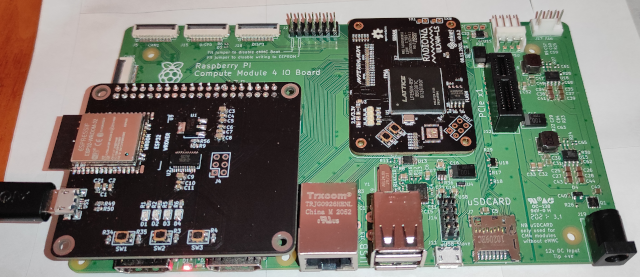
On V1 we have FTDI to FPGA working and we can upload bitstream to FPGA, serial passtrue is also working. For some reason it was hard to put ESP32 into bootloader mode, and I was not able to load micropython while shiled…
ULX4M CM4-HAT is an open-source printed circuit board by intergalaktik, from the intergalaktik/ULX4M-CM4-HAT repository on GitHub, published under the GPL-3.0 licence. It is a 4-layer board of 65 × 56 mm with 41 parts on 45 nets, routed with 708 tracks and 95 vias.
It is built around the FT231XS-R and LM1117-3.3. Its parts include 12 capacitors, 12 resistors, 4 diodes, 3 ICs and 3 switches. It belongs with the computers and single-board computers boards and the ESP32 boards of this library.


On V1 we have FTDI to FPGA working and we can upload bitstream to FPGA, serial passtrue is also working. For some reason it was hard to put ESP32 into bootloader mode, and I was not able to load micropython while shiled was connected to FPGA. After doing that directly (bricking pins on shield FTDI TX > ESP32 RX, ESP32 TX > FTDI RX, GPIO0 > GND) I have succesfully loaded micropython on ESP32. WROOM is still not perfect fit as it has low memory. WROWER can access shared SD card, and flash FPGA over WIFI.
| cm4_gpio | wifi_gpio | HAT function | FPGA | FPGA |
|---|---|---|---|---|
| 0 | 21 | SDA0 | P17 | |
| 1 | 22 | SCL0 | P16 | |
| 2 | 12 | SD_D2 | K1 | K5 |
| 3 | 4 | SD_D1 | H1 | J5 |
| 4 | 2 | SD_D0 | J3 | K4 |
| 5 | 33 | H16 | ||
| 6 | BTN1 | R1 | ||
| 7 | BTN2 | P3 | ||
| 8 | 19 | P4 | ||
| 9 | 27 | G16 | ||
| 10 | 26 | N17 | ||
| 11 | 25 | L16 | ||
| 12 | 23 | TDI | R5 | |
| 13 | FTDI_TXDEN | T1 | ||
| 14 | 13 | SD_D3 | K2 | L4 |
| 15 | 14 | SD_CLK | H2 | L5 |
| 16 | 34 | TDO | V4 | |
| 17 | 35 | N17 | ||
| 18 | LED1 | N5 | ||
| 19 | 0 | BOOT_PULL_UP | U1 | |
| 20 | 18 | TCK | T5 | |
| 21 | 5 | TMS | U5 | |
| 22 | EN | WIFI_EN | U18 | |
| 23 | FTDI_TXD | N4 | ||
| 24 | FTDI_RX | N3 | ||
| 25 | RXD0 | WIFI_RDX | P5 | |
| 26 | TXD0 | WIFI_TXD | V1 | |
| 27 | 15 | SD_CMD | J1 | N16 |
| Qty | Value | Footprint | References |
|---|---|---|---|
| 5 | 549 | Resistor_SMD:R_0603_1608Metric | R1, R2, R5, R6, R35 |
| 4 | 100n | Capacitor_SMD:C_0603_1608Metric | C1, C4, C6, C10 |
| 4 | 10n | Capacitor_SMD:C_0603_1608Metric | C2, C5, C7, C11 |
| 4 | 22uF | Capacitor_SMD:C_0805_2012Metric | C3, C8, C9, C21 |
| 4 | MountingHole | myFP:MountingHole_2.75mm_NoPad | H1, H2, H5, H6 |
| 3 | 15k | Resistor_SMD:R_0603_1608Metric | R9, R34, R56 |
| 2 | 1K | Resistor_SMD:R_0603_1608Metric | R3, R4 |
| 2 | 27 | Resistor_SMD:R_0603_1608Metric | R49, R50 |
| 2 | R | LED_SMD:LED_0805_2012Metric | D1, D4 |
| 1 | B | LED_SMD:LED_0805_2012Metric | D2 |
| 1 | BTN1 | Switch_EVPAA:Switch_EVPAA | SW3 |
| 1 | BTN2 | Switch_EVPAA:Switch_EVPAA | SW2 |
| 1 | CONN_02X03 | Connector_PinSocket_2.54mm:PinSocket_2x03_P2.54mm_Vertical | J4 |
| 1 | ESP32 | ESP32:ESP32 | U9 |
| 1 | FT231XS | ft231x:FT231X-SSOP-20_4.4x6.5mm_Pitch0.65mm | U2 |
| 1 | G | LED_SMD:LED_0805_2012Metric | D3 |
| 1 | LM1117-3.3 | Package_TO_SOT_SMD:SOT-223-3_TabPin2 | U1 |
| 1 | MICRO_USB | usb_otg:USB-MICRO-B-FCI-10118192-0001LF | US1 |
| 1 | Raspberry_Pi_2_3 | Connector_PinSocket_2.54mm:PinSocket_2x20_P2.54mm_Vertical | J1 |
| 1 | WIFI ENABLE | Switch_EVPAA:Switch_EVPAA | SW1 |

sudomesh/disaster-radio
A (paused) work-in-progress long-range, low-bandwidth wireless disaster recovery mesh network powered by the sun.

shorepine/tulipcc
The Tulip Creative Computer and AMYboard - portable Python synthesizers


vaugerbird/sstv-backpack
A ESP32-CAM SSTV backpack for the Baofeng UV-5R + others!

It measures 65 × 56 mm and has 4 copper layers, 1.6 mm thick.
41 parts, built around the FT231XS-R and LM1117-3.3. The full list of its parts is on this page, with links to each part's symbol and footprint where PCBKit's library has them.
From the intergalaktik/ULX4M-CM4-HAT repository on GitHub, at the commit this page was made from: the board is ulx4m-cm4-hat.kicad_pcb. PCBKit opens the board in the browser, with nothing to install.
Its repository publishes it under the GPL-3.0 licence: you may reuse it on that licence's terms (keep the author's notice, and for a copyleft licence share your changes alike).