4 layers80 × 60 mm
Kcell faker
karlp/kcell-faker
fake a load cell, for testing functional behaviour with changing loads.
75 parts

 ikuto0815/eink_mahjong_compass4
This repo contains all the files neccesary to build a bluetooth controlled digital mahjong compass.
Eink mahjong compass is an open-source printed circuit board by ikuto0815, from the ikuto0815/eink_mahjong_compass repository on GitHub, published under the AGPL-3.0 licence. It is a 2-layer board of 123.4 × 123.4 mm with 55 parts on 53 nets, routed with 481 tracks and 94 vias.
It is built around the ESP32-S3-MINI-1-N8, TP4056-42-ESOP8 and ME6211C33R5G, with the SRV05-4-P-T7, TS-1187A-B-A-B and KT-0805G among its other parts. Its parts include 13 capacitors, 11 resistors, 5 ICs, 5 diodes and 5 connectors. It belongs with the lEDs and displays boards and the ESP32 boards of this library.


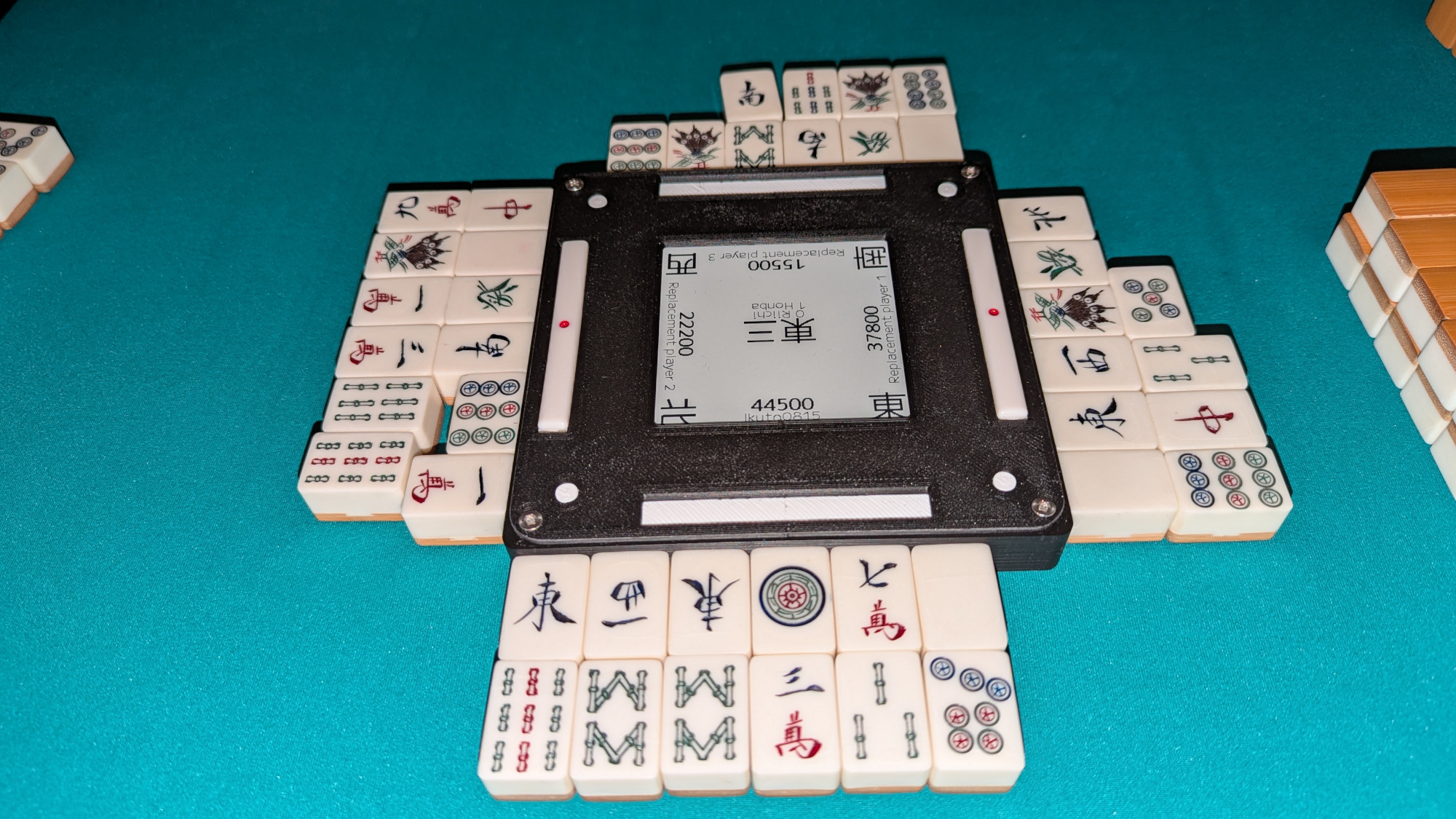
This repo contains all the files neccesary to build a bluetooth controlled digital mahjong compass.
The project is divided into the following main parts:
Additional folders:
The custom made PCB contains an ESP32-S3-WROOM1 microcontroller to talk to a phone via bluetooth and control the connected periphery.
It has the following components:
The production subfolder contains all the files needed to order the PCBs.
The eink_mahjong_compass.zip file contains alle the gerber files needed to order the PCB.
bom.csv and positions.csv are additionally needed when ordering the PCBs assembled.
The files for assembly will work for JLCPCB, other sites might need a different file format.
Even when ordering with assembly, two parts have to be soldered by hand. Those being the connector for the E-ink display and the ESP32 module. Adding those would make the assembly service much more expensive.
The following things need to be ordered:
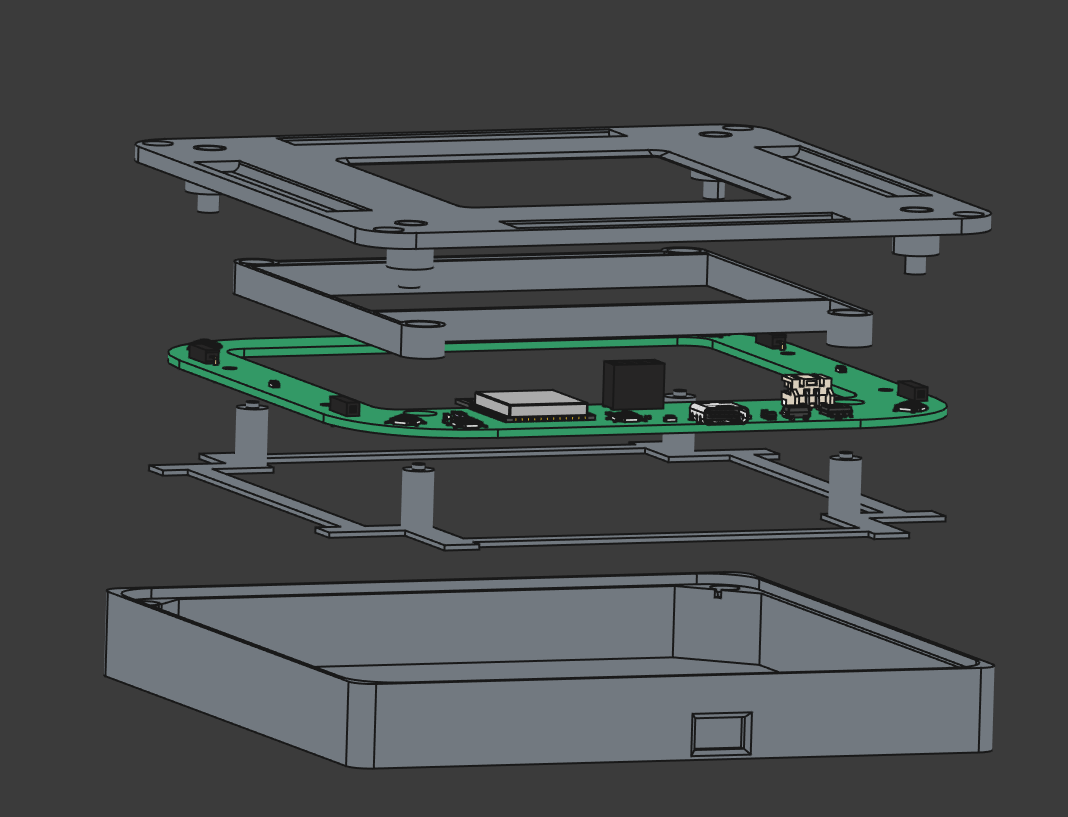
display_feetTo build and flash the firmware, you need to download and install PlatformIO.
Then just connect the compass via USB and run pio run --target upload in the firmware directory.
The compass currently offers a single BLE service under the UID bae5e4dd-f2b4-4461-a84c-b7851fb8efd3 with the following characteristics:
bab40271-33ea-48dc-a145-638361f54d2b)This characteristic is write only and takes a multi line string that describes the current game state in the following format:
roundIndex riichiCount honbaCount
windIndex0
score0
name0
windIndex1
score1
name1
windIndex2
score2
name2
windIndex3
score3
name3
roundIndex describes the current round of the game (0=E1, 1=E2, 4=S1,...). riichiCount and honbaCount are the number of sticks that would be on the table.
The next lines describe describe the 4 players in the game. windIndexN is the current wind of each player (0=E, 1=S, 2=W, 3=N). scoreN and nameN are the current score and name of each player.
The players are drawn on the display in the same order as in the transferred data.
Example:
1 2 1
0
29000
name0
1
29000
name1
2
38000
name2
3
22000
name3
This game is in round east-2, There are two riichi sticks and one honba in the table. Player "name0" is currently east with 29000 points.
bab40271-33ea-48dc-a145-638361f54d2c)This characteristic is read-only. It returns the current battery voltage in mV. This can be used for a battery level indicator in the app.
| Qty | Value | Footprint | References |
|---|---|---|---|
| 6 | C318884 | EasyEDA_Lib:SW-SMD_4P-L5.1-W5.1-P3.70-LS6.5-TL_H1.5 | BOOT1, Reset1, SW3, SW4, SW5, SW6 |
| 4 | 49.9 | Resistor_SMD:R_0402_1005Metric | R5, R7, R9, R12 |
| 4 | C2297 | EasyEDA_Lib:LED0805-R-RD | LED1, LED2, LED3, LED4 |
| 4 | MountingHole | MountingHole:MountingHole_2.7mm_M2.5_ISO14580 | H3, H4, H5, H6 |
| 2 | 1.0uF | Capacitor_SMD:C_0402_1005Metric | C6, C15 |
| 2 | 10uF | PCM_SparkFun-Capacitor:C_0402_1005Metric | C13, C16 |
| 2 | 15pF | EasyEDA_Lib:C0402 | C4, C8 |
| 2 | 1uF | Capacitor_SMD:C_0402_1005Metric | C3, C14 |
| 2 | 4.7uF | Capacitor_SMD:C_0402_1005Metric | C7, C9 |
| 2 | 5.1k | Resistor_SMD:R_0402_1005Metric | R10, R11 |
| 2 | MountingHole | MountingHole:MountingHole_6.4mm_M6_DIN965 | H1, H2 |
| 1 | 0.1uF | PCM_SparkFun-Capacitor:C_0402_1005Metric | C5 |
| 1 | 0.1uF | Capacitor_SMD:C_0402_1005Metric | C2 |
| 1 | 100k | Resistor_SMD:R_0402_1005Metric | R6 |
| 1 | 10k | Resistor_SMD:R_0402_1005Metric | R8 |
| 1 | 1M | PCM_SparkFun-Resistor:R_0603_1608Metric | R1 |
| 1 | 2.0k | Resistor_SMD:R_0402_1005Metric | R4 |
| 1 | 22uF | Capacitor_SMD:C_0603_1608Metric | C1 |
| 1 | 330k | PCM_SparkFun-Resistor:R_0603_1608Metric | R2 |
| 1 | C10487 | EasyEDA_Lib:SOT-23-3_L3.0-W1.7-P0.95-LS2.9-BR | Q1 |
| 1 | C16581 | EasyEDA_Lib:ESOP-8_L4.9-W3.9-P1.27-LS6.0-BL-EP | U1 |
| 1 | C235316 | EasyEDA_Lib:SOT-353_L2.1-W1.3-P0.65-LS2.3-BL | U8 |
| 1 | C2927038 | EasyEDA_Lib:USB-C_SMD-TYPE-C-31-M-12 | USB2 |
| 1 | C32346 | EasyEDA_Lib:FC-135R_L3.2-W1.5 | X1 |
| 1 | C85364 | EasyEDA_Lib:SOT-23-6_L2.9-W1.6-P0.95-LS2.9-BL | U2 |
| 1 | C8678 | EasyEDA_Lib:SMA_L4.3-W2.6-LS5.2-RD | D2 |
| 1 | Conn_02x04_Counter_Clockwise | Connector_PinSocket_2.54mm:PinSocket_2x04_P2.54mm_Vertical | DISP1 |
| 1 | ESP32-S3-MINI | EasyEDA_Lib:WIRELM-SMD_ESP32-S3-WROOM-1 | U3 |
| 1 | MAX17048 | SparkFun-Semiconductor-Standard:DFN-8 | U4 |
| 1 | PH-2AWT | EasyEDA_Lib:CONN-SMD_PH-2AWT | J1 |
| 1 | Touch1 | Connector_PinSocket_2.54mm:PinSocket_1x01_P2.54mm_Horizontal | J2 |
| 1 | Touch2 | Connector_PinSocket_2.54mm:PinSocket_1x01_P2.54mm_Horizontal | J3 |
| 1 | Touch3 | Connector_PinSocket_2.54mm:PinSocket_1x01_P2.54mm_Horizontal | J4 |
| 1 | Touch4 | Connector_PinSocket_2.54mm:PinSocket_1x01_P2.54mm_Horizontal | J5 |
karlp/kcell-faker
fake a load cell, for testing functional behaviour with changing loads.


ilomon10/embedded-totalizer-hour-meter
ESP32 engine hour meter & totalizer: firmware, SensorFrame protocol, Node host tools, KiCad PCB and a Deno device simulator

quintenluyten2/Pocket_2.66_E-reader_PCB
PCB for 2.13" and 2.66" E-ink displays with ESP32-C3, micro-SD card, battery management, and 3 user buttons

tomrodinger/servomotor
Open-source NEMA-17 integrated servomotor (motor + closed-loop driver + controller + encoder). RS-485, Python/Arduino libraries, MCP server for AI control. Hardware, firmware and software.

Kilan777/HomeDeck
Jarvis HomeDeck: a Raspberry Pi CM4 carrier board and voice-assistant software for a 7-inch smart display (KiCad hardware, generated from Python, plus the Python/JS assistant)

It measures 123.4 × 123.4 mm and has 2 copper layers, 1.6 mm thick.
55 parts, built around the ESP32-S3-MINI-1-N8, TP4056-42-ESOP8, ME6211C33R5G and SRV05-4-P-T7. The full list of its parts is on this page, with links to each part's symbol and footprint where PCBKit's library has them.
From the ikuto0815/eink_mahjong_compass repository on GitHub, at the commit this page was made from: the board is pcb/eink_mahjong_compass.kicad_pcb and its schematic pcb/eink_mahjong_compass.kicad_sch. PCBKit opens the board in the browser, with nothing to install.
Its repository publishes it under the AGPL-3.0 licence: you may reuse it on that licence's terms (keep the author's notice, and for a copyleft licence share your changes alike).