2 layers46.4 × 50 mm
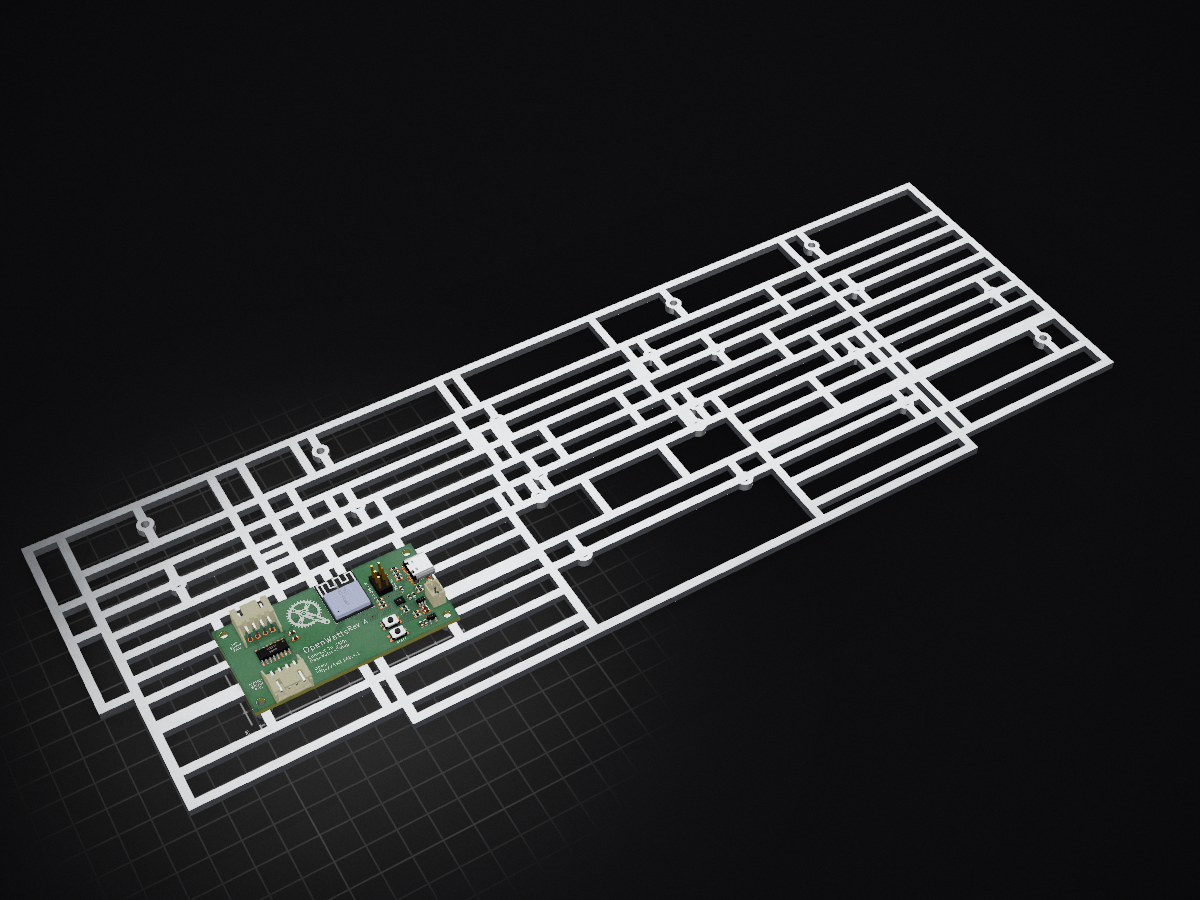
 ikonis/OpenWatts12
OpenWatts is a crank-mounted, single-sided cycling power meter built around an ESP32-C3. A bonded strain-gauge bridge and HX711 measure crank torque, while an LSM6DS3 IMU provides cadence and motion wake.
OpenWatts is an open-source printed circuit board by ikonis, from the ikonis/OpenWatts repository on GitHub. It is a 2-layer board of 70 × 35 mm with 41 parts on 54 nets, routed with 452 tracks and 30 vias.
It is built around the ESP32-C3-MINI-1, HX711 and LSM6DS3, with the ME6211C33M5G-N among its other parts. Its parts include 11 resistors, 7 capacitors, 5 ICs, 2 diodes and 2 connectors. It belongs with the ESP32 and RISC-V boards of this library.


OpenWatts is a crank-mounted, single-sided cycling power meter built around an ESP32-C3. A bonded strain-gauge bridge and HX711 measure crank torque, while an LSM6DS3 IMU provides cadence and motion wake. Firmware publishes standard BLE Cycling Power Service data and includes calibration, ride recording, battery management, OTA updates, a responsive WebUI, and optional MQTT/Home Assistant reporting.
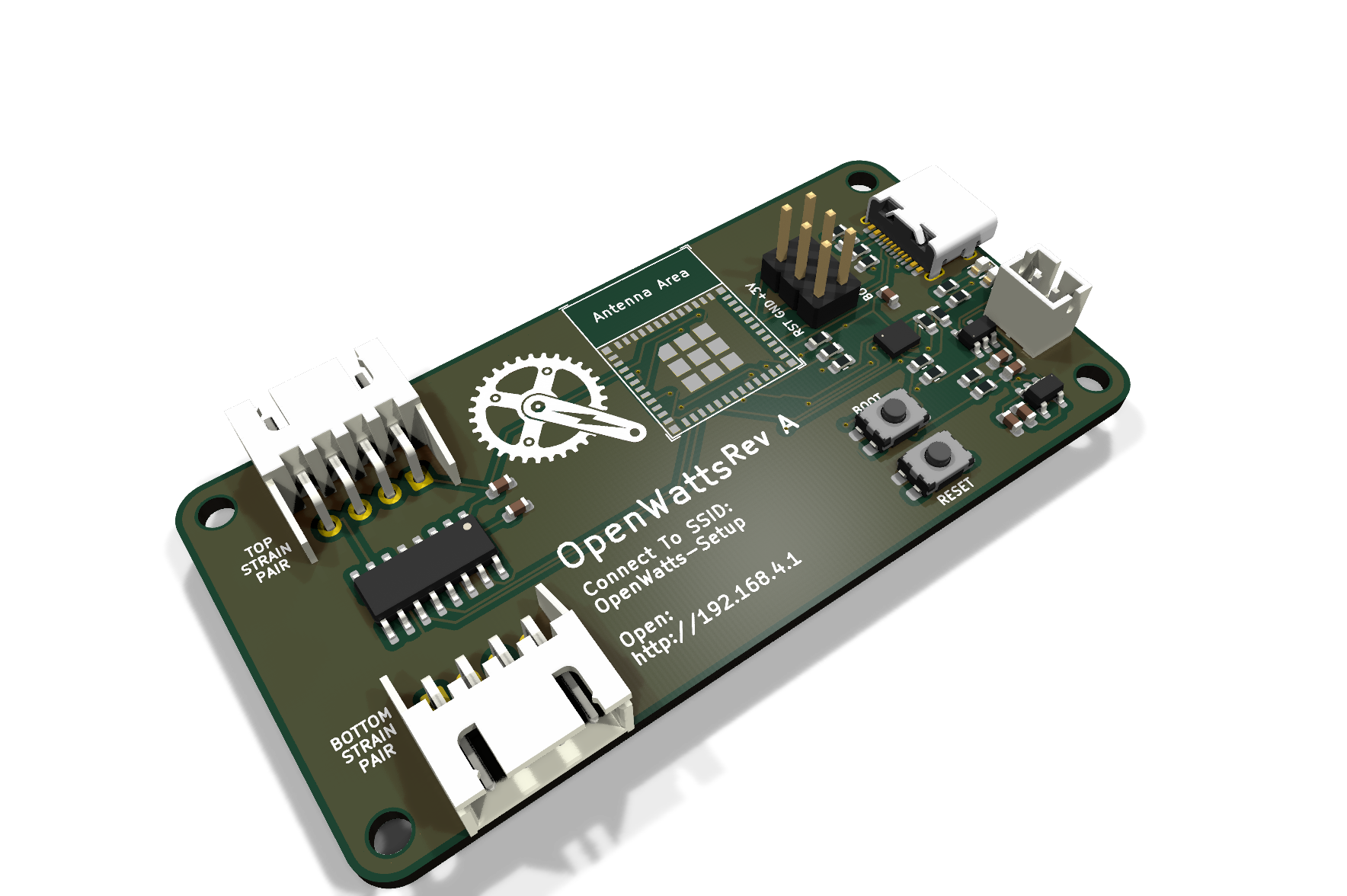
The current hardware is the manufactured and field-validated OpenWatts RevA. It has been calibrated and ridden through the working topology:
OpenWatts --BLE CPS--> SmartSpin2K --> MyWhoosh
The checked-in KiCad PCB describes the board that was actually manufactured; it is not a hypothetical redesign. Exploratory future lessons are deliberately isolated in REV_B_NOTES.md and are not a development promise.
Firmware source, build instructions, and its hardware boundary are documented
in firmware/README.md. Product behavior and validation are
covered by the focused documents in docs/.
No license file is currently included. Until one is added, normal copyright rules apply; public visibility alone does not grant reuse rights.
| Qty | Value | Footprint | References |
|---|---|---|---|
| 4 | 100k | Resistor_SMD:R_0603_1608Metric | R_BAT_BOT1, R_BAT_TOP1, R_USB_BOT1, R_USB_TOP1 |
| 4 | 10k | Resistor_SMD:R_0603_1608Metric | R8, R9, R10, R11 |
| 4 | MountingHole_2.7mm_M2.5 | MountingHole:MountingHole_2.7mm_M2.5 | H1, H2, H3, H4 |
| 3 | 100nF | Capacitor_SMD:C_0603_1608Metric | C1, C5, C8 |
| 2 | 1k | Resistor_SMD:R_0603_1608Metric | R6, R7 |
| 2 | 1µF | Capacitor_SMD:C_0603_1608Metric | C3, C4 |
| 2 | 4.7k | Resistor_SMD:R_0603_1608Metric | R4, R5 |
| 2 | 5.1k | Resistor_SMD:R_0603_1608Metric | R1, R2 |
| 2 | Conn_01x04 | Connector_JST:JST_XH_S4B-XH-A_1x04_P2.50mm_Horizontal | J_BOTTOM1, J_TOP1 |
| 2 | LED | LED_SMD:LED_0603_1608Metric | D2, D3 |
| 2 | SW_Push | Button_Switch_SMD:SW_SPST_EVQP2_MiddlePushTravel_H2.5mm | SW1, SW2 |
| 1 | 10µF | Capacitor_SMD:C_0603_1608Metric | C6 |
| 1 | 2k | Resistor_SMD:R_0603_1608Metric | R3 |
| 1 | 4.7µF | Capacitor_SMD:C_0603_1608Metric | C2 |
| 1 | Conn_02x03_Odd_Even | Connector_PinHeader_2.54mm:PinHeader_2x03_P2.54mm_Vertical | J2 |
| 1 | ESP32-C3-MINI-1 | Espressif:ESP32-C3-MINI-1 | U5 |
| 1 | HX711 | Package_SO:SOIC-16_3.9x9.9mm_P1.27mm | U4 |
| 1 | JST-PH Battery | Connector_JST:JST_PH_B2B-PH-K_1x02_P2.00mm_Vertical | J_BAT1 |
| 1 | LOGO | LOGO | G*** |
| 1 | LSM6DS3 | Package_LGA:LGA-14_3x2.5mm_P0.5mm_LayoutBorder3x4y | U6 |
| 1 | MCP73831-2-OT | Package_TO_SOT_SMD:SOT-23-5 | U1 |
| 1 | ME6211C33M5 | Package_TO_SOT_SMD:SOT-23-5 | U2 |
| 1 | USB_C_Receptacle_USB2.0_16P | Connector_USB:USB_C_Receptacle_HRO_TYPE-C-31-M-12 | J1 |
It measures 70 × 35 mm and has 2 copper layers, 1.6 mm thick.
41 parts, built around the ESP32-C3-MINI-1, HX711, LSM6DS3 and ME6211C33M5G-N. The full list of its parts is on this page, with links to each part's symbol and footprint where PCBKit's library has them.
From the ikonis/OpenWatts repository on GitHub, at the commit this page was made from: the board is OpenWatts.kicad_pcb and its schematic OpenWatts.kicad_sch. PCBKit opens the board in the browser, with nothing to install.
Its repository states no licence, so its author keeps all rights: ask ikonis before reusing the design.

tmjnijssen/OSCD_demo_PCB
Open Science Community Delft demonstration PCB

EhlOps/mini-dyno
The mini dyno (dynamometer) is a tool created to measure the torque and power output of an engine or motor. The mechanical portion of the dyno functions as a water brake.

ShriyanGote/cse123a-project
This repo contains all the code, hardware notes, and documentation for our Smart Pitcher Base project. The system is made up of three pieces:

SkyRizzAI/SkyRizz-ESPSOL
An open-hardware, coin-sized ESP32-S3 development board with an on-board secure element, 6-axis IMU, PDM microphone, buzzer, USB-C, and Li-Po charging — all on a 40.6 mm (1.6") round, 2-layer PCB.

bjkayani/PCB-Reflow-Hot-Plate
The PCB Reflow Hot Plate is a temperature controlled 120 x 70 mm hot plate designed to reflow solder SMD circuit boards.

