
4 layers132.1 × 132.1 mm

 ifilot/bytecradle-65025
Homebrew 6502-based computer
Tinyboard blinkenlight is an open-source printed circuit board by ifilot, from the ifilot/bytecradle-6502 repository on GitHub, published under the GPL-3.0 licence. It is a 2-layer board of 43.2 × 63.5 mm with 15 parts on 58 nets, routed with 185 tracks and 2 vias.
It is built around the 74HC02 and 74HC273D. Its parts include 8 diodes, 2 capacitors, 2 ICs and 1 connector. It belongs with the computers and single-board computers and retro computing and games boards of this library.

The ByteCradle 6502 is a single-board computer (SBC) platform designed for understanding and experimenting with simple operating systems on 8-bit hardware. Built around the WDC 65C02 microprocessor, it provides a hands-on platform for studying system initialization, memory management, device interfacing, and file system handling.
[!NOTE]
The source code for the ByteCradle 6502 operating system for the Mini is found in a separate repository.
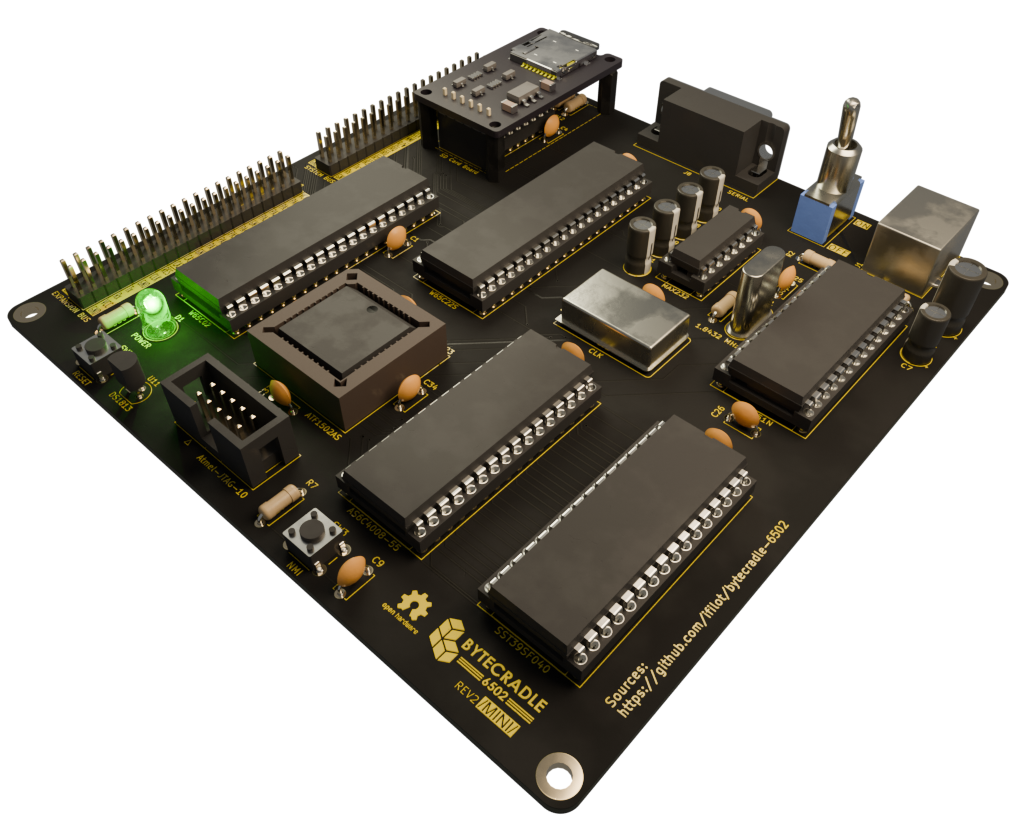
Both SBCs share a common design philosophy — to provide a straightforward and accessible 65C02 system, while exploring different levels of hardware capability.
This project offers two tiers of single board computers (SBCs), each tailored to different levels of complexity and expandability:
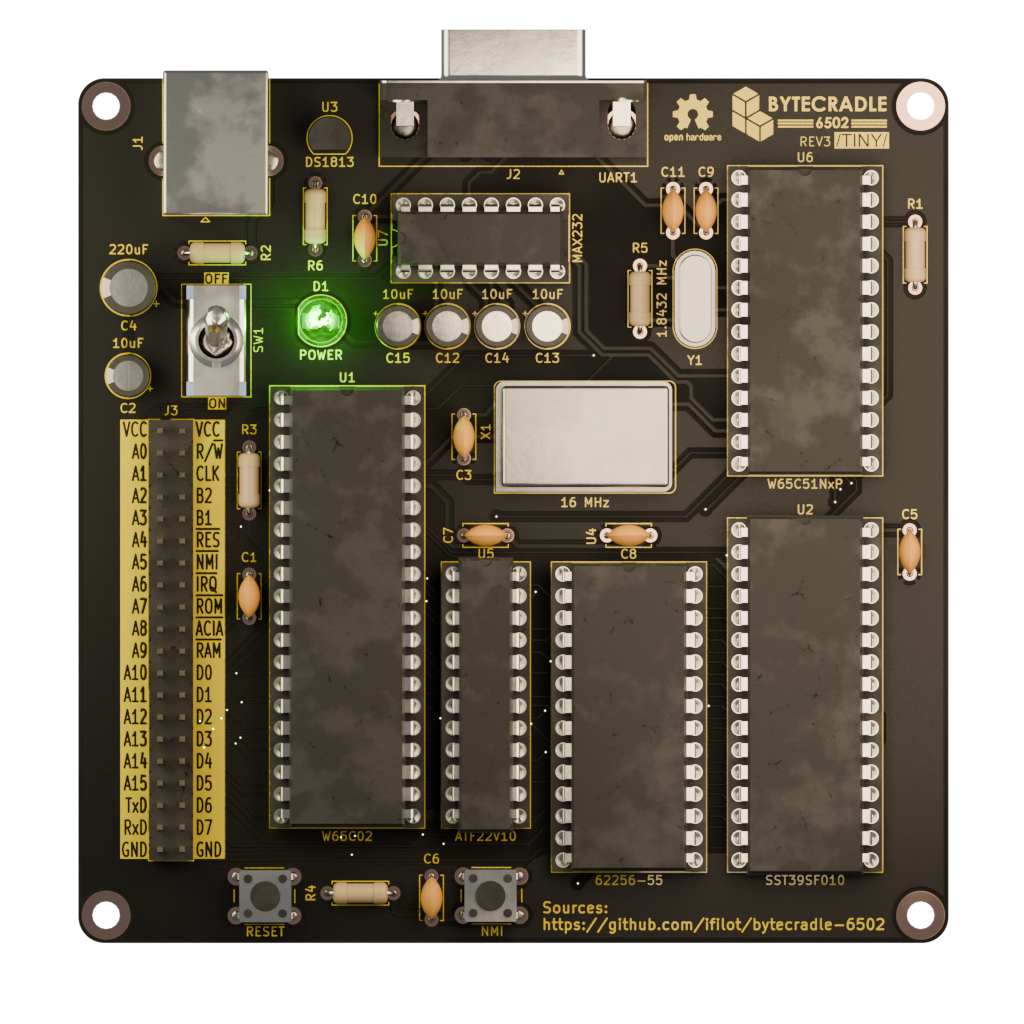
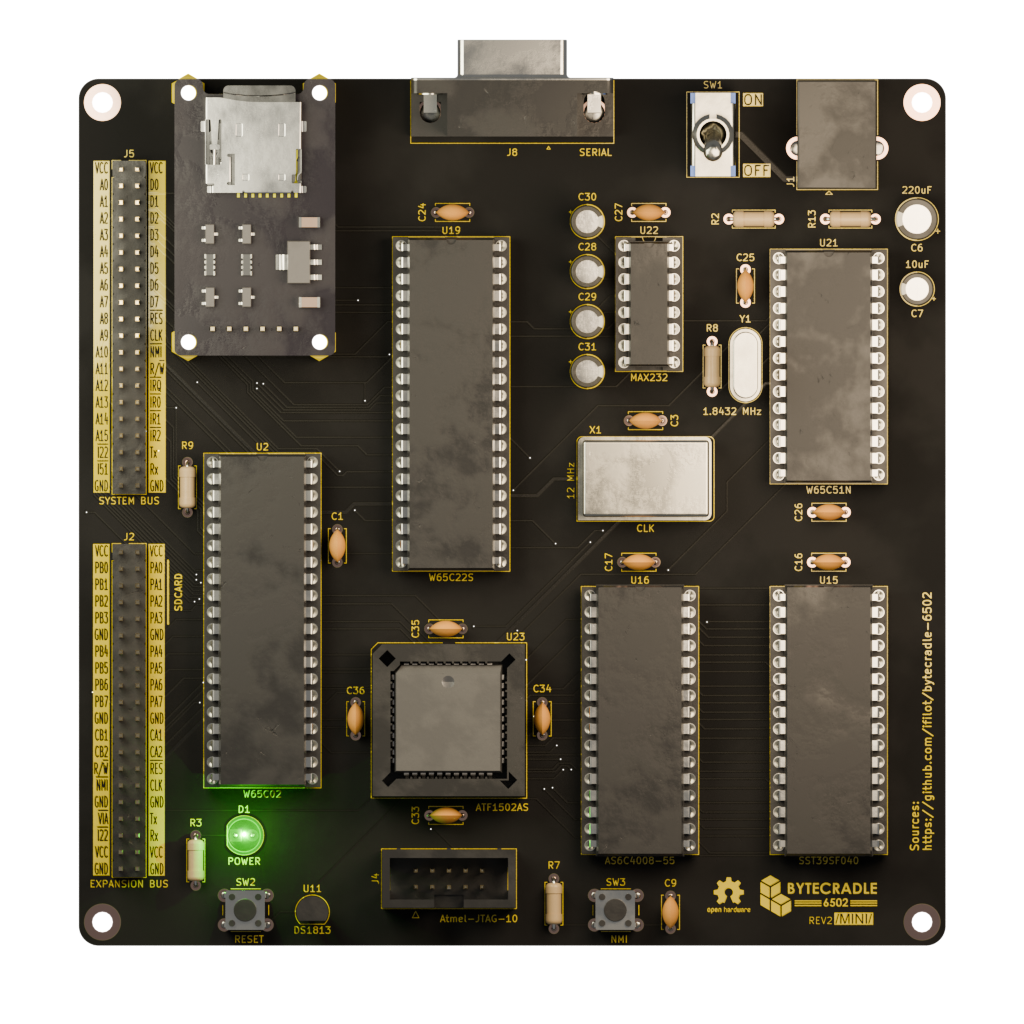
| Feature | Tiny SBC | Mini SBC |
|---|---|---|
| PCB | Two layer | Four layer |
| RAM | 32 KiB | 512 KiB (bank switched) |
| ROM | 32 KiB | 512 KiB (bank switched) |
| Bank Switching | No | Yes - 64 x 8 Kib banks |
| SD Card Support | No | Yes - Using WDC 65C22 VIA |
| I/O Interface | WDC 65C51 ACIA | WDC 65C51 ACIA |
| Expansion Options | Exposes system bus | Exposes system bus and VIA bus |
You can have the ByteCradle PCBs manufactured at any PCB fabrication service of your choice. However, for convenience and ease of ordering, we recommend using PCBWay.
The following links will take you directly to the shared projects on PCBWay, where you can order the boards:
[!NOTE]
These links direct you to the official project pages for the Mini and Tiny Boards on PCBWay.
Below are the available ROM images for use with the ByteCradle single-board computers. These ROMs can be flashed onto your device depending on the board you are using.
[!IMPORTANT]
Make sure to select the appropriate ROM for your board model. Flashing the incorrect ROM may result in system instability.
All software (including ROM code, tools, and firmware) in this repository is licensed under the GNU General Public License v3.0.
This means:
All hardware design files (schematics, PCB layouts, bills of materials, etc.) are licensed under the CERN Open Hardware License v2 - Weakly Reciprocal (CERN-OHL-W).
This means:
Contributions, ideas, and improvements are always welcome. Open an issue or submit a pull request to get involved!
We gratefully acknowledge PCBWay for their generous support in sponsoring the prototype PCB manufacturing of the Mini Board. Their assistance helped accelerate the development and testing of the hardware, and we appreciate their commitment to supporting open hardware projects.
| Qty | Value | Footprint | References |
|---|---|---|---|
| 8 | LED | LED_THT:LED_D5.0mm | D1, D2, D3, D4, D5, D6, D7, D8 |
| 2 | C | Capacitor_THT:C_Disc_D5.0mm_W2.5mm_P5.00mm | C1, C2 |
| 1 | 330 | Resistor_THT:R_Array_SIP9 | RN1 |
| 1 | 74HC02 | Package_DIP:DIP-14_W7.62mm_Socket | U2 |
| 1 | 74HC273 | Package_DIP:DIP-20_W7.62mm_Socket | U1 |
| 1 | LOGO | components:bytecradle-logo | G*** |
| 1 | SYSTEM BUS | Connector_PinSocket_2.54mm:PinSocket_2x20_P2.54mm_Vertical | J2 |


arhefner/1802-Mini-SPI-DMA
SPI Expansion Board for the 1802/Mini Computer


ifilot/p2000t-tape-monitor
P2000T cartridge software for reading out tapes and copying them to external rom chip


It measures 43.2 × 63.5 mm and has 2 copper layers, 1.6 mm thick.
15 parts, built around the 74HC02 and 74HC273D. The full list of its parts is on this page, with links to each part's symbol and footprint where PCBKit's library has them.
From the ifilot/bytecradle-6502 repository on GitHub, at the commit this page was made from: the board is pcb/daughterboards/tinyboard-blinkenlight/tinyboard-blinkenlight.kicad_pcb and its schematic pcb/daughterboards/tinyboard-blinkenlight/tinyboard-blinkenlight.kicad_sch. PCBKit opens the board in the browser, with nothing to install.
Its repository publishes it under the GPL-3.0 licence: you may reuse it on that licence's terms (keep the author's notice, and for a copyleft licence share your changes alike).