4 layers70 × 72 mm

 housey2k/FurModularity
Smart watch/audio mixer/module hub/game console/whatever
EasyEDA Project is an open-source printed circuit board by housey2k, from the housey2k/FurModularity repository on GitHub. It is a 4-layer board of 99 × 59.7 mm with 101 parts on 87 nets, routed with 1,097 tracks and 137 vias.
Its parts include 37 resistors, 26 capacitors, 9 ICs, 8 transistors and 4 connectors. It belongs with the audio and music and wearables boards of this library.
Smart watch/audio mixer/module hub/game console/whatever The FurModularity is a """watch""" meant "For Modularity", it's based on a ESP32-S3 as it's brain
It has 5 input/output connectors for external modules, these modules can be anything, be it a flashlight, a laser pointer, SD card, a second screen, or anything you can imagine, these modules interface with the main board through a SPI bus, a microcontroller inside the module card must interface between the actual module device and the ESP32, this allows more flexibility since a driver on the watch and custom code on the slave microcontroller allows for way more customization than directly interfacing the SPI bus with the module device, it would result in a way more limited module selection, or require you to manually select what kind of module is connected on the user inteface, which would ruin the hotplugging since you'd need to open settings every time you connect something new.
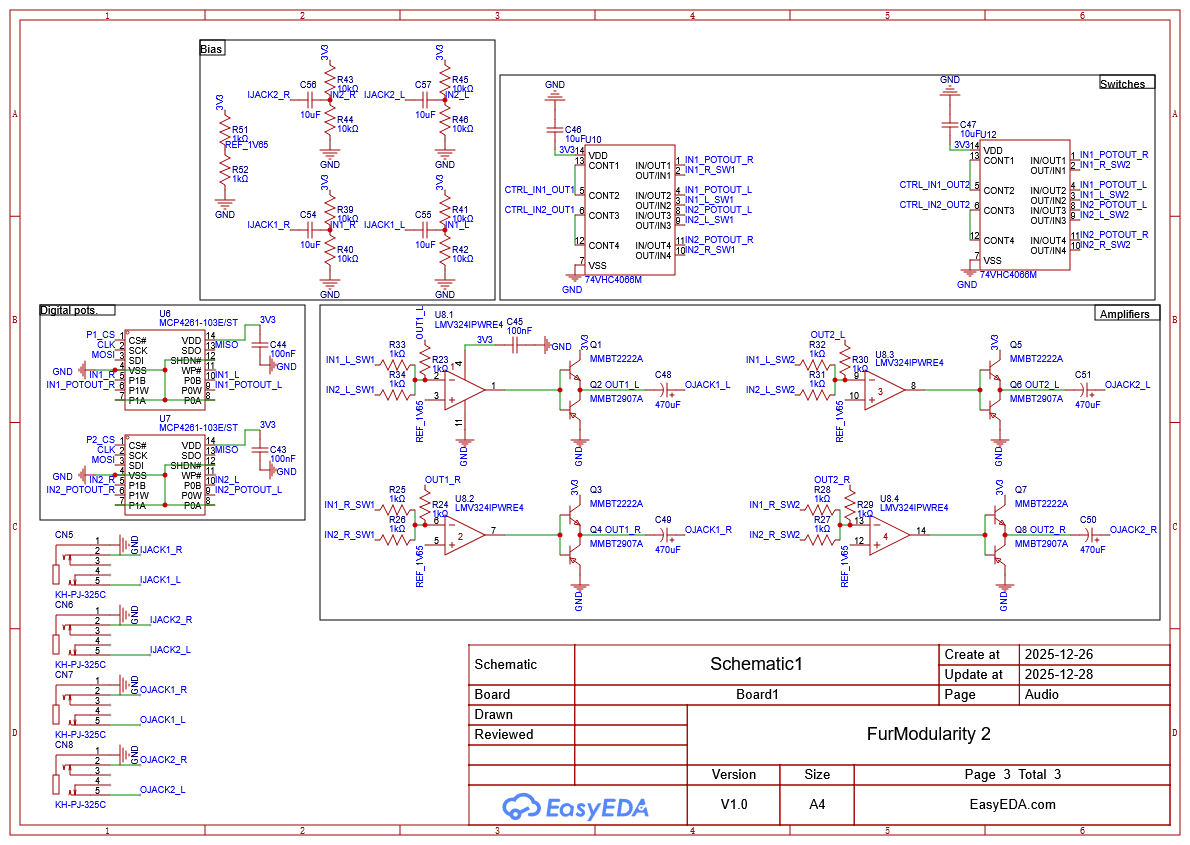
It also has a two input and two output audio mixer, via software you can route inputs 1, 2 or both to outputs 1, 2 or both, the routing is done by two 74VHC4066M Analog Switch ICs, one for each input channel, and you can also change the input volumes, that is done by two MCP4261 ICs, one for each channel too.
I originally built this project as a curious kid exploring CAD software, and I always liked electronics, I wanted to create my own stuff, but I never had the money for it. Now with more experience I restarted this project from scratch hoping to get funds for it.
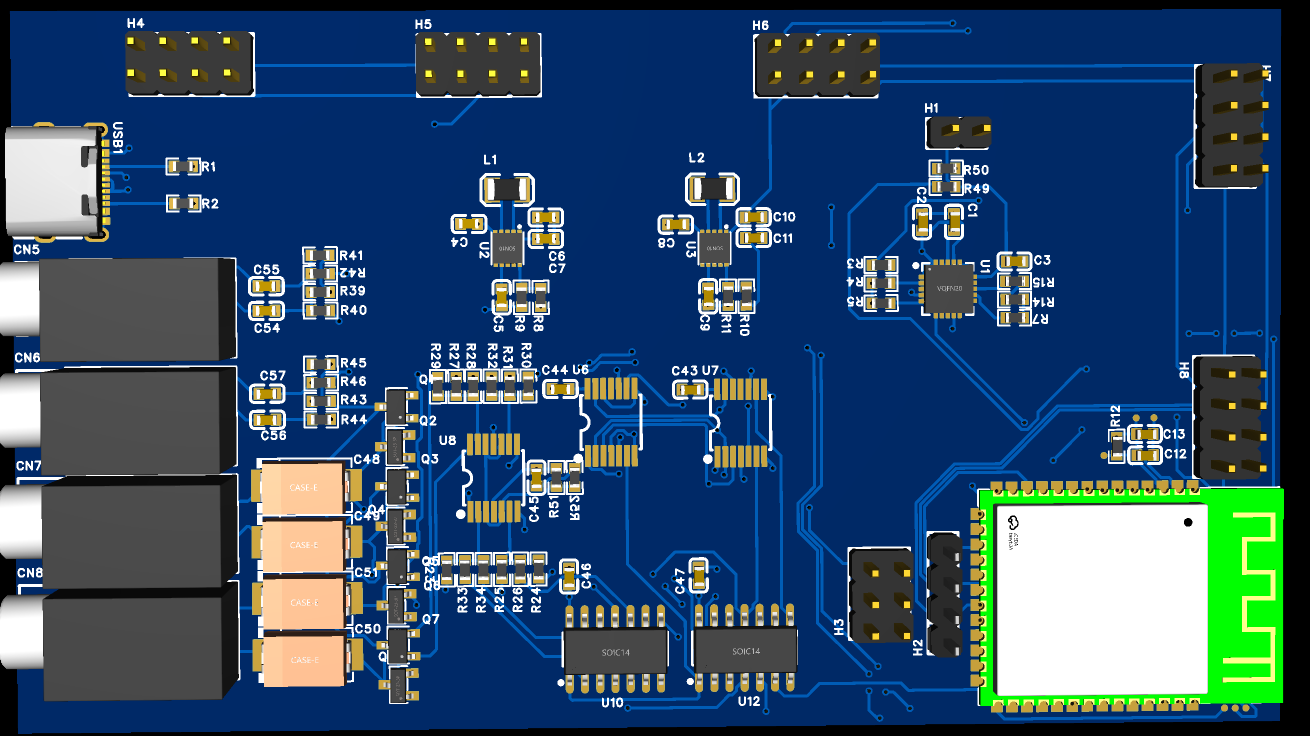
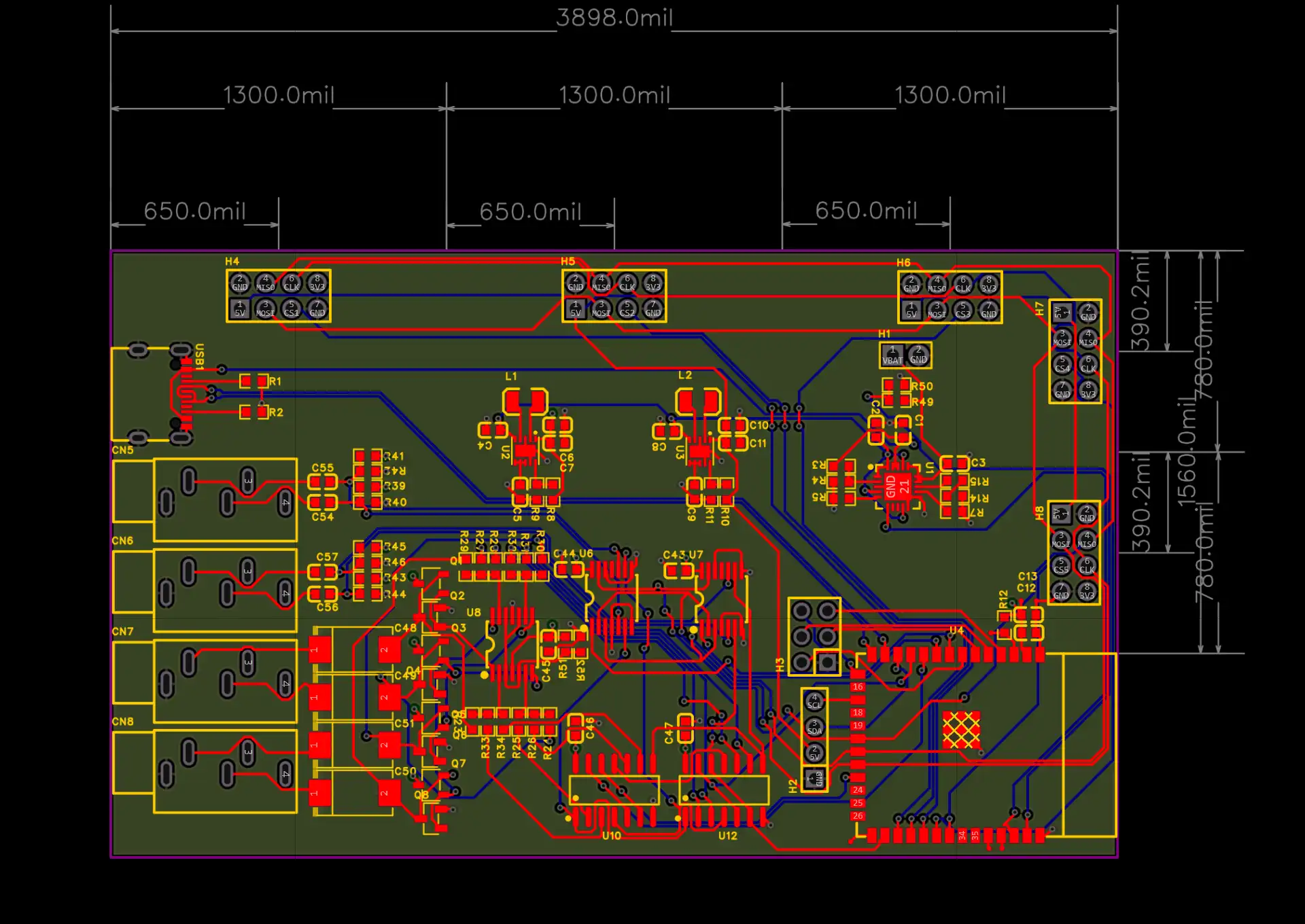
This is how the PCB looks like, the back side has no components, thus simplifying assembly:
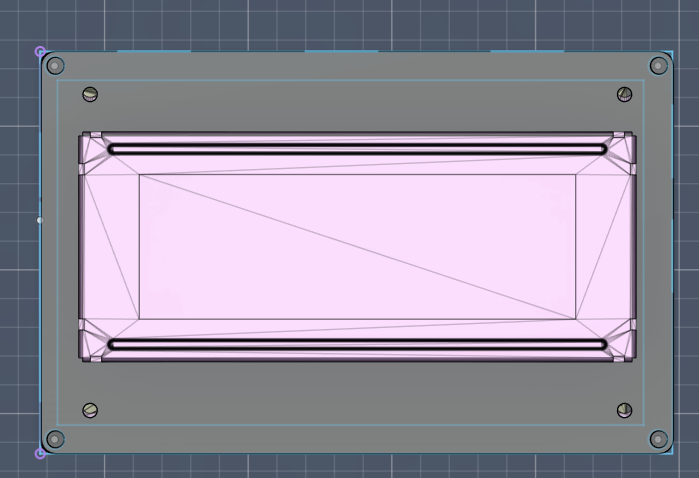
This is how the case looks like:
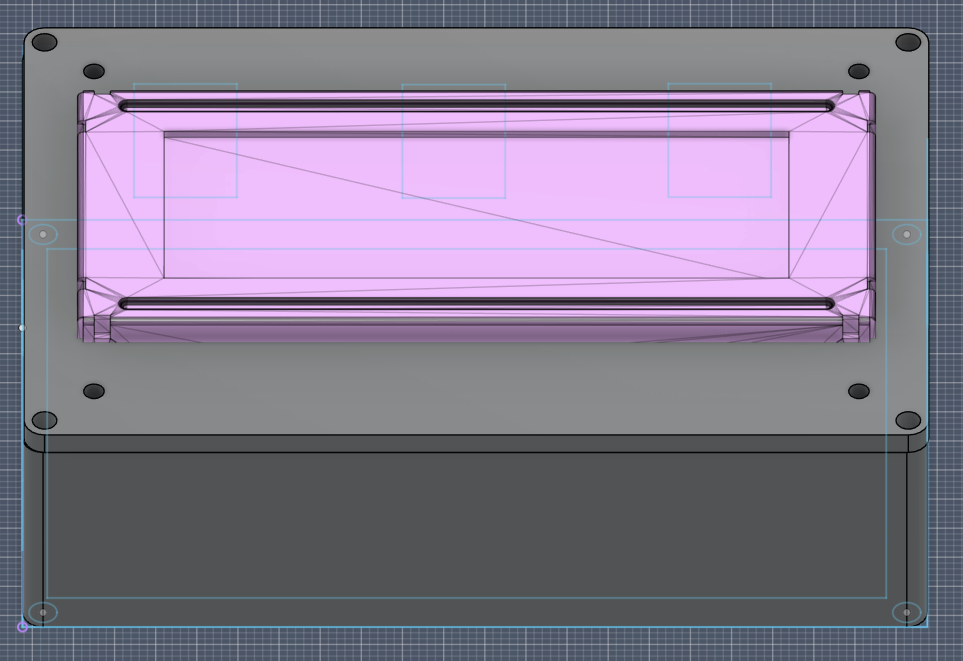
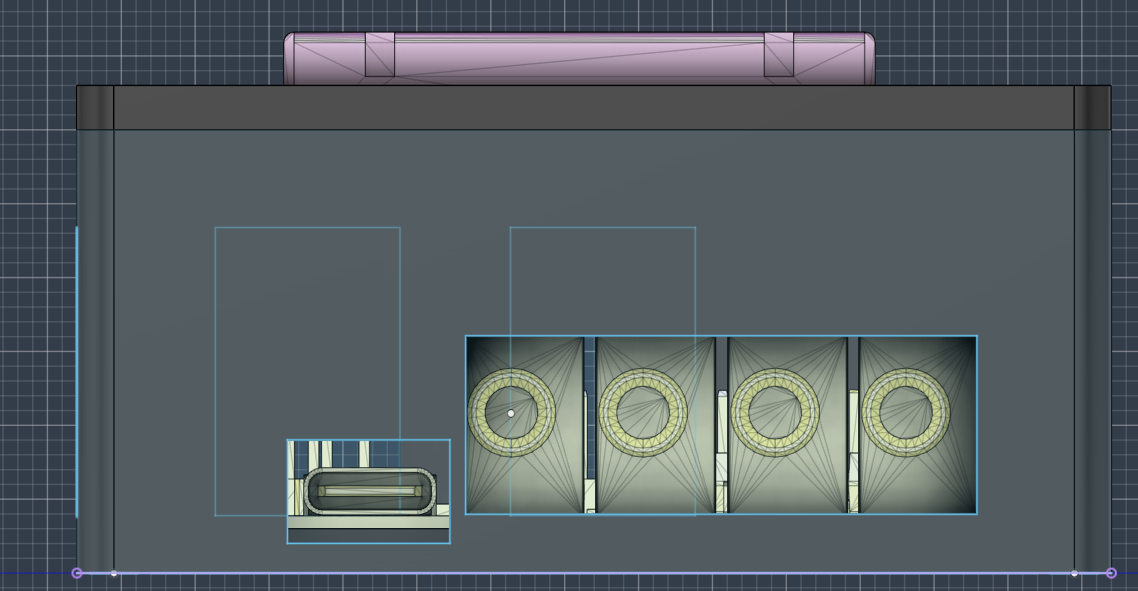
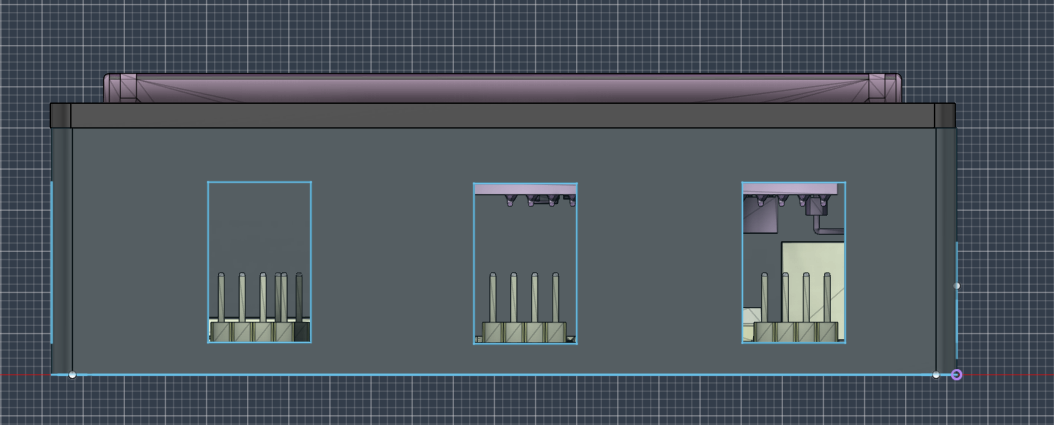
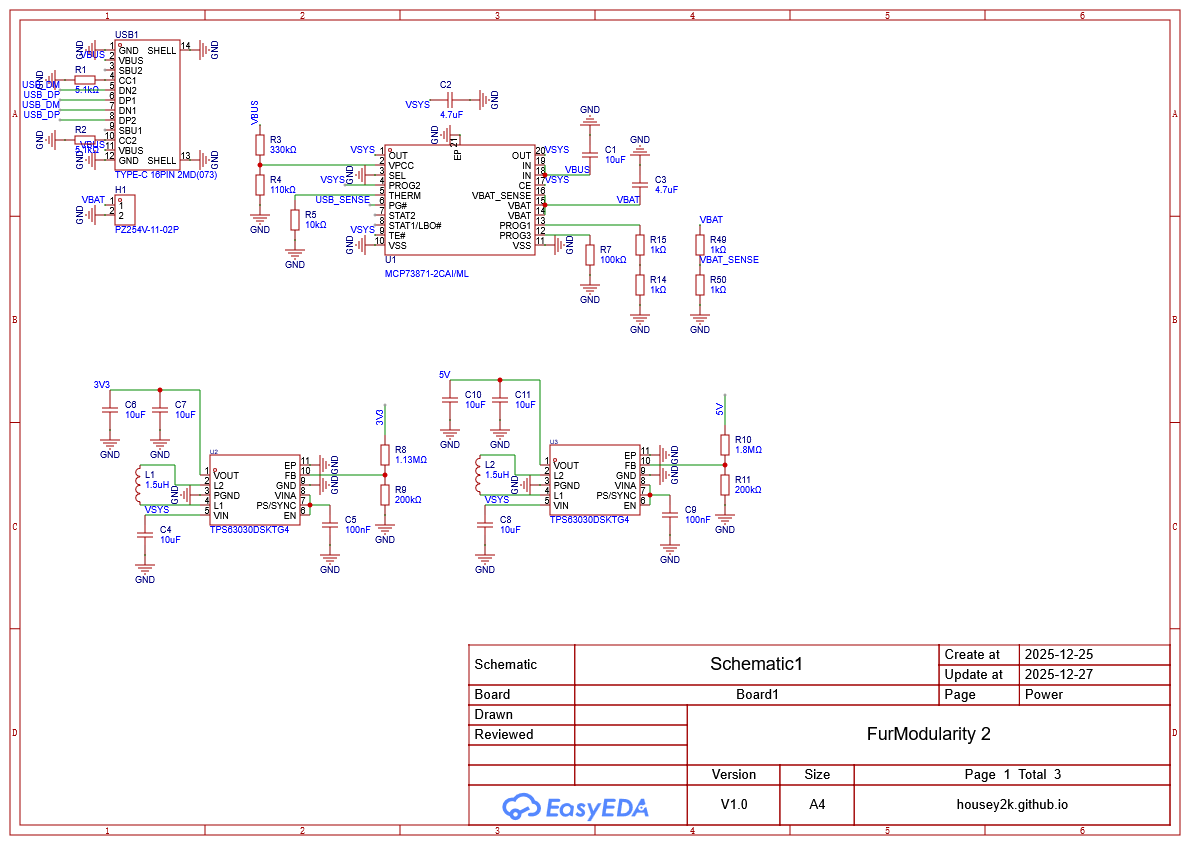
And finally, here is the schematics: This is the power circuit, it handles battery discharging, PowerPath, and generating 5V and 3.3V rails
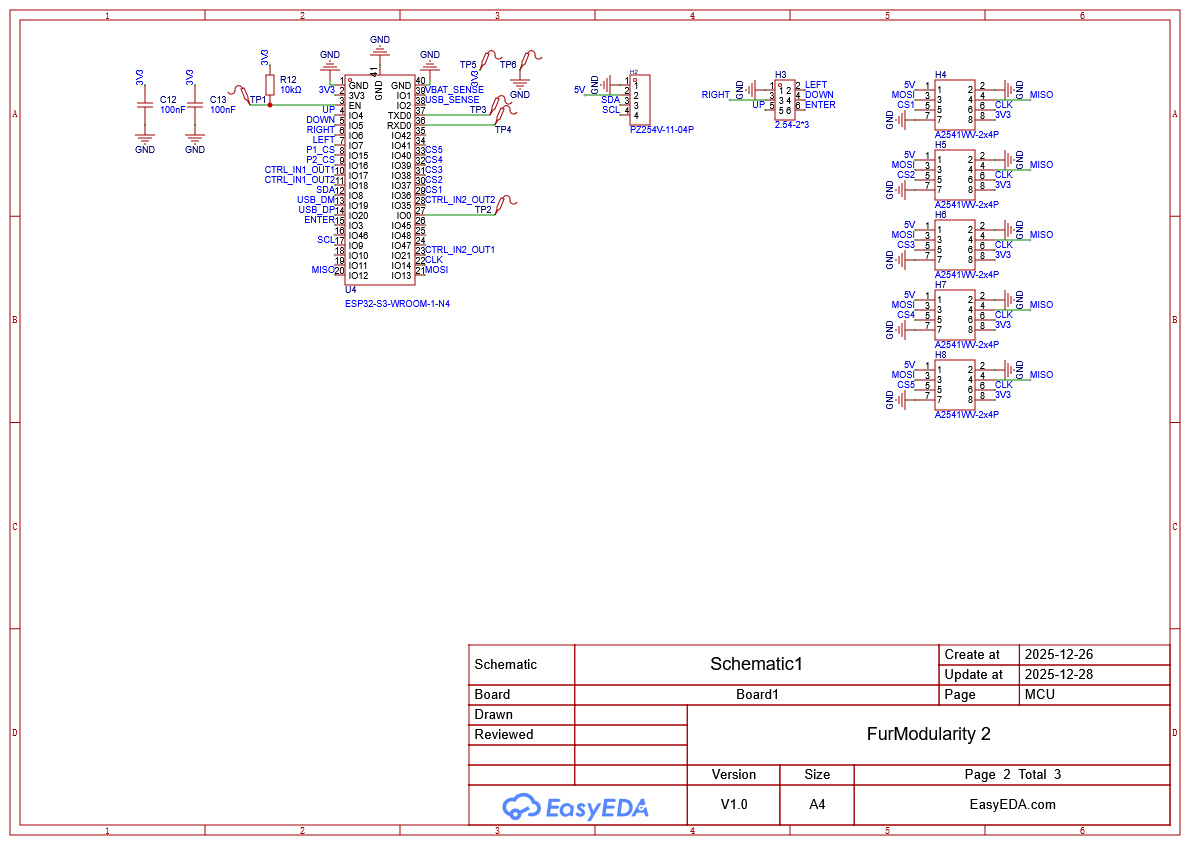
This is the digital circuit, it shows connections from the MCU to other components in the board
This is the audio circuit, it handles audio routing and volume control, everything is controlled by the MCU
| Qty | Value | Footprint | References |
|---|---|---|---|
| 37 | EasyEDA-Project:R0603 | R1, R2, R3, R10, R11, R12, R14, R15, R23, R24, R25, R26, R27, R28, R29, R30 +21 | |
| 22 | EasyEDA-Project:C0603 | C1, C2, C3, C4, C5, C10, C11, C12, C13, C43, C44, C45, C46, C47, C54, C55 +6 | |
| 6 | EasyEDA-Project:Test-Point-0.5mm | TP1, TP2, TP3, TP4, TP5, TP6 | |
| 5 | EasyEDA-Project:HDR-TH_8P-P2.54-V-R2-C4-S2.54_A2541WV-2X4P | H4, H5, H6, H7, H8 | |
| 4 | EasyEDA-Project:CAP-SMD_L7.3-W4.3-FD | C48, C49, C50, C51 | |
| 4 | EasyEDA-Project:AUDIO-TH_KH-PJ-325C | CN5, CN6, CN7, CN8 | |
| 4 | EasyEDA-Project:SOT-23-3_L2.9-W1.6-P1.90-LS2.8-BR | Q1, Q3, Q5, Q7 | |
| 4 | EasyEDA-Project:SOT-23-3_L2.9-W1.3-P1.90-LS2.4-BR | Q2, Q4, Q6, Q8 | |
| 3 | EasyEDA-Project:TSSOP-14_L5.0-W4.4-P0.65-LS6.4-BL | U6, U7, U8 | |
| 2 | EasyEDA-Project:SOIC-14_L8.7-W3.9-P1.27-LS6.0-BL | U10, U12 | |
| 2 | EasyEDA-Project:L1207 | L1, L2 | |
| 2 | EasyEDA-Project:SON-10_L2.5-W2.5-P0.50-TL-EP | U2, U3 | |
| 1 | EasyEDA-Project:USB-C-SMD_TYPE-C-6PIN-2MD-073 | USB1 | |
| 1 | EasyEDA-Project:HDR-TH_6P-P2.54-V-R2-C3-S2.54_A2541WV-2X3P | H3 | |
| 1 | EasyEDA-Project:WIFIM-SMD_ESP32-S3-WROOM-1-N8 | U4 | |
| 1 | EasyEDA-Project:QFN-20_L4.0-W4.0-P0.50-BL-EP2.7 | U1 | |
| 1 | EasyEDA-Project:HDR-TH_2P-P2.54-V-M | H1 | |
| 1 | EasyEDA-Project:HDR-TH_4P-P2.54-V-M | H2 |
It measures 99 × 59.7 mm and has 4 copper layers, 1.6 mm thick.
101 parts. The full list of its parts is on this page, with links to each part's symbol and footprint where PCBKit's library has them.
From the housey2k/FurModularity repository on GitHub, at the commit this page was made from: the board is KiCad mirror/EasyEDA-Project/EasyEDA-Project.kicad_pcb and its schematic KiCad mirror/EasyEDA-Project/1_Power.kicad_sch. PCBKit opens the board in the browser, with nothing to install.
Its repository states no licence, so its author keeps all rights: ask housey2k before reusing the design.


GuitarML/GuitarPedalSTM32
Guitar pedal using a stm32h7 microcontroller programmed with CubeIDE (PCB and Firmware)


QuickLogic-Corp/quick-feather-dev-board
100% open source dev kit for EOS S3 MCU+eFPGA SoC supported by fully open source SDK and FPGA Toolchain

CARSSCenter/OpenNerve-Implantable-Pulse-Generator
Source files for the OpenNerve implantable pulse generator (IPG), including firmware and hardware for Gen1 and Gen2 PCBAs as well as enclosure CAD and documentation.