

4 layers243.8 × 171.5 mm

Raspberry PI eeprom writer code
SPI 28c256 is an open-source printed circuit board by homebrew8088, from the homebrew8088/Raspberry-Pi-32k-EEPROM-Programmer repository on GitHub, published under the GPL-3.0 licence. It is a 2-layer board of 57.4 × 38.6 mm with 7 parts on 42 nets, routed with 267 tracks and 5 vias.
It is built around the MCP23S17-E/SO. Its parts include 3 resistors, 3 ICs and 1 connector.
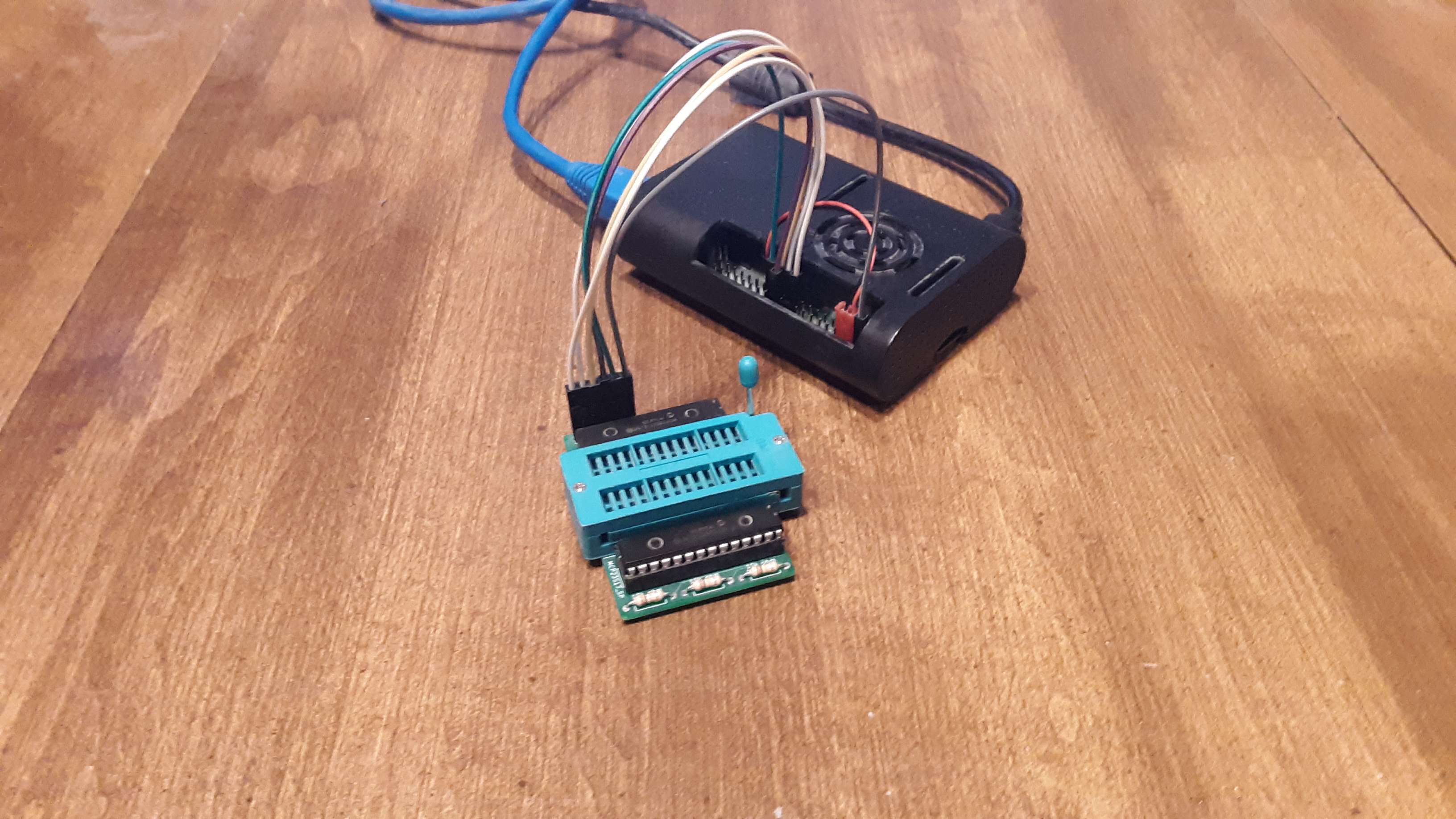
This is a repository for my Rapberry Pi 32k EEPROM Programmer.
The code is written in python. To run it from the command line type "python3 32k.py"
I have included my Kicad Files where you can find the schematics and PCB layout.
https://www.homebrew8088.com/home/28c256-eeprom-writer
This was developed to be a cheap alternative for writing 32k EEPROMs for my 8088 projects. You can compile and upload code in the application or just upload a precompiled file. When using the application to compile the JMP code for an 8088 is automatically inserted at address 0x7FF0.
The project uses
1 - Raspberry PI
2 - MCP23S17 SPI I/O’s
1 - 28 pin ZIF
1 - PCB
3 - 10k resistors
Trouble shoot
-make sure SPI is enabled on the raspberry pi
-install nasm on the raspberry pi
| Qty | Value | Footprint | References |
|---|---|---|---|
| 3 | 10k ohm | Resistor_THT:R_Axial_DIN0207_L6.3mm_D2.5mm_P10.16mm_Horizontal | R1, R2, R3 |
| 2 | MCP23S17 | Package_DIP:DIP-28_W7.62mm | U0, U1 |
| 1 | 28C256 | Socket:DIP_Socket-28_W11.9_W12.7_W15.24_W17.78_W18.5_3M_228-1277-00-0602J | U2 |
| 1 | Pinheader | Connector_PinHeader_2.54mm:PinHeader_1x06_P2.54mm_Vertical | J1 |
It measures 57.4 × 38.6 mm and has 2 copper layers, 1.6 mm thick.
7 parts, built around the MCP23S17-E/SO. The full list of its parts is on this page, with links to each part's symbol and footprint where PCBKit's library has them.
From the homebrew8088/Raspberry-Pi-32k-EEPROM-Programmer repository on GitHub, at the commit this page was made from: the board is Kicad/SPI 28c256.kicad_pcb. PCBKit opens the board in the browser, with nothing to install.
Its repository publishes it under the GPL-3.0 licence: you may reuse it on that licence's terms (keep the author's notice, and for a copyleft licence share your changes alike).

matthewcieplak/super-sixteen
Code and schematics for the Super Sixteen Eurorack sequencer


ranzbak/qmtech_minimig
KiCad design for a minimig compatible board for the QM_XC7A100T_DDR3 board.

michd/modular-synth
Building a hardware modular synthesizer, this is where I'll collect module schematics and hardware designs.

o7-machinehum/uSD_Breakout
Micro SD (uSD) Breakout is a device to be inserted into a micro SD card slot to breakout the pins

davischris/OpenAC1
This work is largely based on the work of Tor-Eirik Bakke Lunde (https://github.com/tebl/RC6502-Apple-1-Replica).
