2 layers40 × 20 mm

 hkzlab/PS1_PowerDeplay_Datel_RE1
Reverse Engineering of a PlayStation 1 Datel clone card
PowerReplay is an open-source printed circuit board by hkzlab, from the hkzlab/PS1_PowerDeplay_Datel_RE repository on GitHub. It is a 2-layer board of 56.3 × 68 mm with 13 parts on 83 nets, routed with 1,316 tracks and 59 vias.
Its parts include 6 ICs, 2 resistors, 2 connectors, 1 capacitor and 1 diode. It belongs with the FPGA and CPLD boards of this library.
I found one of these cloned Datel cheat carts for PlayStation 1 in a box of junk at a flea market. I decided to reverse engineer it just for fun, and maybe to build a better variant of it.
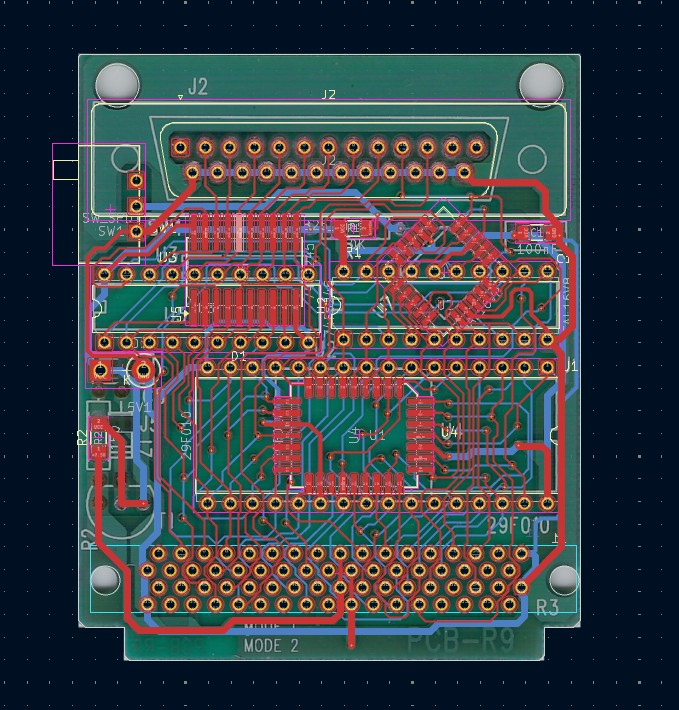
The PCB was fully disassembled, scanned, and traced to reconstruct the schematic. It's a simple dual-layer board containing a diode, a PLD, an EEPROM and a transceiver, plus a few passives.
While the PCB has provisions to fit a 78L05 voltage regulator plus filter caps, the actual regulation on this board was cheaply hacked together using a 5.1V Zener plus a 150 ohm resistor for current limiting.
The EEPROM used on this board is a PLCC AM29F010, 128KB. The Board is wired in a way that a 29F020 can be installed and the a second bank of 128KB used.
A GAL16V8B provides signal decoding to enable the transceiver, EEPROM, read the state of the STROBE signal on the DSUB-25 connector and of the sliding switch.
This IC was protected on my board, so I proceeded with an analysis of the signals and their combinations.
The results can be seen in the PLD directory, and have not been tested yet. Interestingly, while connected, the A20 line seems to be ignored in all the calculations performed by this PLD.
| Qty | Value | Footprint | References |
|---|---|---|---|
| 1 | 100nF | Capacitor_SMD:C_1206_3216Metric_Pad1.33x1.80mm_HandSolder | C1 |
| 1 | 10K | Resistor_SMD:R_1206_3216Metric_Pad1.30x1.75mm_HandSolder | R1 |
| 1 | 150 | Resistor_SMD:R_1206_3216Metric_Pad1.30x1.75mm_HandSolder | R2 |
| 1 | 29F010 | PR_Footprints:PLCC-32 | U4 |
| 1 | 29F010 | Package_DIP:DIP-32_W15.24mm | U1 |
| 1 | 5V1 | PR_Footprints:D_Vertical_KathodeUp | D1 |
| 1 | 74FS245 | Package_DIP:DIP-20_W7.62mm | U3 |
| 1 | 74FS245 | PR_Footprints:SOP-20 | U5 |
| 1 | DB25_Pins | Connector_Dsub:DSUB-25_Pins_Vertical_P2.77x2.84mm | J2 |
| 1 | GAL16V8 | PR_Footprints:PLCC-20 | U7 |
| 1 | GAL16V8 | Package_DIP:DIP-20_W7.62mm | U2 |
| 1 | SW_SPDT | PR_Footprints:SPDT_Switch | SW1 |
| 1 | ~ | PR_Footprints:PIO_Connector | J1 |


samyk/magspoof
A portable device that can spoof/emulate any magnetic stripe, credit card or hotel card "wirelessly", even on standard magstripe (non-NFC/RFID) readers.

fossasia/pslab-scripts
Pocket Science Lab - Scripts for Sensor Experiments


willem-pennings/balancing-cube
A cube that balances itself in a corner or edge using reaction wheels

VoronDesign/Voron-Hardware
Cool Hardware designed by the Voron Design group

hoglet67/RGBtoHDMI
Bare-metal Raspberry Pi project that provides pixel-perfect sampling of Retro Computer RGB/YUV video and conversion to HDMI
It measures 56.3 × 68 mm and has 2 copper layers, 1.6 mm thick.
13 parts. The full list of its parts is on this page, with links to each part's symbol and footprint where PCBKit's library has them.
From the hkzlab/PS1_PowerDeplay_Datel_RE repository on GitHub, at the commit this page was made from: the board is PowerReplay.kicad_pcb and its schematic PowerReplay.kicad_sch. PCBKit opens the board in the browser, with nothing to install.
Its repository states no licence, so its author keeps all rights: ask hkzlab before reusing the design.