Skip to the content
PCBKitNew board
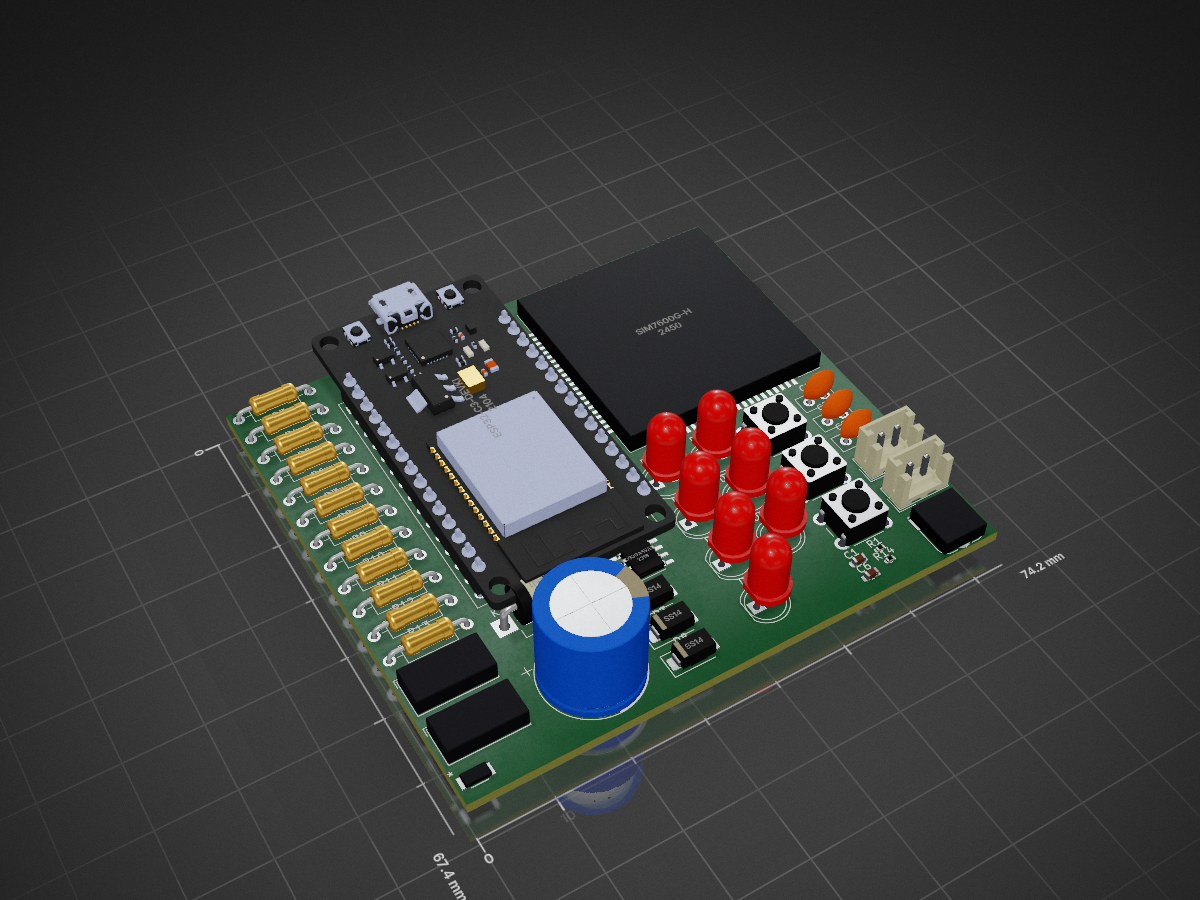
2 layersPanic button, the printed circuit board in 3D

This is an attempt at creating a box that aims to allow you to broacast your location to someone close like the other deivces (air tag, tile, etc) but as it is not a brand and uses the internet instead of ble and an proprietary device grid (airtag) it should not be very obvious.

Copper layers
2
Thickness
1.6 mm
Parts
43
Nets
142
Pads
267
Tracks, vias
0, 0
Routed
Not yet
KiCad
KiCad 9.0 (file 20241229)
Created
13 Aug 2026
Updated
21 Aug 2026

Overview

Panic button is an open-source printed circuit board by HenraL, from the HenraL/panic_button repository on GitHub, published under the MIT licence. It is a 2-layer board with 43 parts on 142 nets.

It is built around the ESP32-C3-DEVKITM-1, SIM7600G-H and BD33GA5WEFJ-E2, with the SS14 and 1206L050/15YR among its other parts. Its parts include 14 resistors, 11 diodes, 6 capacitors, 5 switches and 3 ICs. It belongs with the ESP32 and RISC-V boards of this library.

Main components

5

README

README.md

Panic Button

A small panic beacon (target: no bigger than a finger; a palm if that size can't be reached) that:

  1. Updates its position towards a server.
  2. If that is not available, sends an SMS (or similar).
  3. Regardless of the above, advertises a BLE beacon (Apple Find My-style, Android hub, Samsung if they stray) so nearby phones can interact with it without any app.

Apple UWB is out of reach (proprietary Apple U1/U2 chip + MFi program) — phone interaction is BLE only. Cost target: < $50 / unit (excluding the IoT/SIM plan).

Repository layout

  • AGENTS.md — rules and conventions for AI agents and contributors; read it first.
  • KiCad/v1/panic_button — first board attempt (archive).
  • KiCad/v2/dev/panic_button_dev — dev variant of the v2 circuit.
  • KiCad/v2/tiny/panic_button_tiny — active design (KiCad 10): the tiny variant, as small as possible.
  • KiCad/v2/tiny/bom.md — live bill of materials (strictly the BOM).
  • KiCad/v2/tiny/design.md — design decisions, notes and open questions.
  • platformio/ — firmware (PlatformIO + Arduino on ESP32-C3). Comes after the circuit planning, not in parallel.
  • bonus/ — tools / environments / scratch (bonus/tmp/).

Hardware status

  • Tiny (active): ESP32-C3 (BLE) + SIM7670G LTE Cat1 (GNSS, SMS, HTTP/MQTT), Li-ion + USB-C charging, wake-on-motion accelerometer. Schematic in progress in KiCad 10.
  • Dev = the tiny circuit + test infrastructure (test points, button array, richer LEDs, AirM2M Core ESP32-C3 module as the easier-to-mount MCU), functionally identical.

See bom.md for parts and prices, design.md for decisions.

License

MIT — see LICENSE.
Parts

43
QtyValueFootprintReferences
410kΩResistor_THT:R_Axial_DIN0207_L6.3mm_D2.5mm_P10.16mm_HorizontalR3, R8, R9, R12
4330ΩResistor_THT:R_Axial_DIN0207_L6.3mm_D2.5mm_P10.16mm_HorizontalR2, R7, R10, R11
3100nF_CeramicCapacitor_THT:C_Disc_D5.0mm_W2.5mm_P2.50mmC2, C3, C5
3Push_ButtonButton_Switch_THT:SW_PUSH_6mmSW1, SW2, SW5
3SS14Diode_SMD:D_SMAD1, D3, D8
210k_0402Resistor_SMD:R_0402_1005MetricR1, R14
2JST_02Connector_JST:JST_EH_B2B-EH-A_1x02_P2.50mm_VerticalJ1, J2
2LED greenLED_THT:LED_D5.0mmD7, D9
2LED redLED_THT:LED_D5.0mmD4, D10
2Slide_Switch_SPDT_P3mm_10x5x10mmPCM_SL_Devices:Slide_Switch_SPDT_P3mm_10x5x10mmSW3, SW4
11000uF_25VCapacitor_THT:CP_Radial_D13.0mm_P5.00mmC4
1100kResistor_THT:R_Axial_DIN0207_L6.3mm_D2.5mm_P10.16mm_HorizontalR13
1100pF_0603_50VCapacitor_SMD:C_0603_1608MetricC6
11206L050/15YRfootprints:1206LSeries_LTFF1
115kΩResistor_THT:R_Axial_DIN0207_L6.3mm_D2.5mm_P10.16mm_HorizontalR4
11N6284APCM_Diode_THT_AKL:D_DO-201_P12.70mm_Horizontal_ZenerD2
120kΩResistor_THT:R_Axial_DIN0207_L6.3mm_D2.5mm_P10.16mm_HorizontalR5
127kΩResistor_THT:R_Axial_DIN0207_L6.3mm_D2.5mm_P10.16mm_HorizontalR6
1470pF_0603_25VCapacitor_SMD:C_0603_1608MetricC1
1BD33GA5WEFJPackage_SO:HTSOP-8-1EP_3.9x4.9mm_P1.27mm_EP2.4x3.2mmU1
1ESP32-C3-DevKitM-1RF_Module:ESP32-C3-DevKitM-1U2
1LED blueLED_THT:LED_D5.0mmD11
1LED orangeLED_THT:LED_D5.0mmD5
1LED yellowLED_THT:LED_D5.0mmD6
1SIM7600G-HKiCad:SIM7600GHIC1
1potentiometer_RM065PCM_SL_Devices:Potentiometer_RM065RV1

Questions

What parts does the Panic button use?

43 parts, built around the ESP32-C3-DEVKITM-1, SIM7600G-H, BD33GA5WEFJ-E2 and SS14. The full list of its parts is on this page, with links to each part's symbol and footprint where PCBKit's library has them.

Where can I download the Panic button KiCad files?

From the HenraL/panic_button repository on GitHub, at the commit this page was made from: the board is KiCad/v1/panic_button/panic_button.kicad_pcb and its schematic KiCad/v1/panic_button/panic_button.kicad_sch. PCBKit opens the board in the browser, with nothing to install.

Can I use the Panic button design in my own project?

Its repository publishes it under the MIT licence: you may reuse it on that licence's terms (keep the author's notice, and for a copyleft licence share your changes alike).

More from HenraL/panic_button

1
  • 2 layersPanic button tiny, the printed circuit board in 3D

    Panic button tiny

    HenraL/panic_button

    This is an attempt at creating a box that aims to allow you to broacast your location to someone close like the other deivces (air tag, tile, etc) but as it is not a brand and uses the internet instead of ble and an…

    16 partsMIT

Similar boards

  • 4 layers100 × 70 mmIoT Device, the printed circuit board in 3D

    IoT Device

    paavkar/PCB

    Repository for my Electronics/PCB projects.

    65 parts
  • 4 layers40 × 80 mmSIM7600-breakout, the printed circuit board in 3D

    SIM7600-breakout

    lamemakes/SIM7600-breakout

    A breakout board for the SIM7600 LTE module

    69 parts6
  • 4 layers63.9 × 37.1 mmUsbhid daq, the printed circuit board in 3D

    Usbhid daq

    shraken/usbhid_buddy

    Hardware, firmware, and software for the USBHID DAQ 'Buddy' device

    73 parts2
  • 2 layers100 × 80 mmSpeakerpcb, the printed circuit board in 3D

    Speakerpcb

    gmaxdragon/Seizo-Noise

    A massive PCB for a speaker for my robotic arm with a microphone built into it and a ton of other GPIO ports.

    52 parts1
  • 4 layers160 × 145 mmCarrier, the printed circuit board in 3D

    Carrier

    OrbitalCommons/gumstick

    Gumstick: ESP32 + iCE40UP5K FPGA module (v1 DF40 board-to-board, v2 M.2 gold-finger draft) and its programming carrier. KiCad 10.

    222 parts1MIT
  • 2 layers63.5 × 101.6 mmVULCAN REVB, the printed circuit board in 3D

    VULCAN REVB

    UND-ARC/IREC-ARC-2024

    UND ARC Launch Vehicle for Spaceport America Cup 2024

    63 parts1MIT
  • 4 layers35 × 22 mm3-3V Regulator, the printed circuit board in 3D

    3-3V Regulator

    johnktaylor/protoworks-kicad-3-3v-regulator

    A 3.3v Regulator and USB-C breakout board licensed under CERN-OHL-W-2.0

    24 partsCERN-OHL-W-2.0