

4 layers161 × 100 mm
AD DA module
KLFAMO/relock_Artiq
This project is an electronic device based on the STM32 microcontroller, equipped with an Ethernet port for remote control and data communication.
416 parts
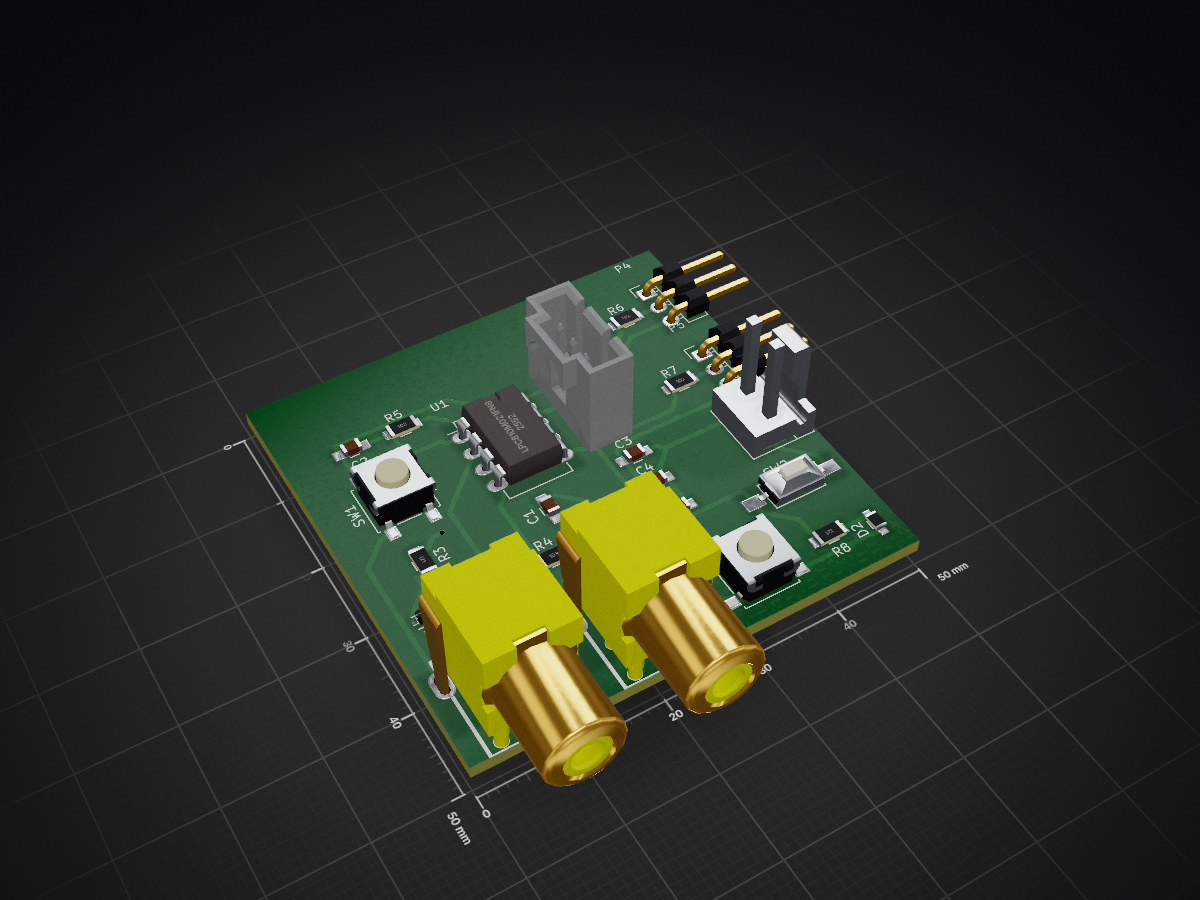
 HACManchester/LaserCutter.PCB.Making
Docs for using the laser cutter to make PCBs
LPC810.Pong2 is an open-source printed circuit board by HACManchester, from the HACManchester/LaserCutter.PCB.Making repository on GitHub. It is a 2-layer board of 50 × 50 mm with 25 parts on 15 nets, routed with 142 tracks and 1 via.
It is built around the LPC810M021FN8 and BAS70JFILM. Its parts include 8 resistors, 5 capacitors, 5 connectors, 3 switches and 2 diodes. It belongs with the NXP (LPC, Kinetis, i.MX RT) boards of this library.
A series of documentation / examples of making PCB's on the Orange Laser Cutter within the Manchester Hacspace
All designs in here licensed under a Creative Commons Attribution-ShareAlike 4.0 International License.
| Qty | Value | Footprint | References |
|---|---|---|---|
| 4 | 100n | Capacitors_SMD:C_0805_HandSoldering | C2, C3, C4, C5 |
| 2 | 10K | Resistors_SMD:R_0805_HandSoldering | R4, R5 |
| 2 | 120R | Resistors_SMD:R_0805_HandSoldering | R3, R8 |
| 2 | 1K | Resistors_SMD:R_0805_HandSoldering | R6, R7 |
| 1 | 2.2n | Capacitors_SMD:C_0805_HandSoldering | C1 |
| 1 | 620R | Resistors_SMD:R_0805_HandSoldering | R1 |
| 1 | 680R | Resistors_SMD:R_0805_HandSoldering | R2 |
| 1 | Audio Out | w_conn_av:rca_yellow | P3 |
| 1 | BAS70JFILM | Diodes_SMD:SOD-323 | D1 |
| 1 | Battery | Pin_Headers:Pin_Header_Straight_1x02_Pitch3.96mm_Friction_Lock | BT1 |
| 1 | LPC810M021FN8 | Housings_DIP:DIP-8_W7.62mm_LongPads | U1 |
| 1 | PWR LED | Resistors_SMD:R_0603_HandSoldering | D2 |
| 1 | Paddle 1 | Pin_Headers:Pin_Header_Angled_1x03 | P4 |
| 1 | Paddle 2 | Pin_Headers:Pin_Header_Angled_1x03 | P5 |
| 1 | Power | Buttons_Switches_SMD:SW_SPST_FSMSM | SW2 |
| 1 | Program | Buttons_Switches_SMD:SW_SPST_B3S-1000 | SW3 |
| 1 | Serial Prog | Pin_Headers:Pin_Header_Straight_1x04 | P1 |
| 1 | Video Out | w_conn_av:rca_yellow | P2 |
| 1 | ~Reset | Buttons_Switches_SMD:SW_SPST_B3S-1000 | SW1 |
KLFAMO/relock_Artiq
This project is an electronic device based on the STM32 microcontroller, equipped with an Ethernet port for remote control and data communication.

google/mozc-devices
Circuit diagrams and firmware source code for Gboard DIY keyboards

davidphilipbarr/Sweep
Sweep - a small promicro based keyboard inspired by the Ferris.


hackclub/OnBoard
💡 Join 1,000 teenagers and make your first PCB with a $100 grant!

xyphro/UsbGpib
Versatile, cheap and portable USB to GPIB converter (USBTMC class based)


jes/scamp-cpu
A homebrew 16-bit CPU with a homebrew Unix-like-ish operating system.
It measures 50 × 50 mm and has 2 copper layers, 1.6 mm thick.
25 parts, built around the LPC810M021FN8 and BAS70JFILM. The full list of its parts is on this page, with links to each part's symbol and footprint where PCBKit's library has them.
From the HACManchester/LaserCutter.PCB.Making repository on GitHub, at the commit this page was made from: the board is Examples/LPC810.Pong2/KiCad/LPC810.Pong2.kicad_pcb. PCBKit opens the board in the browser, with nothing to install.
Its repository states no licence, so its author keeps all rights: ask HACManchester before reusing the design.