

2 layers213 × 128.5 mm

 GlobalSequence/iosefka5
hybrid digital analog synthesizer
Iosefka controlboard is an open-source printed circuit board by GlobalSequence, from the GlobalSequence/iosefka repository on GitHub. It is a 2-layer board of 213 × 128.5 mm with 78 parts on 93 nets, routed with 744 tracks and 8 vias.
It is built around the H11L1 and 1N4148W. Its parts include 21 switches, 13 resistors, 9 diodes, 6 capacitors and 6 ICs. It belongs with the audio and music boards of this library.
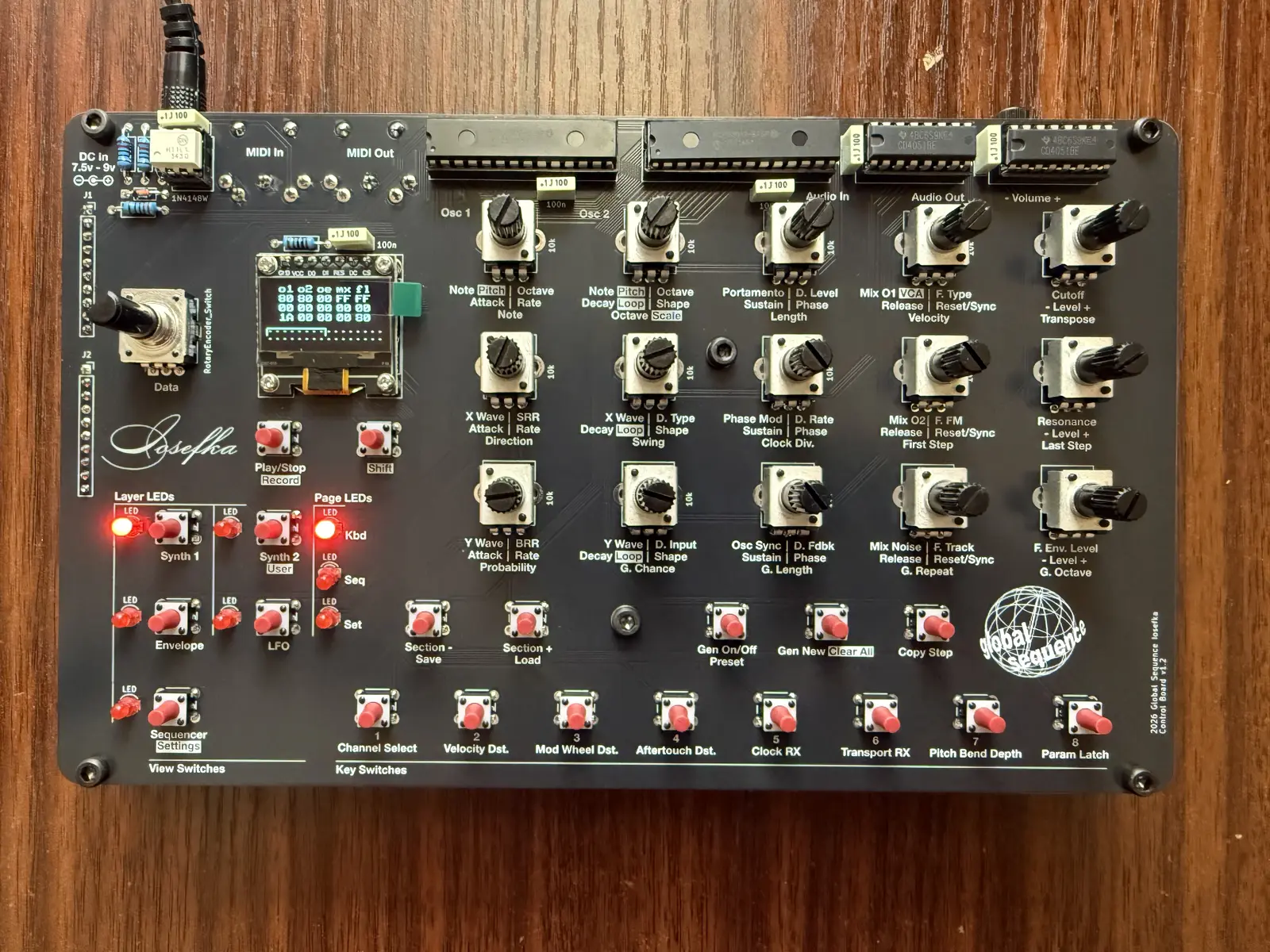
Iosefka is a hybrid digital analog monophonic synthesizer consisting of the following parts:
Digital audio:
Analog audio:
Step sequencer:
Modulation matrix to all audio Parameters:
MIDI Implementation:
Patch storage:
Oscilloscope:
Build Guide - Iosefka Manual (It's part of the manual)
This project includes hardware design files, as well as the gerber files which are required for PCB fabrication. The gerber files for the different boards will be found in the locations linked below. There is also a compressed zip file of all of the gerber files within this folder if that's the format your PCB fab of choice requires.
The three bills of materials can be found in the hardware folder of this project.
You can download the most current Iosefka firmware from the Releases section of this github repository. Or you can click this link: https://github.com/GlobalSequence/iosefka/releases.
Take this as a content warning for what you are about to see should you so much as peek into the code of this repository. It may help to frame this whole thing as a hobbyist's project that got way out of hand. I chalk any and all glaring errors up to the fundamental tension of this machine which was 'I want to create/finish this thing' vs. 'I want to learn this stuff'.
It is resoundingly true that the whole is better than the sum of its parts.
With all of that laid bare, please feel free to reach out to me about any suggestions, recommended fixes, or outright errors in both the code and the schematic. I consider the post-release critique the most enduring part of the learning process. globeseq@gmail.com
This project is provided for informational and educational purposes only. By using the provided instructions, code, and hardware designs, you acknowledge that you are solely responsible for your own safety and the cost of any materials or components used.
| Qty | Value | Footprint | References |
|---|---|---|---|
| 20 | SW_Push | Button_Switch_THT:SW_PUSH_6mm | SW2, SW3, SW4, SW5, SW10, SW11, SW12, SW13, SW14, SW15, SW16, SW17, SW18, SW19, SW20, SW21 +4 |
| 15 | 10k | Potentiometer_THT:Potentiometer_Bourns_PTV09A-1_Single_Vertical | RV1, RV2, RV3, RV4, RV5, RV6, RV7, RV8, RV9, RV10, RV11, RV12, RV13, RV14, RV15 |
| 8 | 470R | Resistor_THT:R_Axial_DIN0207_L6.3mm_D2.5mm_P10.16mm_Horizontal | R2, R3, R4, R5, R6, R7, R8, R9 |
| 8 | LED | LED_THT:LED_D3.0mm | D1, D2, D3, D4, D5, D6, D7, D8 |
| 6 | 100n | Capacitor_THT:C_Rect_L7.0mm_W2.0mm_P5.00mm | C1, C2, C3, C4, C5, C6 |
| 3 | 220R | Resistor_THT:R_Axial_DIN0207_L6.3mm_D2.5mm_P10.16mm_Horizontal | R10, R53, R54 |
| 2 | 4051 | Package_DIP:DIP-16_W7.62mm_Socket | U4, U5 |
| 2 | Conn_01x10 | Connector_PinSocket_2.54mm:PinSocket_1x10_P2.54mm_Vertical | J1, J2 |
| 2 | DIN-5_180degree | Eurocad:MIDI_DIN5 | J3, J6 |
| 2 | LOGO | LOGO | G***, G*** |
| 2 | MCP23017_SP | Package_DIP:DIP-28_W7.62mm_Socket | U2, U3 |
| 1 | 10k | Resistor_THT:R_Axial_DIN0207_L6.3mm_D2.5mm_P10.16mm_Horizontal | R1 |
| 1 | 1N4148W | Diode_THT:D_DO-35_SOD27_P7.62mm_Horizontal | D9 |
| 1 | 270R | Resistor_THT:R_Axial_DIN0207_L6.3mm_D2.5mm_P10.16mm_Horizontal | R52 |
| 1 | H11L1 | Package_DIP:DIP-6_W7.62mm_Socket | U14 |
| 1 | RotaryEncoder_Switch | Rotary_Encoder:RotaryEncoder_Alps_EC11E-Switch_Vertical_H20mm | SW1 |
| 1 | SSD1306_SPI | SSD1306 SPI:128x64_0.96_Disp_Module_oval_holes | U1 |
The 76 most common of 78 parts.

dchwebb/Oscar
Eurorack 3 Channel Oscilloscope based on ARM STM32F446 MCU

relic-se/PicoSynth_Sandbox-hardware
Raspberry Pi Pico digital synthesizer board with I2S stereo audio i/o, MEMS microphones, MIDI i/o, a capacitive keybed, 1602 display, 2 rotary encoders, and LiPo battery. Designed for use with CircuitPython and synthio.


Cherry-Blossom-Development/GreywireStudio
GreywireStudio - a combined software/hardware product

mark-mcnulty/wiggle_stm32
Firmware for a small STM32F1-based audio board: either a LUT-driven oscillator into the onboard DAC, or a short effects chain on whatever comes in on the ADC.

ondras12345/vetrnik
Electronics for heating water with power from a 2 kW wind turbine
It measures 213 × 128.5 mm and has 2 copper layers, 1.6 mm thick.
78 parts, built around the H11L1 and 1N4148W. The full list of its parts is on this page, with links to each part's symbol and footprint where PCBKit's library has them.
From the GlobalSequence/iosefka repository on GitHub, at the commit this page was made from: the board is hardware/iosefka_controlboard/iosefka_controlboard.kicad_pcb and its schematic hardware/iosefka_bottomboard/iosefka_bottomboard.kicad_sch. PCBKit opens the board in the browser, with nothing to install.
Its repository states no licence, so its author keeps all rights: ask GlobalSequence before reusing the design.