4 layers34 × 45.9 mm

 geschmit/hourglass4
Hack Club Onboard submission project
Hourglass reva is an open-source printed circuit board by geschmit, from the geschmit/hourglass repository on GitHub, published under the Apache-2.0 licence. It is a 4-layer board of 34 × 45.9 mm with 97 parts on 85 nets, routed with 822 tracks and 62 vias.
It is built around the ATMEGA32U4-MU, DS3231MZ/V+ and LSM9DS1, with the RT9080-33GJ5, DMG3414U and MBR0540 among its other parts. Its parts include 65 diodes, 9 resistors, 6 capacitors, 5 ICs and 4 connectors. It belongs with the AVR (ATmega, ATtiny) boards of this library.


Hourglass is a custom PCB watch designed in KiCAD 7.0, to be funded by the Hack Club OnBoard grant, which allocates $100 for high schoolers to design and build their own custom PCBs.
Status: ✔️ (COMPLETE)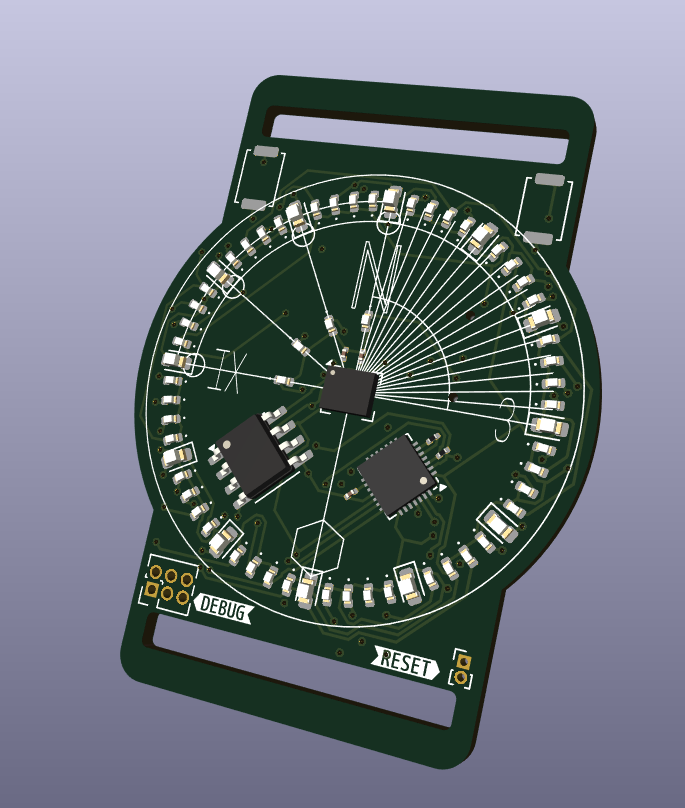
Revision A is the original design, based on the Atmel ATMega32u4 microcontroller. It features a RTC and 9DoF magnetometer-accelerometer to detect orientation, magnetic field strength and more to act as both a device for keeping time and sense when the wearer has raised the watchface to observe. In addition, a USB-C port can allow for interfacing directly to the Mega for uploading code and other functions.
Status: ✔️ (COMPLETE)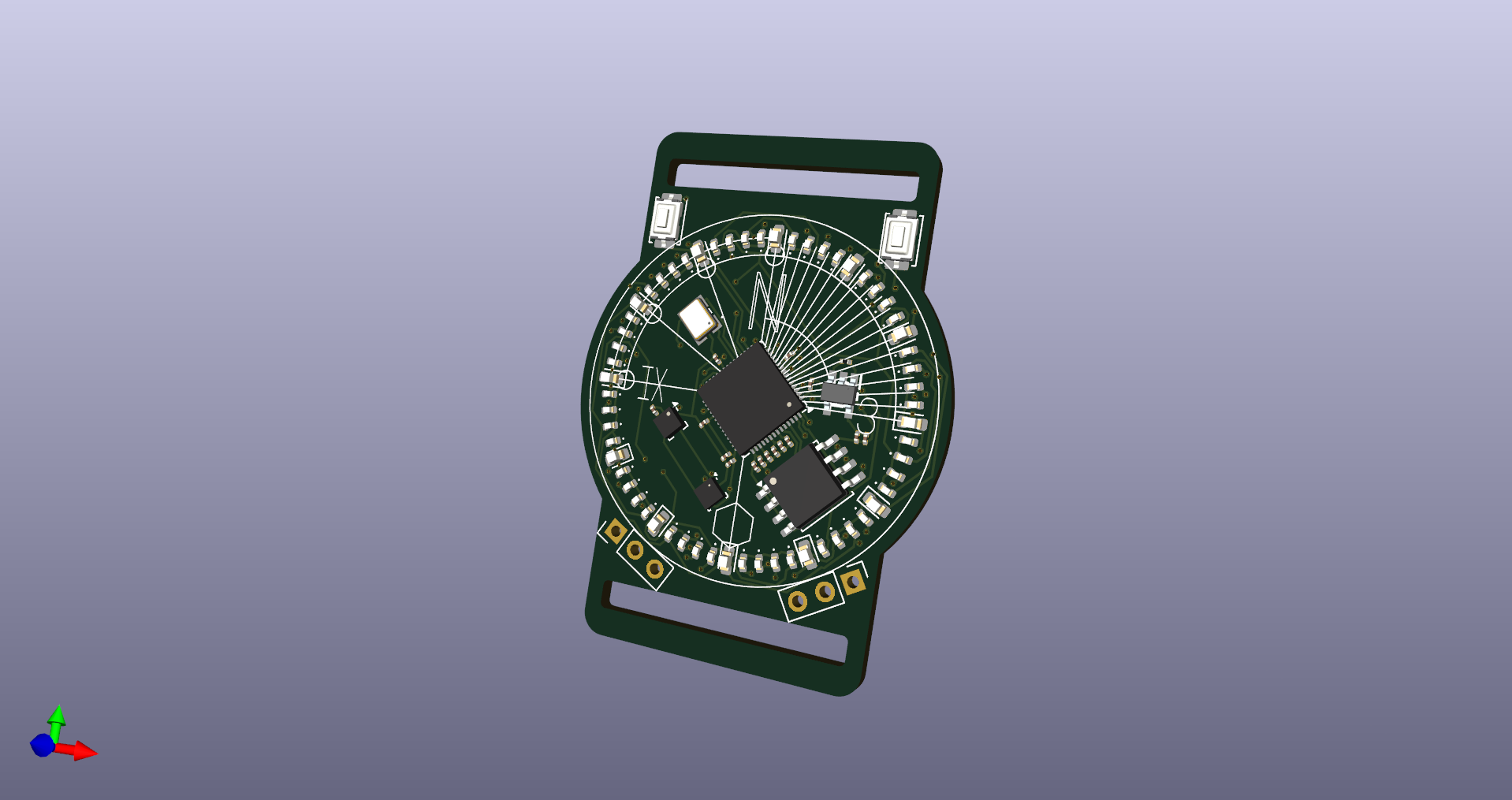
Revision B is a easier, more affordable option. I'm working on this primarily because revision A is simply too expensive with all peripherals added in to have assembled via JLC's PCBA. It swaps the ATMega32 with an RP2040, the 9DoF magnetometer with split magnetometer & accelerometer ICs, and forgoes the rear battery slot alltogether. The caveat with this is you'll need to wire a battery to the device yourself, but comes at a tremendous discount with the requirement for dual-sided PCB assembly forgone.
| Qty | Value | Footprint | References |
|---|---|---|---|
| 52 | LED | LED_SMD:LED_0402_1005Metric | D2, D10, D12, D13, D14, D15, D17, D18, D19, D20, D22, D23, D24, D25, D27, D28 +36 |
| 12 | LED | LED_SMD:LED_0603_1608Metric | D1, D6, D11, D16, D21, D26, D31, D36, D41, D46, D51, D56 |
| 3 | 10k | Resistor_SMD:R_0201_0603Metric | R4, R8, R9 |
| 3 | 10uF | Capacitor_SMD:C_0201_0603Metric | C2, C4, C6 |
| 2 | 0.1uF | Capacitor_SMD:C_0201_0603Metric | C1, C3 |
| 2 | 20k | Resistor_SMD:R_0201_0603Metric | R5, R6 |
| 2 | 22 | Resistor_SMD:R_0201_0603Metric | R2, R7 |
| 2 | 5.1k | Resistor_SMD:R_0201_0603Metric | R1, R3 |
| 1 | 0.22uF | Capacitor_SMD:C_0201_0603Metric | C5 |
| 1 | 8MHz | Crystal:Crystal_SMD_3225-4Pin_3.2x2.5mm | Y1 |
| 1 | ATmega32U4-M | Package_DFN_QFN:QFN-44-1EP_7x7mm_P0.5mm_EP5.2x5.2mm | U1 |
| 1 | AVR-ISP-6 | Connector_PinHeader_1.27mm:PinHeader_2x03_P1.27mm_Vertical | J3 |
| 1 | Conn_BATT | Battery:BatteryHolder_LINX_BAT-HLD-012-SMT | J2 |
| 1 | Conn_RESET | Connector_PinHeader_1.00mm:PinHeader_1x02_P1.00mm_Vertical | J1 |
| 1 | DMG3414U | Package_TO_SOT_SMD:SOT-23 | Q1 |
| 1 | DS3231MZ | Package_SO:SOIC-8_3.9x4.9mm_P1.27mm | U4 |
| 1 | G*** | kibuzzard-66A7EADD | kibuzzard-66A7EADD |
| 1 | G*** | kibuzzard-66A6C661 | kibuzzard-66A6C661 |
| 1 | G*** | kibuzzard-66A7D7EA | kibuzzard-66A7D7EA |
| 1 | G*** | kibuzzard-66A6C66D | kibuzzard-66A6C66D |
| 1 | IS31FL3731-QF | Package_DFN_QFN:QFN-28-1EP_4x4mm_P0.4mm_EP2.3x2.3mm | U2 |
| 1 | LSM9DS1 | Package_LGA:LGA-24L_3x3.5mm_P0.43mm | U3 |
| 1 | MBR0540 | Diode_SMD:D_SOD-123 | D65 |
| 1 | RT9080-33GJ5 | SamacSys_Parts:SOT94P280X100-5N | U5 |
| 1 | SW_User1 | Button_Switch_SMD:SW_Push_SPST_NO_Alps_SKRK | SW1 |
| 1 | SW_User2 | Button_Switch_SMD:SW_Push_SPST_NO_Alps_SKRK | SW2 |
| 1 | USB_C_Receptacle_USB2.0_14P | Connector_USB:USB_C_Receptacle_GCT_USB4110 | J4 |


nrdsp/rvPhone
The goal of the this project is to develop a privacy enhanced, simple and fully featured mobile phone.

vroland/epdiy-hardware
Hardware design files for EPDiy: https://github.com/vroland/epdiy.


cnicolasgr/STM32_e-reader
An modest attempt to build an e-reader using a stm32MP1

Phalkon-Industries/phoenix-instrument
Git repo for the content of the new Phoenix ph handheld instrument.
It measures 34 × 45.9 mm and has 4 copper layers, 1.6 mm thick.
97 parts, built around the ATMEGA32U4-MU, DS3231MZ/V+, LSM9DS1 and RT9080-33GJ5. The full list of its parts is on this page, with links to each part's symbol and footprint where PCBKit's library has them.
From the geschmit/hourglass repository on GitHub, at the commit this page was made from: the board is hourglass_reva/hourglass_reva.kicad_pcb and its schematic hourglass_prototype/daughterboard.kicad_sch. PCBKit opens the board in the browser, with nothing to install.
Its repository publishes it under the Apache-2.0 licence: you may reuse it on that licence's terms (keep the author's notice, and for a copyleft licence share your changes alike).