4 layers36.7 × 49 mm
Megadesk companion
gcormier/megadesk_companion
companion board for megadesk to add smarthome functionality
35 parts27

 gcormier/esptemp8c8
n-channel thermocouple logger using esphome
Esptemp8c is an open-source printed circuit board by gcormier, from the gcormier/esptemp8c repository on GitHub. It is a 2-layer board of 56.6 × 57.7 mm with 42 parts on 49 nets, routed with 260 tracks and 41 vias.
It is built around the ESP32-C3-MINI-1, LMR54406DBVR-MS and 1N5819WS. Its parts include 12 capacitors, 9 resistors, 6 diodes, 6 connectors and 2 ICs. It belongs with the home automation and IoT boards and the ESP32 and RISC-V boards of this library.


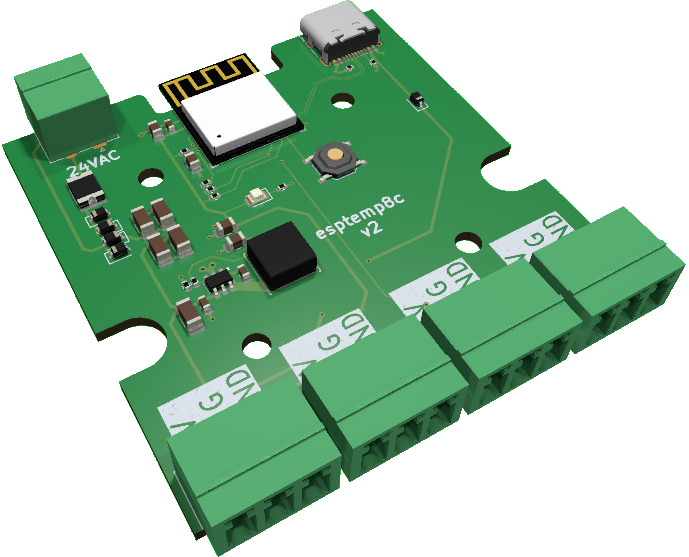
Open source, n-channel temperature logger using esphome for Dallas DS18B20 sensors. Powered by an ESP32-C3-MINI, it can be powered by USB-C or by 24VAC.

They can be found at various locations, including DFRobot, Adafruit, Digikey or the usual suspects.
You will need to find out your sensor ID's as per the esphome documentation.
If you are using a Dallas DS18B20 sensor, I strongly recommend using Digikey, Mouser or Adafruit to avoid obtaining counterfeit sensors.
Only one power source should be used.
A self-resetting polyfuse is included to protect HVAC equipment if sourcing 24VAC from these units. The polyfuse does NOT apply to power from the USB-C port, as the device supplying power should have overcurrent protection per the USB standard.
You must hold down the button while plugging in the device the first time to enter programming mode. The device will then show up as a USB device on your computer. You can then use the esphome flasher to flash the device.
Subsequent flashing does not require use of the button - it can be done via USBC or OTA as well.
Fits in a Hammond 1593KBK. Or you can make your own enclosure and 3D-print it (contributions welcome).
| Qty | Value | Footprint | References |
|---|---|---|---|
| 5 | 1N5819WS | Diode_SMD:D_SOD-323 | D1, D2, D3, D4, D5 |
| 4 | 10u | Capacitor_SMD:C_0805_2012Metric | C1, C7, C11, C12 |
| 4 | 10uF 50V | Capacitor_SMD:C_1206_3216Metric | C3, C4, C5, C6 |
| 4 | MountingHole | MountingHole:MountingHole_3.2mm_M3 | H1, H2, H3, H4 |
| 3 | 0.1u | Capacitor_SMD:C_0603_1608Metric | C2, C9, C10 |
| 3 | 10k | Resistor_SMD:R_0402_1005Metric | R1, R3, R4 |
| 3 | 5k1 | Resistor_SMD:R_0402_1005Metric | R2, R5, R6 |
| 1 | 140mA hold / 340mA trip mSMD014 | Fuse:Fuse_1812_4532Metric | F1 |
| 1 | 15uH | Inductor_SMD:L_Sunlord_SWPA6028S | L1 |
| 1 | 22k | Resistor_SMD:R_0402_1005Metric | R8 |
| 1 | 24VAC | Connector_Phoenix_MC:PhoenixContact_MC_1,5_2-G-3.81_1x02_P3.81mm_Horizontal | J3 |
| 1 | 4u7 | Capacitor_SMD:C_1206_3216Metric | C8 |
| 1 | 680 | Resistor_SMD:R_0402_1005Metric | R9 |
| 1 | 68k | Resistor_SMD:R_0402_1005Metric | R7 |
| 1 | ESP32-C3-MINI-1 | Espressif:ESP32-C3-MINI-1 | U1 |
| 1 | LMR54406DBVR | Package_TO_SOT_SMD:SOT-23-6 | U2 |
| 1 | PWR | LED_SMD:LED_0805_2012Metric | D7 |
| 1 | RESET | Button_Switch_SMD:SW_Push_1P1T_XKB_TS-1187A | SW1 |
| 1 | T1 | Connector_Phoenix_MC:PhoenixContact_MC_1,5_3-G-3.81_1x03_P3.81mm_Horizontal | J1 |
| 1 | T2 | Connector_Phoenix_MC:PhoenixContact_MC_1,5_3-G-3.81_1x03_P3.81mm_Horizontal | J2 |
| 1 | T3 | Connector_Phoenix_MC:PhoenixContact_MC_1,5_3-G-3.81_1x03_P3.81mm_Horizontal | J4 |
| 1 | T4 | Connector_Phoenix_MC:PhoenixContact_MC_1,5_3-G-3.81_1x03_P3.81mm_Horizontal | J6 |
| 1 | USB_C_Receptacle_USB2.0 | Connector_USB:USB_C_Receptacle_HRO_TYPE-C-31-M-12 | J5 |
It measures 56.6 × 57.7 mm and has 2 copper layers, 1.6 mm thick.
42 parts, built around the ESP32-C3-MINI-1, LMR54406DBVR-MS and 1N5819WS. The full list of its parts is on this page, with links to each part's symbol and footprint where PCBKit's library has them.
From the gcormier/esptemp8c repository on GitHub, at the commit this page was made from: the board is pcb/esptemp8c.kicad_pcb and its schematic pcb/esptemp8c-power.kicad_sch. PCBKit opens the board in the browser, with nothing to install.
Its repository states no licence, so its author keeps all rights: ask gcormier before reusing the design.
gcormier/megadesk_companion
companion board for megadesk to add smarthome functionality

OpenDrone-hw/OpenESC-20x20
Open-source 4-in-1 AM32 ESC for FPV drones. 20x20 mm, 2-6S, one MCU per motor, CERN-OHL-S-2.0.


OpenDrone-hw/OpenESC-30x30
Open-source 4-in-1 AM32 ESC for FPV drones. 30.5x30.5 mm, 2-8S, one MCU per motor, CERN-OHL-S-2.0.


holoindustry/AxxSolder_modded
Interested in purchasing an AxxSolder 3.2? On my website 5Dimensions you can purchase assembled and tested AxxSolder 3.2 boards with connectors and hardware.

OliviezGit/OpenESC-30x30
Open-source 4-in-1 BLDC ESC with a 30.5 × 30.5 mm mounting pattern, built around four independent AT32F421 motor controllers running AM32. Six-layer, DShot over the standard 8-pin connector.

tmjnijssen/OSCD_demo_PCB
Open Science Community Delft demonstration PCB