2 layers95 × 54 mm
EinkPDA screen
TalismanDesign/PocketMage_PDA
An E-Ink PDA device using the ESP32 S3.
28 parts2kApache-2.0

 gcask/the-pit
Flexible gamepad system with an arduino-based SPI hc165 daisy-chain
Daisy hc165 is an open-source printed circuit board by gcask, from the gcask/the-pit repository on GitHub, published under the MPL-2.0 licence. It is a 2-layer board of 44 × 55 mm with 12 parts on 15 nets, routed with 70 tracks and 10 vias.
It is built around the 74HC165D, 4D03WGJ0103T5E and CL05B104KO5NNN. Its parts include 4 connectors, 1 capacitor and 1 IC. It belongs with the keyboards and input boards of this library.


Simple arduino-based gamepad to connect custom switches and toggles and easily bind into DCS (uses standard mappings, nothing fancy).
Supports hundreds of switches on a single arduino board.
Relies on HC165N Parallel-Load Shift Registers, which are inexpensive ICs, to achieve a high number of inputs.
Arduino-based program to manage a Sim Pit efficiently. The code is setup to be able to handle hundreds of inputs over a single Arduino chip, via the use of shift registers and SPI.
The recommended and target board is Leonardo.
firmware/hardware folder to your local Arduino install, ie %USERPROFILE%/Documents/Arduino/.
%USERPROFILE%/Documents/Arduino/hardware/thepit/avr/boards.txt file.The Pit (Leonardo) board.Because the software is trying to maximize available inputs, it eats up the endpoints that are used to upload a sketch any time.
Reset the board during the Upload... phase, otherwise it will fail.
Customizable values, such as the number of daisy-chained hc165, how many gamepads we're emulating, etc, are available in thepitconfig.user.h.
A simple board to easily daisy-chain several hc165 together. Each board has 4 connectors:
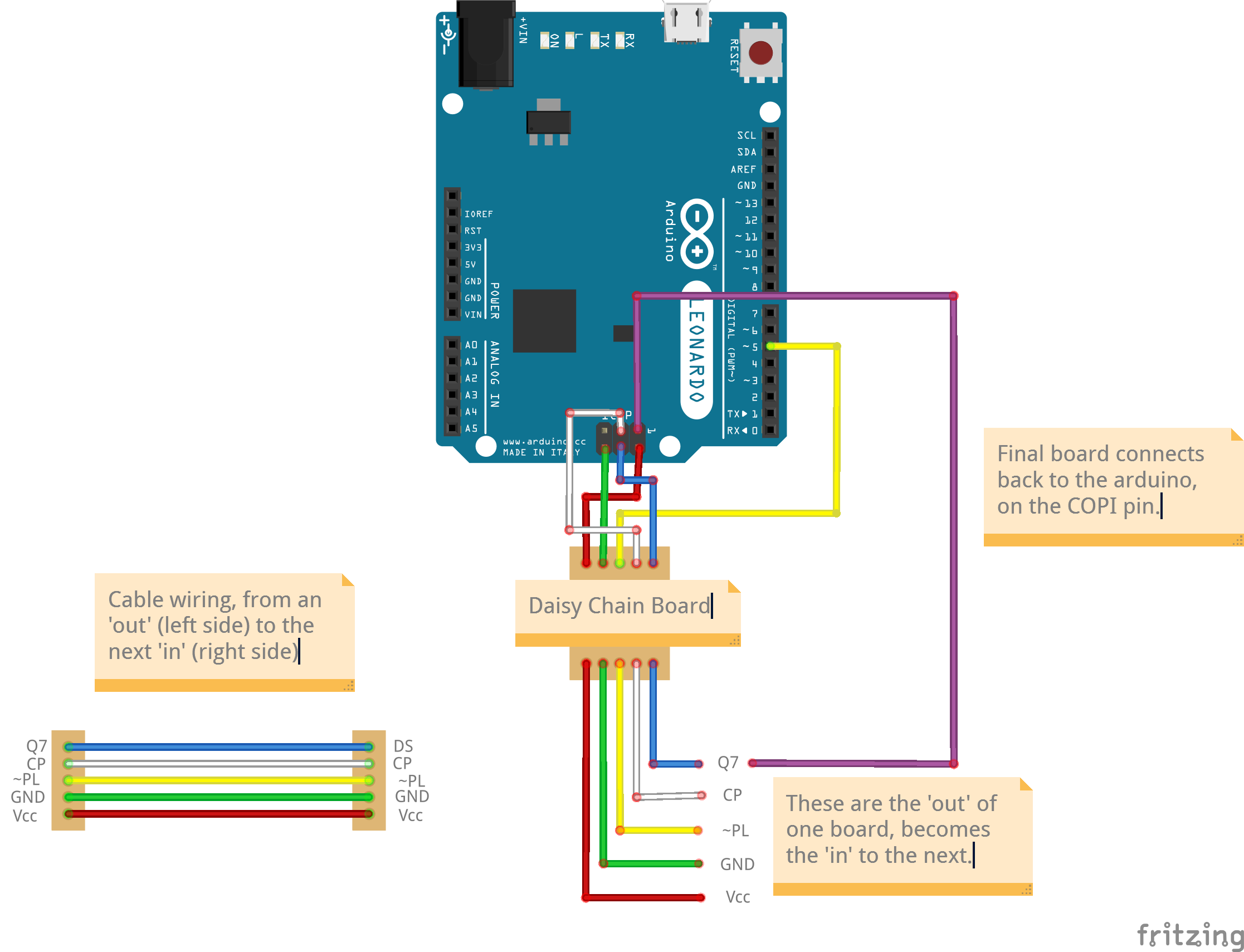
Pin 5 is used to latch the hc165, use the ICSP pins for SPI communication. On the board, the pins from the connector are labeled with their usage:
Firmware is released under the Mozilla Public License 2.0 Hardware designs are Open Hardware, licensed under CERN-OHL-W v2 or later
| Qty | Value | Footprint | References |
|---|---|---|---|
| 2 | 10k | Resistor_SMD:R_Array_Convex_4x0603 | RN1, RN2 |
| 2 | Conn_01x05_Male | Connector_JST:JST_XH_S5B-XH-A-1_1x05_P2.50mm_Horizontal | J1, J2 |
| 1 | 100nF | Capacitor_SMD:C_0402_1005Metric | C1 |
| 1 | 74HC165 | Package_DIP:DIP-16_W7.62mm_Socket_LongPads | U1 |
| 1 | DaisyChain_In | Connector_JST:JST_XH_S5B-XH-A-1_1x05_P2.50mm_Horizontal | J3 |
| 1 | DaisyChain_Out | Connector_JST:JST_XH_S5B-XH-A-1_1x05_P2.50mm_Horizontal | J4 |
The 8 most common of 12 parts.
It measures 44 × 55 mm and has 2 copper layers, 1.6 mm thick.
12 parts, built around the 74HC165D, 4D03WGJ0103T5E and CL05B104KO5NNN. The full list of its parts is on this page, with links to each part's symbol and footprint where PCBKit's library has them.
From the gcask/the-pit repository on GitHub, at the commit this page was made from: the board is hardware/daisy_hc165/daisy_hc165.kicad_pcb and its schematic hardware/daisy_hc165/daisy_hc165.kicad_sch. PCBKit opens the board in the browser, with nothing to install.
Its repository publishes it under the MPL-2.0 licence: you may reuse it on that licence's terms (keep the author's notice, and for a copyleft licence share your changes alike).
TalismanDesign/PocketMage_PDA
An E-Ink PDA device using the ESP32 S3.

FujiNetWIFI/fujinet-hardware
Schematics and design files for FujiNet hardware

jlcjak/neurband
Open, minimal sEMG wristband like the Meta Neural Band: 8-ch ADS1298 + nRF52832 BLE, dry gold electrodes on a flex, 3D-printed band. KiCad, FreeCAD, Zephyr, Python, simulations.

christrotter/shift-register-spi-breakout-pcb
Simple breakout board that gets you 16 rows and 16 cols for your QMK matrix.

igorwolfs/modular-processing-hw
MCU Breakout board with Hirose BM28B connector


christrotter/mk19-pcb
Do you need... - To use the Cyboard flex-pcb system? and extend it?? - Two Ultrafalcons...per side? - SPI devices - PMW3360/3389 (right side only) - Dual GC9A01 TFTs per side - Quad-shift register-powered 32 pins for…
