

2 layers133.5 × 172.2 mm
Ic access control
5hnrjz2xxq-blip/ic-card-access-system
数字信号处理课设:IC卡门禁系统设计(ESP32 + MFRC522 + PN532 + HomeKit)
55 parts

 funvill/mixxtape
PCB Mix tape
Mixxtape is an open-source printed circuit board by funvill, from the funvill/mixxtape repository on GitHub. It is a 2-layer board of 99.5 × 63.5 mm with 72 parts on 76 nets, routed with 601 tracks and 111 vias.
It is built around the XL-1615RGBC-2812B and R0603. Its parts include 29 diodes, 16 capacitors, 11 resistors, 5 ICs and 4 switches. It belongs with the ESP32 boards of this library.

A 2-layer PCB in the form factor of a compact cassette (99.5 × 63.5 mm) that slides into a real Norelco cassette case. The bare board is the object — no enclosure, no bezel.
An onboard MEMS microphone records three 4-minute tracks. Hold REC to record, release to stop. Pair it to any Bluetooth earbuds or speaker and press PLAY.
Cassette-shaped Bluetooth players exist. Nobody ships a cassette-shaped recorder — and recording is the part that made a mixtape a mixtape.
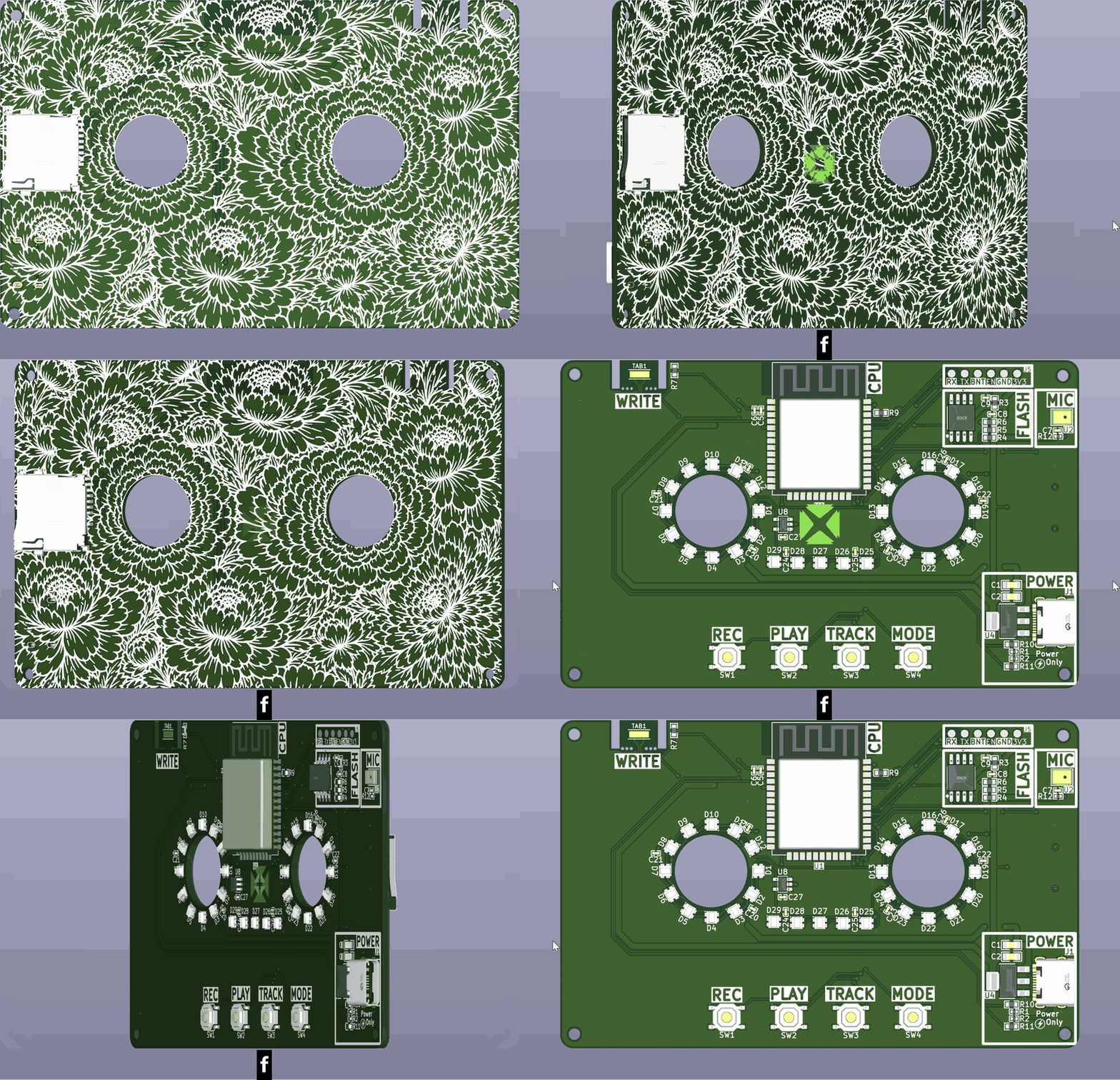
3D render from KiCad. The mask reads green here because that is the viewer's default — the board ships matte white, which is what makes the sharpie label work.
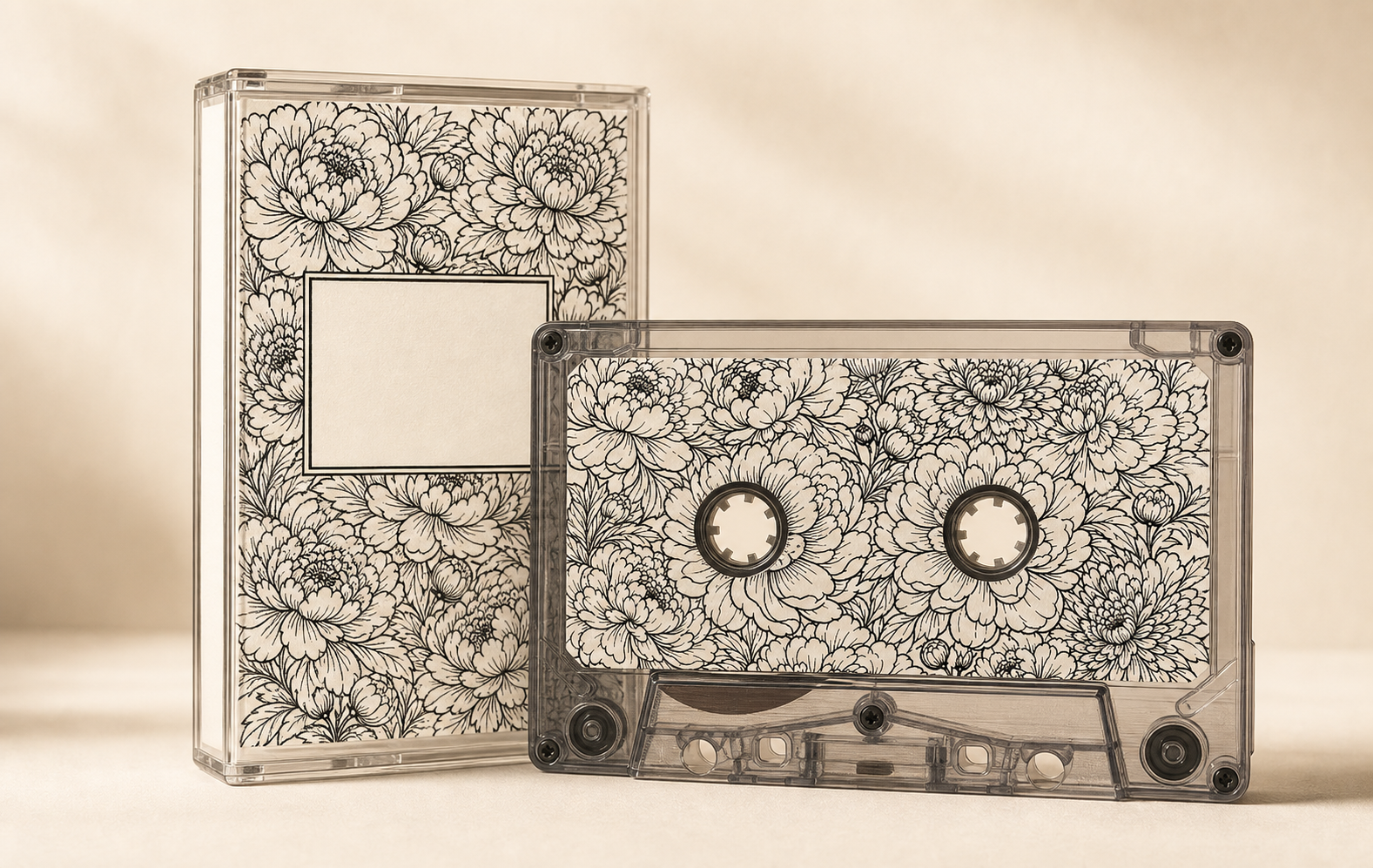
Artwork mockup of the B-side design and the J-card insert. The board is the object; this shows where the artwork is going.
Every fitted part is stocked at JLCPCB. The project rule is a minimum of 5,000 in stock, so a run never stalls on one line item — with a single documented exception: the microphone sits at ~3,500, because no digital MEMS microphone at JLCPCB clears the bar, and the one that does is analogue and would wreck the audio path.
| Block | Part | JLCPCB | Qty | Notes |
|---|---|---|---|---|
| MCU | ESP32-WROOM-32E-N4 | C701341 | 1 | The original Xtensa ESP32 — the only one with Classic Bluetooth, so the only one that can be an A2DP source |
| Microphone | MSM261DHT006 | C51928215 | 1 | PDM digital MEMS, mono, top-ported — sound enters from the component side, so there is no hole through the board |
| Storage | GD25Q128ESIG | C2758105 | 1 | 16 MB NOR flash, separate from the module's own flash. Three fixed slots, ~4 min each. Winbond W25Q128JVSIQ (C97521) is a drop-in second source |
| Indicators | XL-2020RGBC-2812B | C5349954 | 29 | WS2812-compatible RGB. Two 12-LED reel rings, three track lamps, REC, BT |
| LED data buffer | SN74AHCT1G125 | C7484 | 1 | Lifts the ESP32's 3.3 V data line to the LEDs' 5 V rail |
| Regulator | AMS1117-3.3 | C6186 | 1 | 5 V USB down to 3.3 V |
| USB-C | TYPE-C-31-M-12 | C165948 | 1 | Power and CC sensing only — no data lines |
| Buttons | TS-1187A-B-A-B | C318884 | 4 | REC, PLAY, TRACK, MODE |
| Write-protect tab | — | — | 1 | Not a part. A mouse-bitten PCB tongue carrying a net tie; snap it and recording is disabled for good |
| Programming pads | — | — | 1 | Six bare pogo targets. No USB-UART on the board |
Passives are all JLCPCB basic-library parts: 10 µF 0805 ×2 (rail bulk), 10 µF 0402, 1 µF (the ESP32's EN delay), 100 nF ×12, 10 k ×7, 5.1 k ×2 (the USB-C CC pull-downs) and 100 Ω (microphone supply isolation).
| Audio | 44.1 kHz mono, ADPCM-encoded at record time; playback decodes with table lookups and hands PCM to the Bluetooth stack |
| Power | USB-C only, power and CC sense. No battery, no charger |
| Board | 2-layer, 99.50 × 63.50 mm, matte white solder mask with black silkscreen |
| Cost | $9.41/board at a run of 20 — $173.14 in parts plus $15.00 of setup fees for five extended-library parts |
Full detail, with live stock and pricing, is in the generated BOM — it is derived from the schematic, so it cannot drift out of step with it.
Design locked, schematic and firmware core underway. hardware/ holds a
KiCad 9 project with a first-pass schematic (ERC-clean) and JLCPCB part
libraries. firmware/ has the ESP-IDF skeleton plus the host-tested core —
crash-safe slot manager, ADPCM codec, playback sequencer, reel display,
pairing policy, bond table and record limiter — all proven without hardware,
since there is no devkit. Target: a prototype run of 3–5 boards, then a full
run of 20. What is left needs a board in hand: the SPI flash, I²S capture,
the A2DP plumbing, LED output, and A2DP against real earbuds.
Before ordering boards:
For people using one:
For people building or hacking one:
| Qty | Value | Footprint | References |
|---|---|---|---|
| 29 | XL-1615RGBC-2812B | LED-SMD_4P-L1.6-W1.5_XL-1615RGBC-2812B | D1, D2, D10, D11, D12, D13, D14, D15, D16, D17, D18, D19, D20, D21, D22, D23 +13 |
| 13 | C0402 | C0402 | C5, C6, C7, C8, C19, C20, C21, C22, C23, C24, C25, C26, C27 |
| 8 | R0603 | R0402 | R3, R4, R5, R6, R7, R9, R10, R11 |
| 4 | SW-SMD_4P-L5.1-W5.1-P3.70-LS6.5-TL_H1.5 | SW-SMD_4P-L5.1-W5.1-P3.70-LS6.5-TL_H1.5 | SW1, SW2, SW3, SW4 |
| 2 | 10uF | C0805 | C1, C2 |
| 2 | LOGO | LOGO | G***, G*** |
| 2 | R0402 | R0402 | R1, R2 |
| 1 | 100R | R0402 | R12 |
| 1 | 1uF | C0402 | C9 |
| 1 | LGA-8_L4.0-W3.0-R_WMM7040DT0 | LGA-8_L4.0-W3.0-R_WMM7040DT0 | U2 |
| 1 | MOUSEBITE_6 | MOUSEBITE_6 | MB1 |
| 1 | PROG_JIG | PROG_JIG_6PAD | J5 |
| 1 | SOIC-8_L5.3-W5.3-P1.27-LS8.0-BL | SOIC-8_L5.3-W5.3-P1.27-LS8.0-BL | U3 |
| 1 | SOT-223-3_L6.5-W3.4-P2.30-LS7.0-BR | SOT-223-3_L6.5-W3.4-P2.30-LS7.0-BR | U4 |
| 1 | SOT-23-5_L3.0-W1.7-P0.95-LS2.8-BR | SOT-23-5_L3.0-W1.7-P0.95-LS2.8-BR | U8 |
| 1 | TF-SMD_TF-01A | TF-SMD_TF-01A | J4 |
| 1 | USB-C_SMD-TYPE-C-31-M-12_1 | USB-C_SMD-TYPE-C-31-M-12_1 | J1 |
| 1 | WIFI-SMD_ESP32-WROOM-32E | WIFI-SMD_ESP32-WROOM-32E | U1 |
| 1 | WRITE-PROTECT | TAB_BREAKOFF_LINK | TAB1 |
It measures 99.5 × 63.5 mm and has 2 copper layers, 1.6 mm thick.
72 parts, built around the XL-1615RGBC-2812B and R0603. The full list of its parts is on this page, with links to each part's symbol and footprint where PCBKit's library has them.
From the funvill/mixxtape repository on GitHub, at the commit this page was made from: the board is hardware/mixxtape.kicad_pcb and its schematic hardware/mixxtape.kicad_sch. PCBKit opens the board in the browser, with nothing to install.
Its repository states no licence, so its author keeps all rights: ask funvill before reusing the design.
5hnrjz2xxq-blip/ic-card-access-system
数字信号处理课设:IC卡门禁系统设计(ESP32 + MFRC522 + PN532 + HomeKit)

dovy6/Faiked
This project is subject to the licence in the LICENCE file, and even if that says it is an open source project, you cannot sell boards or cases bearing the Andrews & Arnold Ltd name, the A&A logo, the registered…

Rsa76d/FaikoutRSA
This project is subject to the licence in the LICENCE file, and even if that says it is an open source project, you cannot sell boards or cases bearing the Andrews & Arnold Ltd name, the A&A logo, the registered…

Yang-xy-svg/ESP_OpenMic
This project is subject to the licence in the LICENCE file, and even if that says it is an open source project, you cannot sell boards or cases bearing the Andrews & Arnold Ltd name, the A&A logo, the registered…


sijinhui/SolarSystem
Fork of codeberg.org/RevK/SolarSystem — adds ESP32-S3 N16R8 (octal PSRAM) build variant (branch n16r8-octal-psram)

hackclub/OnBoard
💡 Join 1,000 teenagers and make your first PCB with a $100 grant!

BlueSCSI/BlueSCSI-v2
BlueSCSI v2/Ultra - an open source, open hardware, SCSI emulator using the Pi Pico PR2040 and Pico 2 RP2350