

2 layers48.3 × 50.8 mm
Electronic load controller
ondras12345/electronic-load
Digital control for XHDZ-FZ-2g electronic load
63 parts2MIT

 FrankBuss/riscv-challenge2
MIDI synthesizer for the RISC-V Design Challenge
Midi in module is an open-source printed circuit board by FrankBuss, from the FrankBuss/riscv-challenge repository on GitHub, published under the BSD-2-Clause licence. It is a 2-layer board of 25.4 × 25.4 mm with 10 parts on 12 nets, routed with 64 tracks and 1 via.
It is built around the H11L1 and BAV99. Its parts include 4 resistors, 3 connectors, 1 capacitor, 1 IC and 1 diode. It belongs with the audio and music boards of this library.
This is the MIDI synthesizer project for the RISC-V Design Challenge. I'm using this board for it.
The board is configured to receive the MIDI data with an opto-isolator with the standard MIDI frequency of 31,250 Hz. The firmware then detects note-on and note-off events and generates a PWM signal with the requested pitch.
Soldering the MIDI-in board and testing the project:
https://www.youtube.com/watch?v=y-bby_u5XV8
First install MounRiver, as described here: https://www.youtube.com/watch?v=JHzsH9RhTR4
Then download or clone this repository and open the project file midi-synthesizer.wvproj in the midi-synthesizer directory. You can then build and upload it.
Circuit diagram of the MIDI-in board:
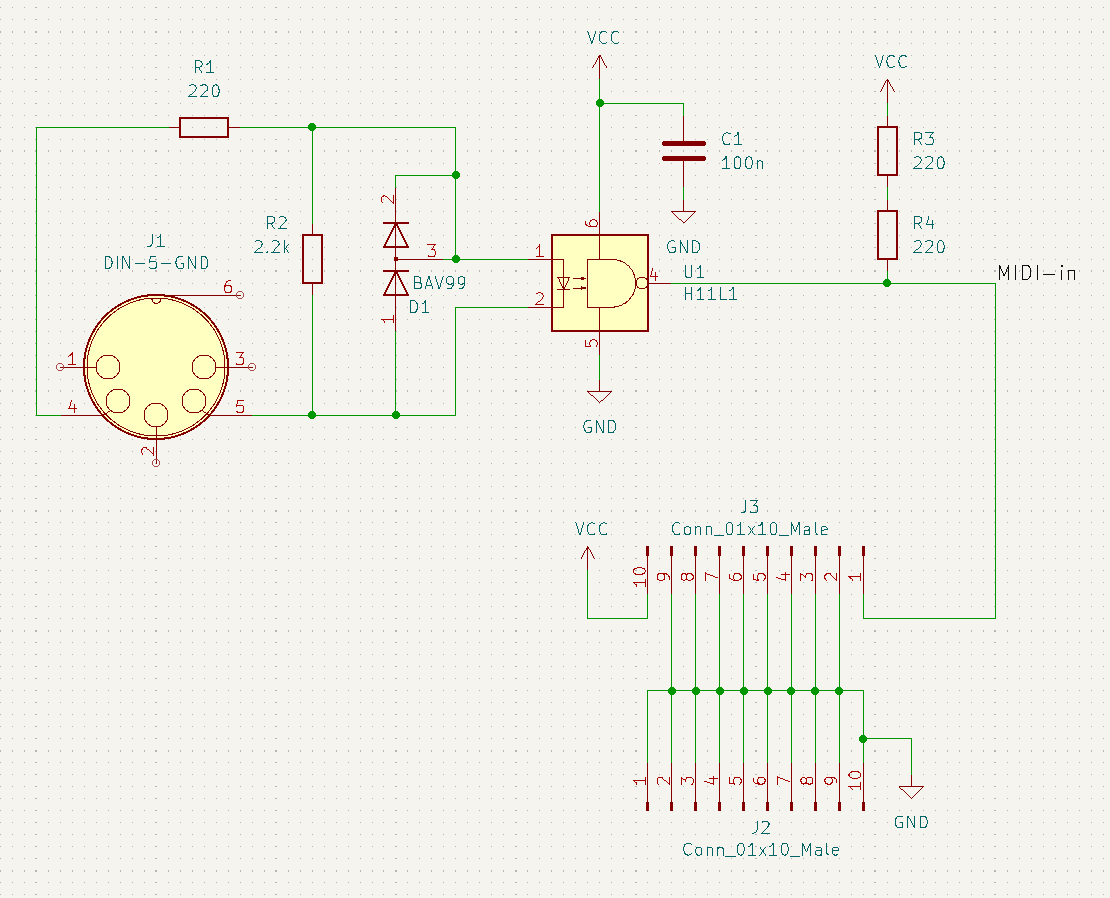
You can find the KiCad project in the midi-in-module directory. There is also a gerbers.zip file, which you can use to order your board from a PCB manufacturer like https://jlcpcb.com.
Parts list, which you can get from https://www.digikey.com:
| Id | Designator | Package | Quantity | Designation | Digi-Key Part Number |
|---|---|---|---|---|---|
| 1 | D1 | SOT-23 | 1 | BAV99 | 3191-BAV99CT-ND |
| 2 | R1,R3,R4 | R_1206_3216Metric | 3 | 220 | 311-220ERCT-ND |
| 3 | J3,J2 | PinHeader_1x10_P2.54mm_Vertical | 2 | Conn_01x10_Male | Z12462-ND |
| 4 | J1 | DIN_CUI_SD-50BV | 1 | DIN-5-GND | CP-3150-ND |
| 5 | C1 | C_0805_2012Metric | 1 | 100n | 478-1395-1-ND |
| 6 | R2 | R_0805_2012Metric | 1 | 2.2k | 311-2.20KLRCT-ND |
| 7 | U1 | DIP-6_W8.89mm_SMDSocket_LongPads | 1 | H11L1 | H11L1SMCT-ND |
When soldering it, you can use (this interactive placement tool)[midi-in-module/bom/ibom.html] to find the location of the components.
You can connect the PWM output directly to a high impedance amplifier, or you can build a simple amplifier with a N-channel MOSFET to drive a speaker, as seen in the video:
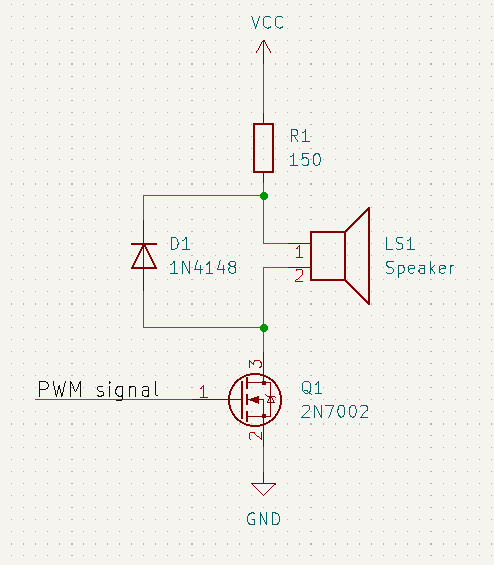
On the dev board, connect PA0 to LED1, to light the LED when a note is playing. Connections to the MIDI-in board:
| dev board | MIDI-in board |
|---|---|
| VCC | +5V |
| GND | GND |
| PA10 | MIDI-in |
Note: VCC is 3.3V. The MIDI-in board works with 5V and 3.3V.
Then connect PA8 to an audio amplifier, connect a MIDI keyboard, or a USB-to-MIDI interface as seen in the video.
The MIDI demo file is from https://www.free-scores.com/download-sheet-music.php?pdf=11596#.
| Qty | Value | Footprint | References |
|---|---|---|---|
| 3 | 220 | Resistor_SMD:R_1206_3216Metric | R1, R3, R4 |
| 2 | Conn_01x10_Male | Connector_PinHeader_2.54mm:PinHeader_1x10_P2.54mm_Vertical | J2, J3 |
| 1 | 100n | Capacitor_SMD:C_0805_2012Metric | C1 |
| 1 | 2.2k | Resistor_SMD:R_0805_2012Metric | R2 |
| 1 | BAV99 | Package_TO_SOT_SMD:SOT-23 | D1 |
| 1 | DIN-5-GND | Connectors:DIN_CUI_SD-50BV | J1 |
| 1 | H11L1 | Package_DIP:DIP-6_W8.89mm_SMDSocket_LongPads | U1 |
ondras12345/electronic-load
Digital control for XHDZ-FZ-2g electronic load

ondras12345/vetrnik
Electronics for heating water with power from a 2 kW wind turbine

bkshepherd/DaisySeedProjects
A collection of hardware and software projects based around the Electro-Smith Daisy Seed

zynthian/zynthian-hw
Zynthian hardware stuff: PCBs, schemes, parts specifications, pin assignment, ...

chris-jh/mt32-pi-midi-hat
A Raspberry Pi Midi Hat for the project mt32-pi by Dale Whinham (https://github.com/dwhinham/mt32-pi)


todbot/pico_test_synth
Simple board to help make synths with Raspberry Pi Pico/Pico2 and PCM5102 I2S DAC

grantek/minisynth32
A 3D-printable MIDI synthesiser inspired by the Roland MT-32 and clumsyMIDI, and powered by the mt32-pi MT-32 emulator.
It measures 25.4 × 25.4 mm and has 2 copper layers, 1.6 mm thick.
10 parts, built around the H11L1 and BAV99. The full list of its parts is on this page, with links to each part's symbol and footprint where PCBKit's library has them.
From the FrankBuss/riscv-challenge repository on GitHub, at the commit this page was made from: the board is midi-in-module/midi-in-module.kicad_pcb and its schematic midi-in-module/midi-in-module.kicad_sch. PCBKit opens the board in the browser, with nothing to install.
Its repository publishes it under the BSD-2-Clause licence: you may reuse it on that licence's terms (keep the author's notice, and for a copyleft licence share your changes alike).