
2 layers
Tricomp
fo-am/viruscraft
A citizen science project using visual programming, craft, tangible interfaces and games to explore virus host shifts – where a virus jumps from one host species to another.
30 parts3AGPL-3.0

 fo-am/viruscraft3
A citizen science project using visual programming, craft, tangible interfaces and games to explore virus host shifts – where a virus jumps from one host species to another.
Capsid mult is an open-source printed circuit board by fo-am, from the fo-am/viruscraft repository on GitHub, published under the AGPL-3.0 licence. It is a 2-layer board with 39 parts on 72 nets, routed with 641 tracks and 26 vias.
It is built around the 74HC4067D. Its parts include 19 resistors, 17 connectors and 3 diodes. It belongs with the interfaces and adapters boards of this library.
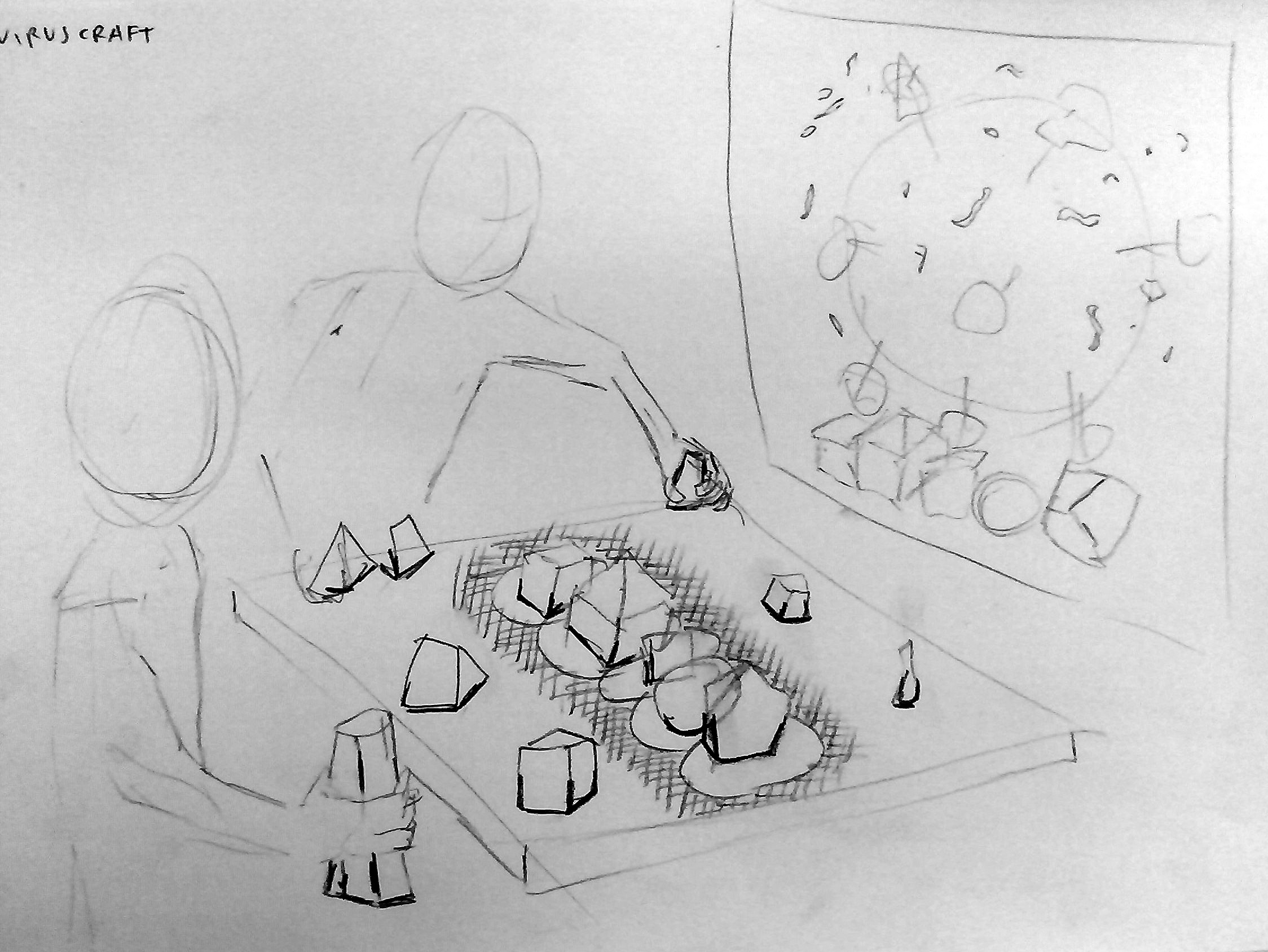
In this project we ask - what determines the ability of a virus to infect some hosts but not others? Working with evolutionary biologist Ben Longdon, we're developing a citizen science project using visual programming, craft, tangible interfaces and games to explore virus host shifts – where a virus jumps from one host species to another.
aims
These are ones that can be tweaked & need to be checked:
Currently a probability curve between 0 (totally immune) and 1 (certain to get infection)
"returns the susceptibility of the host of infection to the supplied virus susceptibility will range from 0..1 with 0 being completely immune pow give us a slope so that 1 is always 1 but we reduce the likelyhood with fewer receptors - not science"
The point here is to make the successful strategy one of continual mutation. In order for this to work, we need to construct a tradeoff so that viruses with one or two of each type of ligands are not very good. Specialist viruses should generally be successful to infect.
| Qty | Value | Footprint | References |
|---|---|---|---|
| 19 | R | Resistors_THT:R_Axial_DIN0207_L6.3mm_D2.5mm_P10.16mm_Horizontal | R1, R2, R3, R4, R5, R6, R10, R11, R12, R13, R14, R15, R16, R17, R18, R19 +3 |
| 16 | Conn_01x06 | Pin_Headers:Pin_Header_Straight_1x06_Pitch2.54mm | J2, J3, J4, J5, J6, J7, J8, J9, J10, J11, J12, J13, J14, J15, J16, J17 |
| 3 | 74HC4067 | Housings_DIP:DIP-24_W15.24mm_Socket | D1, D2, D3 |
| 1 | Conn_01x09 | Pin_Headers:Pin_Header_Straight_1x09_Pitch2.54mm | J1 |
fo-am/viruscraft
A citizen science project using visual programming, craft, tangible interfaces and games to explore virus host shifts – where a virus jumps from one host species to another.

fo-am/viruscraft
A citizen science project using visual programming, craft, tangible interfaces and games to explore virus host shifts – where a virus jumps from one host species to another.

fo-am/viruscraft
A citizen science project using visual programming, craft, tangible interfaces and games to explore virus host shifts – where a virus jumps from one host species to another.

fo-am/viruscraft
A citizen science project using visual programming, craft, tangible interfaces and games to explore virus host shifts – where a virus jumps from one host species to another.

fo-am/viruscraft
A citizen science project using visual programming, craft, tangible interfaces and games to explore virus host shifts – where a virus jumps from one host species to another.

fo-am/viruscraft
A citizen science project using visual programming, craft, tangible interfaces and games to explore virus host shifts – where a virus jumps from one host species to another.

shanteacontrols/OpenDeck
A platform for building interactive control and sensing devices using MIDI and OSC built with Zephyr RTOS.


joshjetson/phosphor
A full fledged DAW in TUI and GUI flavors: Run it in the terminal or run it as a desktop app (Desktop App Coming Soon..maybe)


alientanya/line-follower-PCB
A modular PCB platform for Fast Line Follower (FLF) robots, designed to prioritize sensor experimentation and component flexibility.

DanielHeEGG/Nixie-Controller-v2
Second generation universal nixie clock controller

chickadee-tech/g-test-top
Generic Test Jig Top for testing Polystack boards

CptEdward-MP/RM_Electronics_Central_Library
Over time, every team also writes the same firmware again.
39 parts, built around the 74HC4067D. The full list of its parts is on this page, with links to each part's symbol and footprint where PCBKit's library has them.
From the fo-am/viruscraft repository on GitHub, at the commit this page was made from: the board is hardware/capsid-mult/capsid-mult.kicad_pcb. PCBKit opens the board in the browser, with nothing to install.
Its repository publishes it under the AGPL-3.0 licence: you may reuse it on that licence's terms (keep the author's notice, and for a copyleft licence share your changes alike).