
2 layers
Capsid mult
fo-am/viruscraft
A citizen science project using visual programming, craft, tangible interfaces and games to explore virus host shifts – where a virus jumps from one host species to another.
39 parts3AGPL-3.0

 fo-am/viruscraft3
A citizen science project using visual programming, craft, tangible interfaces and games to explore virus host shifts – where a virus jumps from one host species to another.
Tricomp is an open-source printed circuit board by fo-am, from the fo-am/viruscraft repository on GitHub, published under the AGPL-3.0 licence. It is a 2-layer board with 30 parts on 25 nets, routed with 179 tracks and 71 vias.
It is built around the ATMEGA328P-PU. Its parts include 19 resistors, 6 connectors, 3 capacitors, 1 IC and 1 crystal. It belongs with the interfaces and adapters boards and the AVR (ATmega, ATtiny) boards of this library.
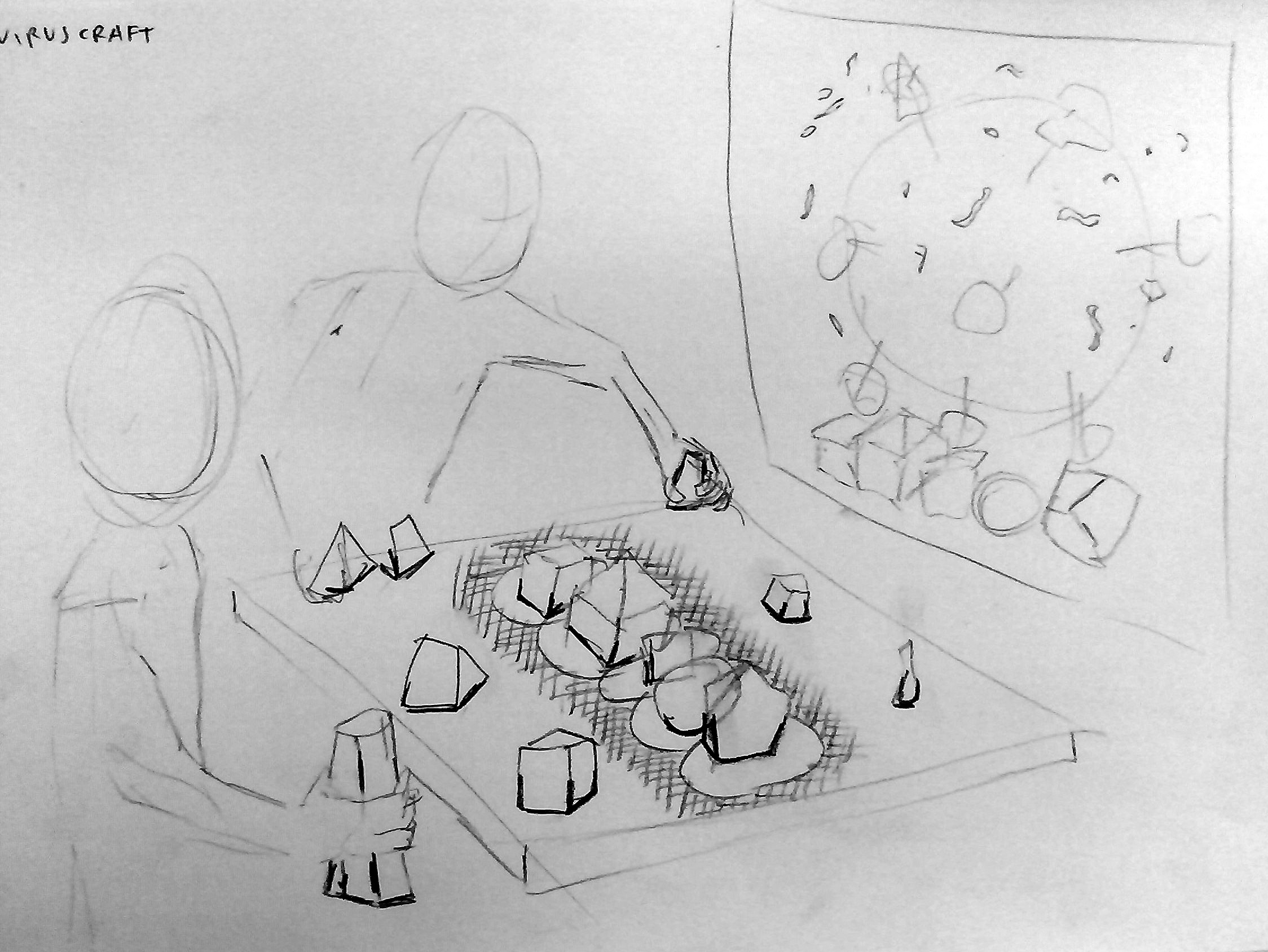
In this project we ask - what determines the ability of a virus to infect some hosts but not others? Working with evolutionary biologist Ben Longdon, we're developing a citizen science project using visual programming, craft, tangible interfaces and games to explore virus host shifts – where a virus jumps from one host species to another.
aims
These are ones that can be tweaked & need to be checked:
Currently a probability curve between 0 (totally immune) and 1 (certain to get infection)
"returns the susceptibility of the host of infection to the supplied virus susceptibility will range from 0..1 with 0 being completely immune pow give us a slope so that 1 is always 1 but we reduce the likelyhood with fewer receptors - not science"
The point here is to make the successful strategy one of continual mutation. In order for this to work, we need to construct a tradeoff so that viruses with one or two of each type of ligands are not very good. Specialist viruses should generally be successful to infect.
| Qty | Value | Footprint | References |
|---|---|---|---|
| 19 | R | Resistors_THT:R_Axial_DIN0204_L3.6mm_D1.6mm_P7.62mm_Horizontal | R1, R2, R3, R4, R5, R6, R10, R11, R12, R13, R14, R15, R16, R17, R18, R19 +3 |
| 4 | Conn_01x05 | Pin_Headers:Pin_Header_Straight_1x05_Pitch2.54mm | J3, J4, J5, J6 |
| 3 | C | Capacitors_THT:C_Axial_L3.8mm_D2.6mm_P7.50mm_Horizontal | C1, C2, C3 |
| 1 | ATMEGA328P-PU | Housings_DIP:DIP-28_W7.62mm | U1 |
| 1 | Crystal | Connectors_Terminal_Blocks:TerminalBlock_bornier-2_P5.08mm | Y1 |
| 1 | ISP | Pin_Headers:Pin_Header_Straight_2x03_Pitch2.54mm | J1 |
| 1 | Power/i2c | Pin_Headers:Pin_Header_Straight_1x04_Pitch2.54mm | J2 |
fo-am/viruscraft
A citizen science project using visual programming, craft, tangible interfaces and games to explore virus host shifts – where a virus jumps from one host species to another.

fo-am/viruscraft
A citizen science project using visual programming, craft, tangible interfaces and games to explore virus host shifts – where a virus jumps from one host species to another.

fo-am/viruscraft
A citizen science project using visual programming, craft, tangible interfaces and games to explore virus host shifts – where a virus jumps from one host species to another.

fo-am/viruscraft
A citizen science project using visual programming, craft, tangible interfaces and games to explore virus host shifts – where a virus jumps from one host species to another.

fo-am/viruscraft
A citizen science project using visual programming, craft, tangible interfaces and games to explore virus host shifts – where a virus jumps from one host species to another.

fo-am/viruscraft
A citizen science project using visual programming, craft, tangible interfaces and games to explore virus host shifts – where a virus jumps from one host species to another.

zmaker/arduino_cookbook
gli sketch del nuovo progetto Arduino Cookbook e dei video di YouTube

coseyfannitutti/discipad
17-key numpad assembled with only through hole components, including usb type-c

matthewcieplak/super-sixteen
Code and schematics for the Super Sixteen Eurorack sequencer

coseyfannitutti/romeo
Staggered 40% keyboard pcb that can be assembled with only through hole components, including USB Type-C

mattybrad/drumkid
Version 4 was the first successful working design, with full code, schematics, Gerbers, etc available on GitHub.


leomil72/LM80C
A Z80-based homebrew computer withTMS9918, AY-3-8910, Z80 CTC, Z80 PIO, and Z80 SIO

30 parts, built around the ATMEGA328P-PU. The full list of its parts is on this page, with links to each part's symbol and footprint where PCBKit's library has them.
From the fo-am/viruscraft repository on GitHub, at the commit this page was made from: the board is hardware/tricomp/tricomp.kicad_pcb. PCBKit opens the board in the browser, with nothing to install.
Its repository publishes it under the AGPL-3.0 licence: you may reuse it on that licence's terms (keep the author's notice, and for a copyleft licence share your changes alike).