2 layers30 × 122 mm
 flurples/campus41
mechanical keyboard conversion for a framework 13
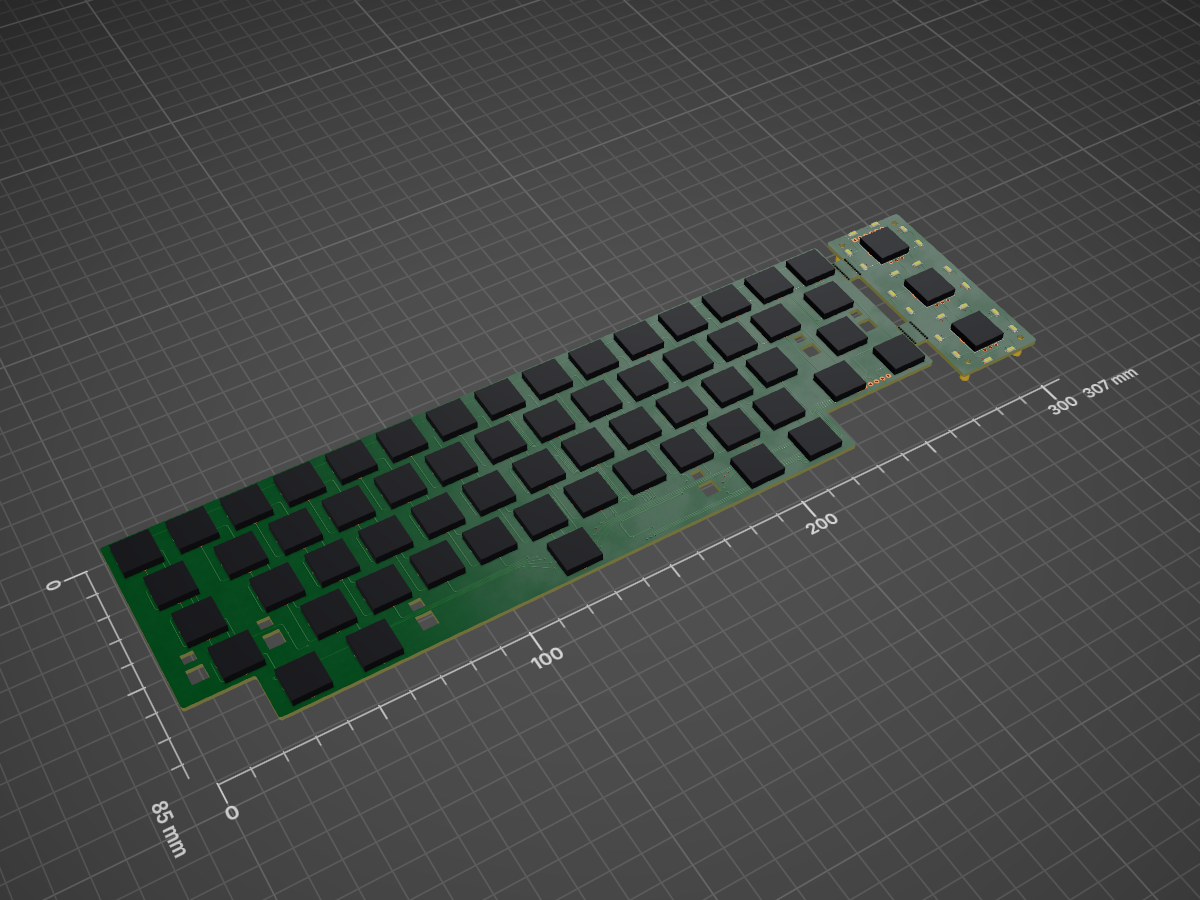
Campus keyboard is an open-source printed circuit board by flurples, from the flurples/campus repository on GitHub, published under the GPL-3.0 licence. It is a 2-layer board of 307 × 85 mm with 293 parts on 180 nets, routed with 1,395 tracks and 135 vias.
It is built around the ATMEGA32U4-MU and SI2302. Its parts include 86 resistors, 80 diodes, 7 capacitors, 1 IC and 1 transistor. It belongs with the keyboards and input boards and the AVR (ATmega, ATtiny) boards of this library.


mechanical keyboard conversion for a framework 13
campus is designed to be a drop-in replacement housing for a framework 13 that features a hhkb layout kailh choc mechanical keyboard.
bottom chassis, input cover, lid, knobs, and plate were cnc'd from aluminum. all 3d printed parts were printed in petg to avoid breaking down over the years. heat set inserts for screw holes to mount factory components are installed into the bottom-brackets, which are then epoxied to the bottom-chassis. due to jlcpcb's minimum thickness requirements, the input and lid do not use heat set inserts. instead, the aluminum is directly tapped.
the usb hub was too complex and I wasn't able to get it working. because the keyboard was originally meant to connect internally through the usb hub, I ended up simply bypassing the usb hub entirely, bypassing it with a unified daughterboard s1. in case anyone wants to attempt to diagnose why, I've uploaded the kicad files as is for reference.
campus is a highly involved project and will require completely tearing down your framework laptop and transplanting all the components into an objectively worse-designed chassis than the factory framework chassis. some features will be lost, for example, the privacy switches built into the webcam module, or the little buttons that lock the expansion cards in place. I am not a professional electronics designer, so expect to perform some janky workarounds to get the laptop functioning as it should. I am not responsible for any issues you may encounter with the build, so please use the files with caution.
I do not sell any products, and I am not affiliated with any vendors who claim to sell my designs. if you choose to support these vendors, I am not responsible for any issues you may encounter with them.
| Qty | Value | Footprint | References |
|---|---|---|---|
| 81 | 470 | campus-parts:R_0805_2012Metric-CenterREF__ | R1, R2, R10, R11, R12, R13, R14, R15, R16, R17, R18, R19, R20, R21, R22, R23 +65 |
| 60 | SOD-123 | campus-parts:D_SOD-123-CenterREF__ | D1, D2, D10, D11, D12, D13, D14, D15, D16, D17, D18, D19, D20, D21, D22, D23 +44 |
| 49 | MX-LED | mbk:Choc-1u-GW | MX1, MX2, MX10, MX11, MX12, MX13, MX14, MX15, MX17, MX18, MX19, MX20, MX21, MX22, MX23, MX24 +33 |
| 40 | , , , , , , , , , , , , , , , +24 | ||
| 20 | 2815 | campus-parts:GW JCLPS2.EM | D61, D62, D63, D64, D65, D66, D67, D68, D69, D70, D71, D72, D73, D74, D75, D76 +4 |
| 4 | MX-LED | mbk:Choc-1.25u-GW | MX56, MX57, MX59, MX60 |
| 3 | 0.1uF | Capacitor_SMD:C_0805_2012Metric | C4, C5, C6 |
| 3 | 10k | campus-parts:R_0805_2012Metric-CenterREF__ | R82, R83, R86 |
| 3 | RotaryEncoder | campus-parts:SW3_EC12E1220301_ALPS | EC1, EC2, EC3 |
| 2 | 22 | campus-parts:R_0805_2012Metric-CenterREF__ | R84, R85 |
| 2 | 22pF | Capacitor_SMD:C_0805_2012Metric | C1, C2 |
| 2 | MX-LED | mbk:Choc-1.5u-GW | MX16, MX29 |
| 2 | MX-LED | mbk:Choc-2.25u-GW | MX42, MX43 |
| 2 | MX-LED | mbk:Choc-1.75u-GW | MX30, MX54 |
| 1 | 10uF | Capacitor_SMD:C_0805_2012Metric | C7 |
| 1 | 16MHz | Crystal:Crystal_SMD_3225-4Pin_3.2x2.5mm | Y1 |
| 1 | 1uF | Capacitor_SMD:C_0805_2012Metric | C3 |
| 1 | 500mA | Fuse:Fuse_1206_3216Metric | F1 |
| 1 | ATmega32U4-MU | Package_DFN_QFN:QFN-44-1EP_7x7mm_P0.5mm_EP5.2x5.2mm | U1 |
| 1 | Conn_01x04 | Connector_Molex:Molex_Pico-EZmate_78171-0004_1x04-1MP_P1.20mm_Vertical | J1 |
| 1 | LOGO | campus-parts:campus-3mm | G*** |
| 1 | MX-LED | mbk:Choc-6.25u-GW | MX58 |
| 1 | SI2302 | Package_TO_SOT_SMD:SOT-23 | Q1 |
| 1 | SW_Push | random-keyboard-parts:SKQG-1155865 | SW1 |
The 283 most common of 293 parts.

giant-axon/lu.i-neuron-pcb
Lu.i is an electronic neuron circuit mimicking and illustrating the basic dynamics of real, biological neurons. The printed circuit board (PCB) features a configurable, fully analog implementation of the leaky…

john0312/hitcon-pcb-badge
execute fw/merge.py to merge STM32CubeIDE generated main.c with user code in main.cc into main.cc.

adlerweb/uPoff
Small circuit/library to shut down a µC to save power for battery powered applications


bezmi/orthrus
56 key wireless split keyboard running on QMK. Staggered Orthogonal layout

PacketChat/MonkeyBadge
This repository contains the hardware design files, badge code, and backend infrastructure code for the HushCon Winter 2023 badge.

tufourn/corne-choc-xiao
Corne keyboard with XIAO BLE microcontroller and LIR2032 support
It measures 307 × 85 mm and has 2 copper layers, 1.6 mm thick.
293 parts, built around the ATMEGA32U4-MU and SI2302. The full list of its parts is on this page, with links to each part's symbol and footprint where PCBKit's library has them.
From the flurples/campus repository on GitHub, at the commit this page was made from: the board is pcb/campus-keyboard/campus-keyboard.kicad_pcb and its schematic pcb/campus-hub/campus-hub.kicad_sch. PCBKit opens the board in the browser, with nothing to install.
Its repository publishes it under the GPL-3.0 licence: you may reuse it on that licence's terms (keep the author's notice, and for a copyleft licence share your changes alike).