
4 layers100 × 50 mm
Pcm5102a mux board
cbaurtx/RetroBox
RetroBox is an internet radio using an ESP32-S3 system on a chip
86 parts

Arduino Controlled 16-Step Sequencer
Seq2 is an open-source printed circuit board by Fihdi, from the Fihdi/16Sequencer repository on GitHub. It is a 2-layer board of 239.6 × 235.2 mm with 260 parts on 147 nets, routed with 1,036 tracks and 136 vias.
It is built around the TL072, TCA9555PWR(UMW) and L7805, with the BC547 among its other parts. Its parts include 59 diodes, 55 resistors, 22 switches, 16 connectors and 4 ICs. It belongs with the audio and music boards and the AVR (ATmega, ATtiny) boards of this library.


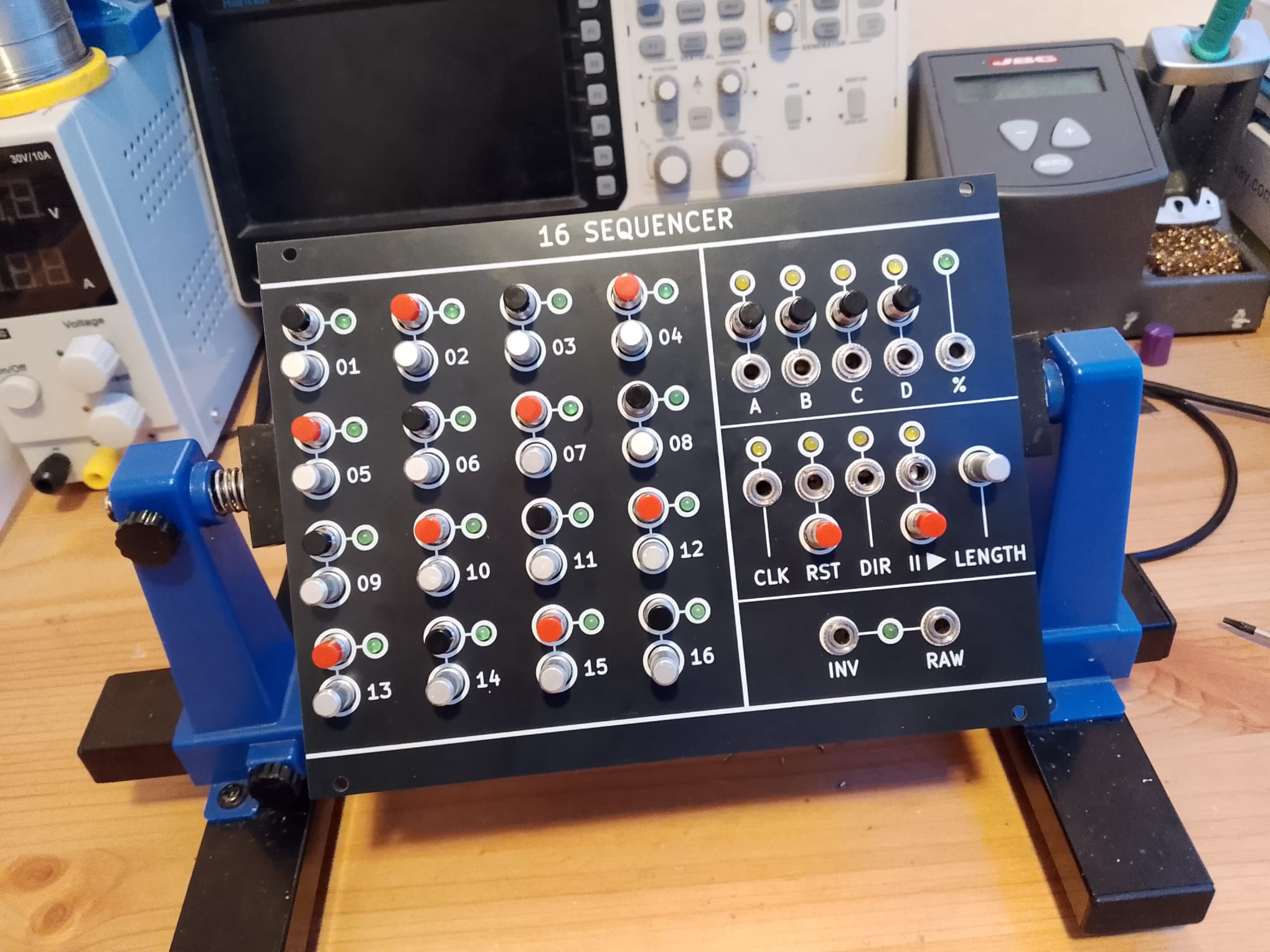
A 16-Step sequencer with individual CV knobs and 4 programmable gate outputs, including a probability gate output. Input gates can control the Clock, Reset, Direction and Pause/Play.
To program a gate channel, hold down the channel button (A through D) and select or deselect the steps are active.
The functionality is similar to the famous "Baby 8" sequencers but instead of a CD4017, a TCA9555 IO-expander sends 5 or 0V to the potentiometers, which are then summed together. Another TCA9555 is used for the LEDs and push-buttons, both of which are set up in a 4x4 Matrix, allowing both of them to be handled by a single expander.
ToDo:
Individual gate channel lengths: The length of every gate channel should be set individually with the LENGTH knob. Turning the LENGTH knob while holding down a channel button will change the length of that gate channel. Turning the LENGTH knob on its own only changes the length of the CV channel.
Ratcheting: Pushing on a step button multiple times should allow for re-triggering (2, 4 or 8 times that of the CLK signal)
| Qty | Value | Footprint | References |
|---|---|---|---|
| 33 | D | Diode_SMD:D_1206_3216Metric | D1, D2, D3, D4, D10, D11, D12, D13, D30, D34, D35, D36, D37, D43, D44, D45 +17 |
| 26 | LED | LED_THT:LED_D3.0mm | D14, D15, D16, D17, D18, D19, D20, D21, D22, D23, D24, D25, D26, D27, D28, D29 +10 |
| 22 | SW_Push | Library:PushButton | SW1, SW2, SW3, SW10, SW11, SW12, SW13, SW14, SW15, SW16, SW17, SW18, SW19, SW20, SW21, SW22 +6 |
| 19 | 100k | Resistor_SMD:R_1206_3216Metric | R11, R17, R19, R20, R26, R27, R28, R31, R32, R33, R34, R35, R36, R37, R38, R39 +3 |
| 18 | R | Resistor_SMD:R_1206_3216Metric | R3, R4, R5, R7, R10, R16, R18, R21, R22, R23, R24, R60, R61, R62, R63, R64 +2 |
| 14 | R_Potentiometer | Potentiometer_THT:Potentiometer_Alpha_RD901F-40-00D_Single_Vertical_CircularHoles | RV2, RV3, RV4, RV5, RV6, RV9, RV10, RV11, RV12, RV13, RV14, RV15, RV16, RV17 |
| 11 | AudioJack2 | Library:3mm5 Mono Aux | J1, J2, J3, J4, J5, J6, J7, J8, J9, J10, J11 |
| 8 | 1k | Resistor_SMD:R_1206_3216Metric | R1, R2, R13, R25, R44, R48, R49, R65 |
| 6 | 10k | Resistor_SMD:R_1206_3216Metric | R6, R12, R43, R45, R46, R47 |
| 4 | BC547 | Package_TO_SOT_THT:TO-92L_Inline_Wide | Q1, Q2, Q3, Q4 |
| 2 | 47k | Resistor_SMD:R_1206_3216Metric | R29, R30 |
| 2 | 4k7 | Resistor_SMD:R_1206_3216Metric | R14, R15 |
| 2 | C | Capacitor_THT:C_Rect_L7.0mm_W3.5mm_P5.00mm | C1, C2 |
| 2 | Conn_01x10_Pin | Connector_PinHeader_2.54mm:PinHeader_1x10_P2.54mm_Vertical | J14, J16 |
| 2 | Conn_01x11_Pin | Connector_PinHeader_2.54mm:PinHeader_1x11_P2.54mm_Vertical | J13, J17 |
| 2 | R_Potentiometer | Library:Alpha_RD901_NoMountPins | RV7, RV8 |
| 2 | TCA9555PWR | Package_SO:SSOP-24_5.3x8.2mm_P0.65mm | U5, U6 |
| 1 | 100k | Potentiometer_THT:Potentiometer_Alpha_RD901F-40-00D_Single_Vertical_CircularHoles | RV1 |
| 1 | Arduino_Nano_Every | Module:Arduino_Nano | A1 |
| 1 | Conn_02x05_Odd_Even | Connector_PinHeader_2.54mm:PinHeader_2x05_P2.54mm_Vertical | J12 |
| 1 | L7805 | Package_TO_SOT_SMD:TO-252-3_TabPin2 | U2 |
| 1 | TL072 | Package_DIP:DIP-8_W7.62mm | U3 |
The 180 most common of 260 parts.
It measures 239.6 × 235.2 mm and has 2 copper layers, 1.6 mm thick.
260 parts, built around the TL072, TCA9555PWR(UMW), L7805 and BC547. The full list of its parts is on this page, with links to each part's symbol and footprint where PCBKit's library has them.
From the Fihdi/16Sequencer repository on GitHub, at the commit this page was made from: the board is Seq2.kicad_pcb and its schematic Controls.kicad_sch. PCBKit opens the board in the browser, with nothing to install.
Its repository states no licence, so its author keeps all rights: ask Fihdi before reusing the design.
cbaurtx/RetroBox
RetroBox is an internet radio using an ESP32-S3 system on a chip


EchelonForce/vclfo10
A Eurorack LFO design based on the Electric Druid VCLFO10 chip.

EchelonForce/lfo_stomp
A design for a Eurorack LFO module based on the ElectricDruid STOMPLFO chip.


fledsbo/Modules
Eurorack module designs using KiCad — VCO, VCF, VCA, ADSR, and Daisy Seed