

2 layers44 × 55 mm
RTC GL
farzad-moradkhani/GreenLink
Green Link is an open-source, autonomous IoT irrigation system designed for efficient garden and plant watering.
12 partsMIT

Green Link is an open-source, autonomous IoT irrigation system designed for efficient garden and plant watering. It features a robust ESP32-based hardware controller with two independent watering channels and a modern Android application built with Jetpack Compose for remote monitoring and control.
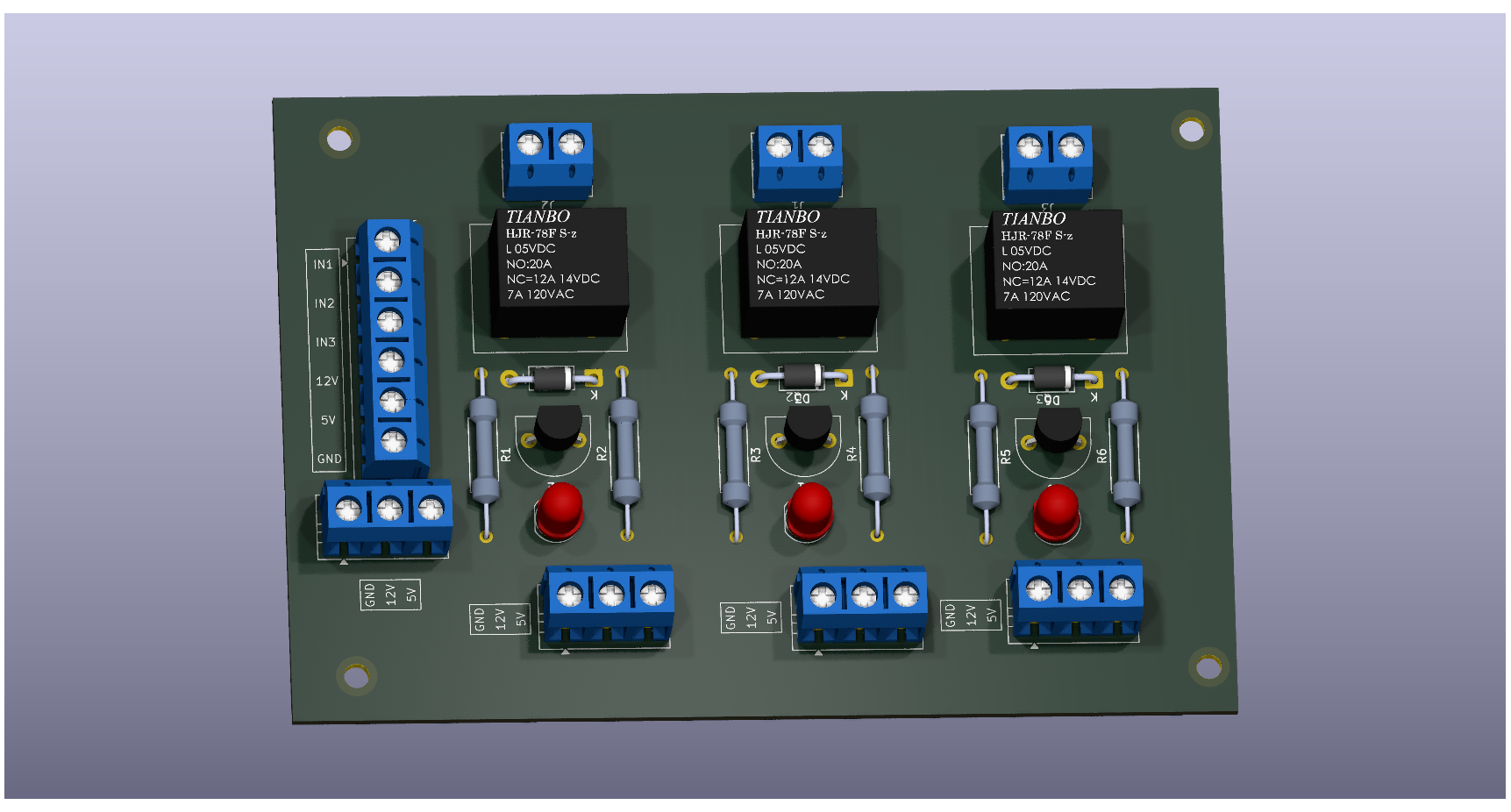
MC GL is an open-source printed circuit board by farzad-moradkhani, from the farzad-moradkhani/GreenLink repository on GitHub, published under the MIT licence. It is a 2-layer board of 77.7 × 114 mm with 26 parts on 21 nets, routed with 230 tracks and 4 vias.
Its parts include 8 connectors, 6 resistors, 6 diodes, 3 ICs and 3 transistors. It belongs with the home automation and IoT boards of this library.
Smart Dual-Zone IoT Garden Watering System


Designed Motor Channel module and also added it's 3D components
/firmware – ESP32 source code/android – Jetpack Compose Android app/hardware – Schematics, BOM, and 3D models/docs – Detailed documentation and API specificationfirmware folder in PlatformIOconfig.handroid folder in Android StudioDetailed setup instructions are available in the docs folder.
(Add screenshots here: Dashboard, Schedule screen, Manual control, Hardware photo)
This project showcases full-stack IoT development skills, including embedded systems programming, hardware integration, sensor-actuator control, and modern mobile application development. It is built with clean code, modularity, and reliability in mind.
Ideal for learning or as a practical demonstration of embedded + mobile engineering capabilities.
This project is licensed under the MIT License – see the LICENSE file for details.
Contributions are welcome! Please read CONTRIBUTING.md for guidelines.
Made with ❤️ by farzad for efficient and sustainable gardening.
Project developed as a complete IoT solution for portfolio and learning purposes.
| Qty | Value | Footprint | References |
|---|---|---|---|
| 4 | Screw_Terminal_01x03 | TerminalBlock:TerminalBlock_MaiXu_MX126-5.0-03P_1x03_P5.00mm | J4, J6, J7, J8 |
| 3 | 12v | Relays:HJR-3FF-S-Z | U1, U2, U3 |
| 3 | 1K | Resistor_THT:R_Axial_DIN0309_L9.0mm_D3.2mm_P20.32mm_Horizontal | R2, R4, R6 |
| 3 | 1N4002 | Diode_THT:D_DO-41_SOD81_P10.16mm_Horizontal | D3, D4, D6 |
| 3 | 4.7K | Resistor_THT:R_Axial_DIN0309_L9.0mm_D3.2mm_P20.32mm_Horizontal | R1, R3, R5 |
| 3 | LED | LED_THT:LED_D5.0mm | D1, D2, D5 |
| 3 | NPN | Transistors_BJT:2N2222 | Q1, Q2, Q3 |
| 3 | S_T_01x02 | TerminalBlock:TerminalBlock_MaiXu_MX126-5.0-02P_1x02_P5.00mm | J1, J2, J3 |
| 1 | Screw_Terminal_01x06 | TerminalBlock:TerminalBlock_MaiXu_MX126-5.0-06P_1x06_P5.00mm | J5 |
farzad-moradkhani/GreenLink
Green Link is an open-source, autonomous IoT irrigation system designed for efficient garden and plant watering.


hackclub/OnBoard
💡 Join 1,000 teenagers and make your first PCB with a $100 grant!


harbaum/galagino
A Galaga, Pac-Man and Donkey Kong arcade emulator for the ESP32

Luos-io/luos_engine
Open-source and real-time orchestrator for cyber-physical-systems, to easily design, test and deploy embedded applications and digital twins.

google/walt
A device for measuring latency of physical sensors and outputs on phones and computers

It measures 77.7 × 114 mm and has 2 copper layers, 1.6 mm thick.
26 parts. The full list of its parts is on this page, with links to each part's symbol and footprint where PCBKit's library has them.
From the farzad-moradkhani/GreenLink repository on GitHub, at the commit this page was made from: the board is hardware/PCB/Motor Channel Module/MC_GL/MC_GL.kicad_pcb and its schematic hardware/PCB/Motor Channel Module/MC_GL/MC_GL.kicad_sch. PCBKit opens the board in the browser, with nothing to install.
Its repository publishes it under the MIT licence: you may reuse it on that licence's terms (keep the author's notice, and for a copyleft licence share your changes alike).