
4 layers81.7 × 100.6 mm
Final Project PCB
ndesserich/ECE-36200-Final-Project-PCB
A PCB that integrates an RP2350 and various peripherals to play games.
80 parts1

Chromatone is an embedded audio visualizer running on the Raspberry Pi RP2350. It samples audio through the ADC, performs a real-time FFT, detects musical notes, and drives an RGB LED output based on the results.
Proton is an open-source printed circuit board by ewyrick-mark-1, from the ewyrick-mark-1/Chromatone repository on GitHub. It is a 4-layer board of 20.3 × 99.1 mm with 119 parts on 155 nets, routed with 1,215 tracks and 142 vias.
It is built around the RP2040, SN74AUP1T17DCKR-TP and W25Q128JVSIQ, with the USBLC6-2P6, AP2112K-3.3 and ABM8-272-T3 among its other parts. Its parts include 42 capacitors, 35 resistors, 10 ICs, 7 connectors and 5 diodes. It belongs with the RP2040 and RP2350 boards of this library.


Author: Elliot Wyrick
Chromatone is an embedded audio visualizer running on the Raspberry Pi RP2350. It samples audio through the ADC, performs a real-time FFT, detects musical notes, and drives an RGB LED output based on the results.
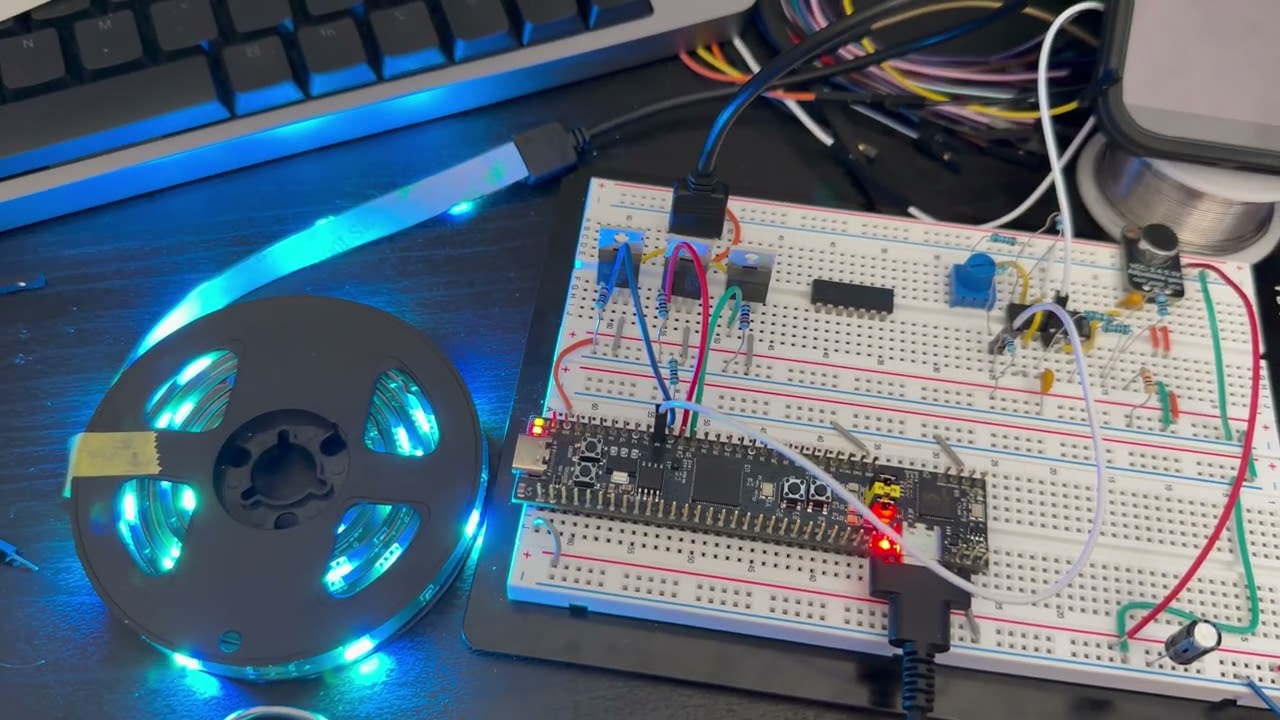
KiCad/Audio is captured at 20 kHz using DMA ping-pong buffers. Each buffer triggers a 16384 point FFT with 50% overlap and a Hanning window applied. Detected frequency peaks are mapped to MIDI notes (A0–C8), and the corresponding hue is output to the RGB LED.
Two display modes are available (toggled via display_mode in main.c):
Each of the 12 chromatic notes is assigned a fixed hue evenly spaced around the color wheel (360° / 12 = 30° per note), with C at 0° (red) through B at 330° (pink).
Detected peaks are converted to a note index using the standard MIDI formula:
n = 12 × log₂(f / 440) + 69When multiple notes are detected simultaneously, their hues are blended using a circular weighted average- each hue is converted to a unit vector on the color wheel, weighted by FFT magnitude, and the vectors are summed:
x = Σ( cos(hue_i) × weight_i )
y = Σ( sin(hue_i) × weight_i )
blended_hue = atan2(y, x)
This handles wraparound correctly (e.g. blending 10° and 350° yields 0°, not 180°).
The blended hue is then smoothed over time using an exponential moving average on the shortest angular path (15% per frame) to avoid jarring color jumps between notes.
Finally, the smoothed hue is converted from HSV (full saturation and brightness) to RGB via the standard piecewise HSV→RGB formula and output as an 8-bit PWM duty cycle on each channel.
This project uses PlatformIO with the Proton board target.
pio run
pio run --target upload
Serial monitor at 115200 baud:
pio device monitorAlternativly, and what I used during development, the platform IO extension works well. It provides gui upload and monitor buttons.
| Qty | Value | Footprint | References |
|---|---|---|---|
| 26 | 100n | Capacitor_SMD:C_0402_1005Metric | C3, C11, C13, C14, C15, C16, C17, C18, C19, C20, C21, C22, C23, C28, C29, C30 +10 |
| 9 | 1k | Resistor_SMD:R_0402_1005Metric | R3, R4, R7, R8, R12, R14, R15, R17, R20 |
| 6 | 100 | Resistor_SMD:R_0402_1005Metric | R24, R25, R26, R27, R28, R29 |
| 5 | 5.1k | Resistor_SMD:R_0402_1005Metric | R1, R2, R6, R18, R19 |
| 4 | 10u | Capacitor_SMD:C_0805_2012Metric | C4, C7, C12, C26 |
| 4 | 15p | Capacitor_SMD:C_0402_1005Metric | C1, C2, C24, C25 |
| 4 | 27 | Resistor_SMD:R_0402_1005Metric | R9, R10, R21, R22 |
| 3 | 2k | Resistor_SMD:R_0402_1005Metric | R13, R30, R32 |
| 3 | 470 | Resistor_SMD:R_0402_1005Metric | R23, R31, R33 |
| 3 | LOGO | LOGO | G***, G***, G*** |
| 2 | 10k | Resistor_SMD:R_0402_1005Metric | R34, R35 |
| 2 | 10u | Capacitor_SMD:C_0603_1608Metric | C27, C32 |
| 2 | 1u | Capacitor_SMD:C_0402_1005Metric | C31, C34 |
| 2 | 4.7u | Capacitor_SMD:C_0402_1005Metric | C9, C10 |
| 2 | 4.7u | RP2350_80QFN_minimal:C_0402_1005Metric_small_pads | C5, C6 |
| 2 | ABM8-272-T3 | Crystal:Crystal_SMD_3225-4Pin_3.2x2.5mm | Y1, Y2 |
| 2 | BAT60JFILM | BAT60JFILM:CR_60JFILM_STM | CR1, CR2 |
| 2 | Conn_01x28_Pin | Connector_PinHeader_2.54mm:PinHeader_1x28_P2.54mm_Vertical | J2, J4 |
| 2 | GREEN | Diode_SMD:D_0402_1005Metric | D2, D4 |
| 2 | GREEN | LED_SMD:LED_0805_2012Metric | PD2, UD3 |
| 2 | RED | LED_SMD:LED_0805_2012Metric | PD1, UD1 |
| 2 | SN74AUP1T17DCKR | SN74AUP1T17DCKR:DCK5 | U7, U8 |
| 2 | USBLC6-2P6 | Package_TO_SOT_SMD:SOT-666 | U9, U10 |
| 2 | USB_C_Receptacle_USB2.0_14P | Connector_USB:USB_C_Receptacle_G-Switch_GT-USB-7010ASV | J1, J5 |
| 2 | YELLOW | Diode_SMD:D_0402_1005Metric | D3, D5 |
| 1 | 3.3u | RP2350_80QFN_minimal:L_pol_2016 | L1 |
| 1 | 33 | Resistor_SMD:R_0402_1005Metric | R5 |
| 1 | 3k | Resistor_SMD:R_0402_1005Metric | R11 |
| 1 | 510 | Resistor_SMD:R_0402_1005Metric | R16 |
| 1 | AP2112K-3.3 | Package_TO_SOT_SMD:SOT-23-5 | U5 |
| 1 | BLUE | LED_SMD:LED_0805_2012Metric | UD4 |
| 1 | BOOTSEL | Button_Switch_SMD:SW_SPST_PTS647_Sx38 | SW1 |
| 1 | Conn_02x03_Top_Bottom | Connector_PinSocket_2.54mm:PinSocket_2x03_P2.54mm_Vertical | J6 |
| 1 | DebugnBoot | Connector_PinHeader_2.54mm:PinHeader_1x04_P2.54mm_Vertical | J3 |
| 1 | LEFT | Button_Switch_SMD:SW_SPST_PTS647_Sx38 | SW3 |
| 1 | LOGO | logos:purdue-small | G*** |
| 1 | LOGO | logos:362-small | G*** |
| 1 | NCP1117-3.3_SOT223 | Package_TO_SOT_SMD:SOT-223-3_TabPin2 | U2 |
| 1 | RED | Diode_SMD:D_0402_1005Metric | D1 |
| 1 | RESET | Button_Switch_SMD:SW_SPST_PTS647_Sx38 | SW2 |
| 1 | RIGHT | Button_Switch_SMD:SW_SPST_PTS647_Sx38 | SW4 |
| 1 | RP2040 | DebugProbe:RP2040-QFN-56 | U6 |
| 1 | RP2350_80QFN | RP2350_80QFN_minimal:RP2350-QFN-80-1EP_10x10_P0.4mm_EP3.4x3.4mm_ThermalVias | U3 |
| 1 | UART-PINS | Connector_PinHeader_2.54mm:PinHeader_1x03_P2.54mm_Vertical | J7 |
| 1 | W25Q128JVS | Package_SO:SOIC-8_5.23x5.23mm_P1.27mm | U1 |
| 1 | W25Q16JVUXIQ TR | W25Q16JVUXIQ:USON-8_UX_2x3x0p6_WIN | U4 |
| 1 | YELLOW | LED_SMD:LED_0805_2012Metric | UD2 |
ndesserich/ECE-36200-Final-Project-PCB
A PCB that integrates an RP2350 and various peripherals to play games.

MAGG4444/BT_Audio_Player_PCB
Bluetooth-enabled audio player PCB for wireless audio playback and easy device integration.

PurdueECE-362-SSTV-Project/SSTV-Hardware
This repo contains the SCHEM and PCB files for the SSTV Receiver.

rober708/BIRD-E
The Bounded Infrared Recording Drone Ecosystem (BIRD-E) is a tethered quadcopter with an attached infrared camera, with livestream functionality and XBOX ground control. Senior design capstone at Purdue ECE.


GilDev/GDEK
Low-profile, compact, beginner-friendly, assembly-friendly 4×6 with 5-keys thumb cluster ergonomic keyboard with universal keyswitch support, per-key RGB LED, encoder and RP2040 controller. Phew, that’s a lot!


It measures 20.3 × 99.1 mm and has 4 copper layers, 1.6 mm thick.
119 parts, built around the RP2040, SN74AUP1T17DCKR-TP, W25Q128JVSIQ and USBLC6-2P6. The full list of its parts is on this page, with links to each part's symbol and footprint where PCBKit's library has them.
From the ewyrick-mark-1/Chromatone repository on GitHub, at the commit this page was made from: the board is KiCad/4% possibilities/Proton-KiCAD/Proton.kicad_pcb and its schematic KiCad/4% possibilities/Proton-KiCAD/DebugProbe.kicad_sch. PCBKit opens the board in the browser, with nothing to install.
Its repository states no licence, so its author keeps all rights: ask ewyrick-mark-1 before reusing the design.