2 layers

 eszkadev/nixie-clock
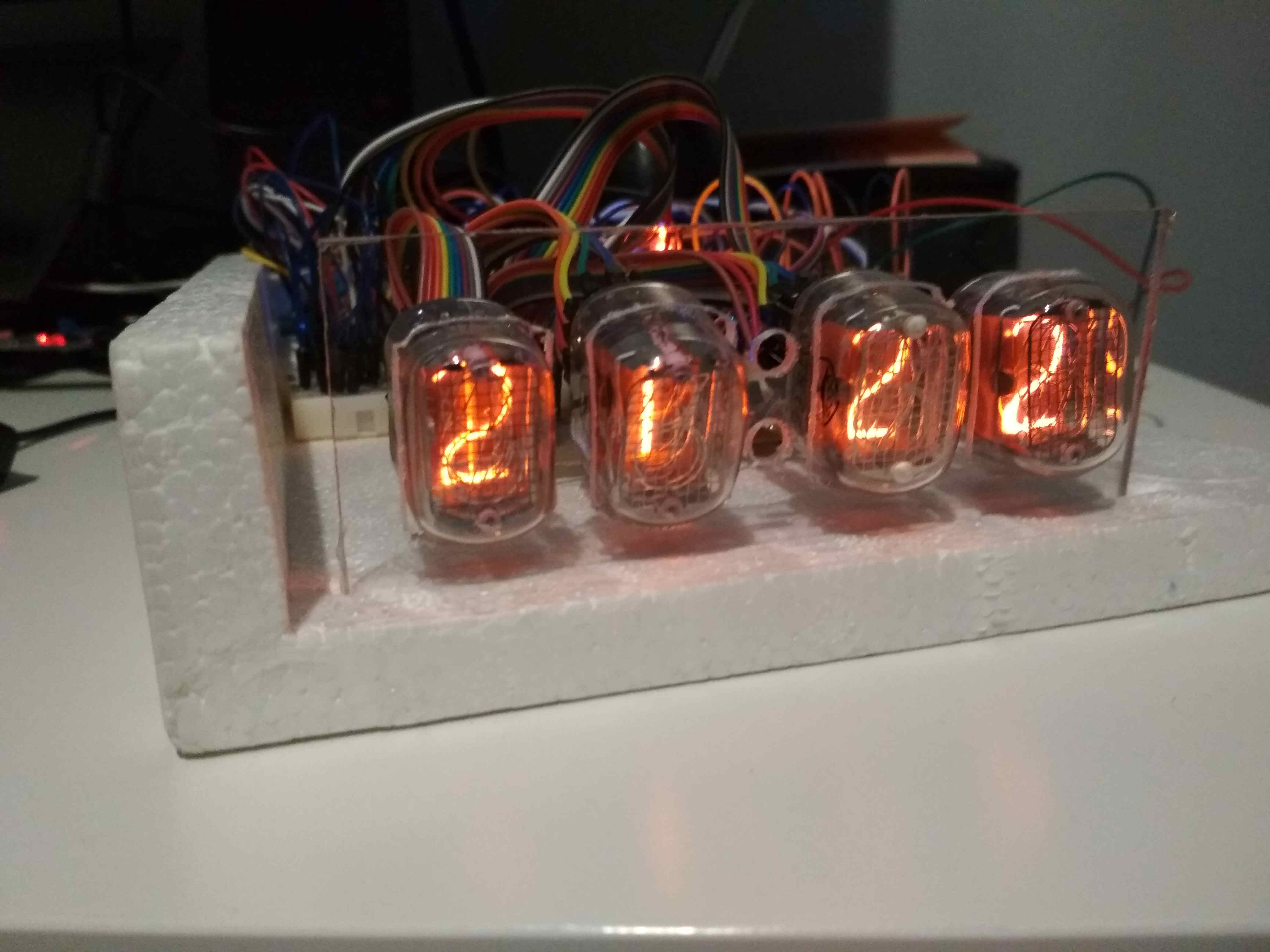
Clock built using nixie tubes and ATmega
Boost converter is an open-source printed circuit board by eszkadev, from the eszkadev/nixie-clock repository on GitHub, published under the MIT licence. It is a 2-layer board of 78.7 × 44.4 mm with 18 parts on 12 nets, routed with 97 tracks and 0 vias.
It is built around the NE555, BC547 and IRF730, with the UF4004 among its other parts. Its parts include 6 resistors, 4 capacitors, 2 transistors, 2 connectors and 1 IC. It belongs with the lEDs and displays and power boards of this library.


| Qty | Value | Footprint | References |
|---|---|---|---|
| 2 | CONN_02X01 | Terminal_Blocks:TerminalBlock_Pheonix_MKDS1.5-2pol | P1, P2 |
| 1 | 100pF | Capacitors_ThroughHole:C_Disc_D3.0mm_W1.6mm_P2.50mm | C2 |
| 1 | 100uH | Choke_Toroid_ThroughHole:Choke_Toroid_horizontal_Diameter7-5mm_Amidon-T25 | L1 |
| 1 | 10k | Resistors_ThroughHole:R_Axial_DIN0309_L9.0mm_D3.2mm_P12.70mm_Horizontal | R5 |
| 1 | 1k | Potentiometers:Potentiometer_Triwood_RM-065 | RV1 |
| 1 | 1k | Resistors_ThroughHole:R_Axial_DIN0309_L9.0mm_D3.2mm_P12.70mm_Horizontal | R4 |
| 1 | 2.2uF | Capacitors_ThroughHole:CP_Radial_D8.0mm_P3.80mm | C1 |
| 1 | 220k | Resistors_ThroughHole:R_Axial_DIN0309_L9.0mm_D3.2mm_P12.70mm_Horizontal | R1 |
| 1 | 2k2 | Resistors_ThroughHole:R_Axial_DIN0309_L9.0mm_D3.2mm_P12.70mm_Horizontal | R3 |
| 1 | 2n2 | Capacitors_ThroughHole:C_Disc_D3.0mm_W1.6mm_P2.50mm | C3 |
| 1 | 330uF | Capacitors_ThroughHole:CP_Radial_D5.0mm_P2.50mm | C4 |
| 1 | 470R | Resistors_ThroughHole:R_Axial_DIN0309_L9.0mm_D3.2mm_P12.70mm_Horizontal | R2 |
| 1 | 56k | Resistors_ThroughHole:R_Axial_DIN0309_L9.0mm_D3.2mm_P12.70mm_Horizontal | R6 |
| 1 | BC547 | TO_SOT_Packages_THT:TO-92_Inline_Wide | Q2 |
| 1 | IRF730 | TO_SOT_Packages_THT:TO-220_Neutral123_Vertical_LargePads | Q1 |
| 1 | NE555 | Housings_DIP:DIP-8_W7.62mm_Socket_LongPads | U1 |
| 1 | UF4004 | Diodes_ThroughHole:D_A-405_P10.16mm_Horizontal | D1 |


LightestDark/Divergence_Meter_Final
04/09/26 Changed Production files to the Multiplexed version, to reduce costs and make tracing much easier

ondras12345/vetrnik
Electronics for heating water with power from a 2 kW wind turbine

It measures 78.7 × 44.4 mm and has 2 copper layers, 1.6 mm thick.
18 parts, built around the NE555, BC547, IRF730 and UF4004. The full list of its parts is on this page, with links to each part's symbol and footprint where PCBKit's library has them.
From the eszkadev/nixie-clock repository on GitHub, at the commit this page was made from: the board is boost-converter/boost-converter.kicad_pcb. PCBKit opens the board in the browser, with nothing to install.
Its repository publishes it under the MIT licence: you may reuse it on that licence's terms (keep the author's notice, and for a copyleft licence share your changes alike).