2 layers197.5 × 17.8 mm
Set board avr
eshazen/nixie-transistor-clock
Documents and files for Nixie Transistor Clock (Kabtronic)
39 parts

 eshazen/nixie-transistor-clock
Documents and files for Nixie Transistor Clock (Kabtronic)
Wwvb board is an open-source printed circuit board by eshazen, from the eshazen/nixie-transistor-clock repository on GitHub. It is a 2-layer board with 2 parts on 34 nets.
It belongs with the lEDs and displays boards and the AVR (ATmega, ATtiny) boards of this library.
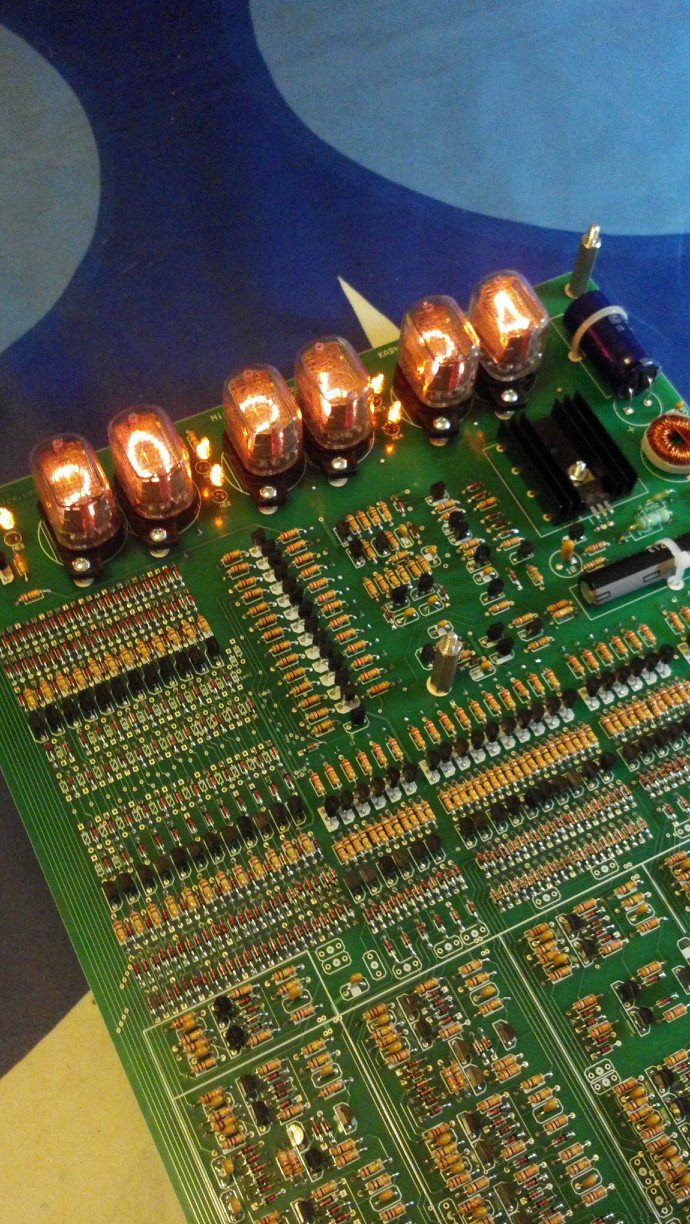
In 2013 I built a clock from a kit purchased here: https://tube-clock.com/
set_board - start of a design to set the time using an ESP32
case - acrylic case design
Some circuit analysis for setting remotely.
Set switches (ref schematic in manual):
SW1 (minutes) - page 8/23 (PDF page 70) SW2 (Hours) - page 10/23 (PDF page 72) SW3 (s hold) - page 2/23 (PDF page 64)
Based on Peter's claim that WWVB reception was ok at Deb's place, purchased a Canaduino Atomic Clock board and 3D printed a little holder for it. It seems to work OK powered by 2xAA batteries in the kitchen. Maybe at night it will work in a window?
Per suggestion in the datasheet, thinking to connect with a shielded
RJ-45 patch cable. Re-do set_board_avr to accommodate the connector,
and remove the 8MHz crystal and WiFi module.
Should probably add a couple of buttons.
Also, maybe need an additional small PCB for the WWVB board with jumpers for LED and power (choose between battery and remote power).
Confirm that ESP-01 works using FTDI at 115200 baud.
Problem is that hardware UART on 8MHz AVR is unreliable.
Downloaded https://github.com/nerdralph/picoUART
Tested on "control panel" PCB with FTDI and seems to work
Starting to write some WiFi test code
Reviving the "set board" project. Thinking of a new design with an ESP-01 serial WiFi module connected to a small AVR (ATTiny85?). This could be much lower power or even fire up once only on power-up to retrieve the time from somewhere.
The main issue may be poor wifi in the kitchen!
ESP-01 doco at: https://nurdspace.nl/ESP8266
| Qty | Value | Footprint | References |
|---|---|---|---|
| 1 | Arduino_Nano_Socket | PCM_arduino-library:Arduino_Nano_Socket | A1 |
| 1 | Conn_01x07 | my_WWV:Canaduino_V4 | J1 |
eshazen/nixie-transistor-clock
Documents and files for Nixie Transistor Clock (Kabtronic)

eshazen/nixie-transistor-clock
Documents and files for Nixie Transistor Clock (Kabtronic)

hzeller/rpi-rgb-led-matrix
Controlling up to three chains of 64x64, 32x32, 16x32 or similar RGB LED displays using Raspberry Pi GPIO


adamws/kicad-kbplacer
KiCad plugin for automatic keyboard's key placement and routing

Luos-io/luos_engine
Open-source and real-time orchestrator for cyber-physical-systems, to easily design, test and deploy embedded applications and digital twins.

NVNTLabs/switch2-SDEX2M2
Micro SD Express to M.2 NVME Adapter for Nintendo Switch 2

BlueSCSI/BlueSCSI-v2
BlueSCSI v2/Ultra - an open source, open hardware, SCSI emulator using the Pi Pico PR2040 and Pico 2 RP2350

ohmtech-rdi/eurorack-blocks
Software to Hardware Prototyping for Eurorack using C++, Max/Gen~ or Faust

2 parts. The full list of its parts is on this page, with links to each part's symbol and footprint where PCBKit's library has them.
From the eshazen/nixie-transistor-clock repository on GitHub, at the commit this page was made from: the board is KiCAD/wwvb-board/wwvb-board.kicad_pcb and its schematic KiCAD/set_board/set_board.kicad_sch. PCBKit opens the board in the browser, with nothing to install.
Its repository states no licence, so its author keeps all rights: ask eshazen before reusing the design.