2 layers76.2 × 50.8 mm
Set board
eshazen/nixie-transistor-clock
Documents and files for Nixie Transistor Clock (Kabtronic)
20 parts

 eshazen/nixie-transistor-clock
Documents and files for Nixie Transistor Clock (Kabtronic)
Set board avr is an open-source printed circuit board by eshazen, from the eshazen/nixie-transistor-clock repository on GitHub. It is a 2-layer board of 197.5 × 17.8 mm with 39 parts on 38 nets, routed with 400 tracks and 108 vias.
It is built around the ATTINY4313-SU, 74HC14 and BAV99, with the RJ45 among its other parts. Its parts include 16 resistors, 7 diodes, 5 capacitors, 3 ICs and 3 transistors. It belongs with the lEDs and displays boards and the AVR (ATmega, ATtiny) boards of this library.


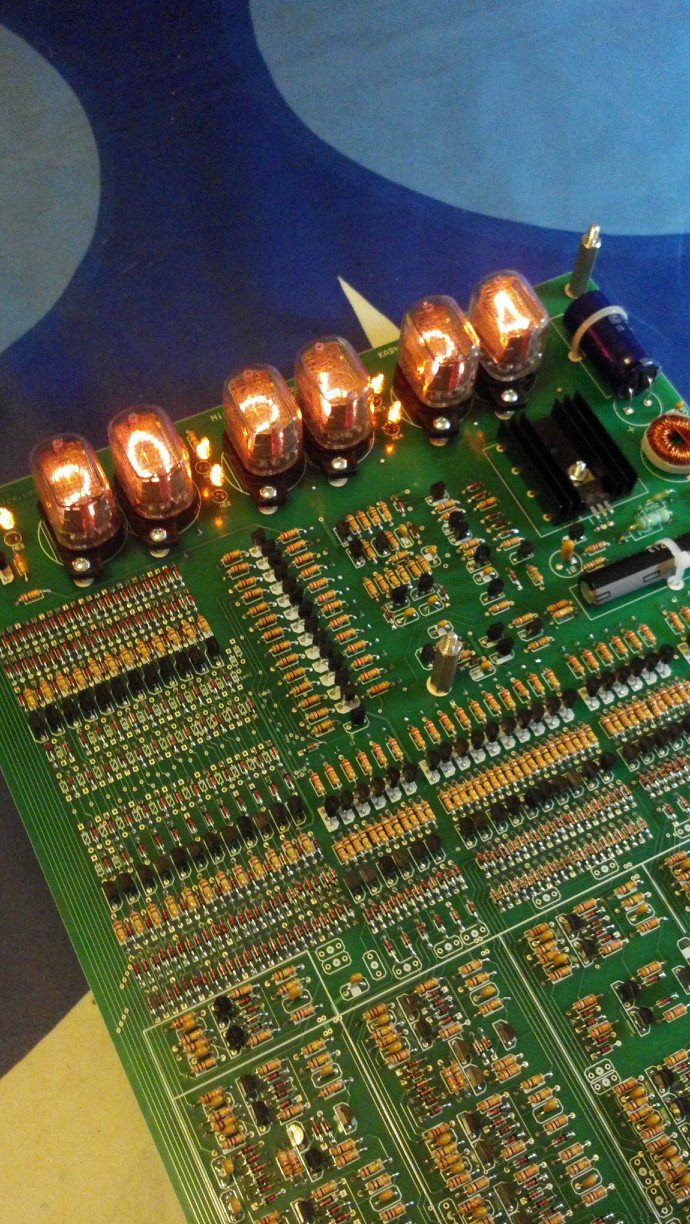
In 2013 I built a clock from a kit purchased here: https://tube-clock.com/
set_board - start of a design to set the time using an ESP32
case - acrylic case design
Some circuit analysis for setting remotely.
Set switches (ref schematic in manual):
SW1 (minutes) - page 8/23 (PDF page 70) SW2 (Hours) - page 10/23 (PDF page 72) SW3 (s hold) - page 2/23 (PDF page 64)
Based on Peter's claim that WWVB reception was ok at Deb's place, purchased a Canaduino Atomic Clock board and 3D printed a little holder for it. It seems to work OK powered by 2xAA batteries in the kitchen. Maybe at night it will work in a window?
Per suggestion in the datasheet, thinking to connect with a shielded
RJ-45 patch cable. Re-do set_board_avr to accommodate the connector,
and remove the 8MHz crystal and WiFi module.
Should probably add a couple of buttons.
Also, maybe need an additional small PCB for the WWVB board with jumpers for LED and power (choose between battery and remote power).
Confirm that ESP-01 works using FTDI at 115200 baud.
Problem is that hardware UART on 8MHz AVR is unreliable.
Downloaded https://github.com/nerdralph/picoUART
Tested on "control panel" PCB with FTDI and seems to work
Starting to write some WiFi test code
Reviving the "set board" project. Thinking of a new design with an ESP-01 serial WiFi module connected to a small AVR (ATTiny85?). This could be much lower power or even fire up once only on power-up to retrieve the time from somewhere.
The main issue may be poor wifi in the kitchen!
ESP-01 doco at: https://nurdspace.nl/ESP8266
| Qty | Value | Footprint | References |
|---|---|---|---|
| 6 | 10k | Resistor_SMD:R_1206_3216Metric_Pad1.30x1.75mm_HandSolder | R3, R4, R5, R6, R11, R14 |
| 4 | 1k | Resistor_SMD:R_1206_3216Metric_Pad1.30x1.75mm_HandSolder | R12, R15, R16, R17 |
| 4 | 33k | Resistor_SMD:R_1206_3216Metric_Pad1.30x1.75mm_HandSolder | R7, R8, R9, R10 |
| 4 | BAV99 | Package_TO_SOT_SMD:SOT-23 | D4, D5, D6, D7 |
| 3 | 0.1uF | Capacitor_SMD:C_1206_3216Metric_Pad1.33x1.80mm_HandSolder | C2, C5, C6 |
| 3 | LED | LED_SMD:LED_1206_3216Metric | D1, D2, D3 |
| 3 | Q_NPN | my_NPN:SOT-23_Handsoldering_BEC | Q1, Q2, Q3 |
| 2 | MountingHole_Pad | MountingHole:MountingHole_4.5mm_Pad | H1, H2 |
| 1 | 1.0uF | Capacitor_SMD:C_1206_3216Metric_Pad1.33x1.80mm_HandSolder | C1 |
| 1 | 100 | Resistor_SMD:R_1206_3216Metric_Pad1.30x1.75mm_HandSolder | R18 |
| 1 | 100uF | Capacitor_THT:CP_Radial_D5.0mm_P2.00mm | C3 |
| 1 | 470 | Resistor_SMD:R_1206_3216Metric_Pad1.30x1.75mm_HandSolder | R13 |
| 1 | 74HC14 | Package_SO:SOIC-14_3.9x8.7mm_P1.27mm | U4 |
| 1 | ATtiny4313-S | Package_SO:SOIC-20W_7.5x12.8mm_P1.27mm | U1 |
| 1 | AVR-ISP-6 | Connector_PinHeader_2.54mm:PinHeader_2x03_P2.54mm_Vertical_SMD | J2 |
| 1 | Conn_01x10 | Connector_PinHeader_2.54mm:PinHeader_2x05_P2.54mm_Horizontal | J1 |
| 1 | NCP1117-3.3_SOT223 | Package_TO_SOT_SMD:SOT-223-3_TabPin2 | U5 |
| 1 | RJ45 | my_RJ45:Metz_AJT65B8813 | J3 |
eshazen/nixie-transistor-clock
Documents and files for Nixie Transistor Clock (Kabtronic)

eshazen/nixie-transistor-clock
Documents and files for Nixie Transistor Clock (Kabtronic)

GhostWrench/ttrpg9000
Hardware and software for a hand-held dice rolling computer


sbstnh/programmable_precision_resistor
A SCPI programmable precision resistor


roberto314/SpeedoCableReplace
An electronic replacement for a Speedometer Cable from an old car.


fwachsmuth/Synkino
Allows sound playback synchronised to a running,jittery Super 8 projector
It measures 197.5 × 17.8 mm and has 2 copper layers, 1.6 mm thick.
39 parts, built around the ATTINY4313-SU, 74HC14, BAV99 and RJ45. The full list of its parts is on this page, with links to each part's symbol and footprint where PCBKit's library has them.
From the eshazen/nixie-transistor-clock repository on GitHub, at the commit this page was made from: the board is KiCAD/set_board_avr/set_board_avr.kicad_pcb and its schematic KiCAD/set_board/set_board.kicad_sch. PCBKit opens the board in the browser, with nothing to install.
Its repository states no licence, so its author keeps all rights: ask eshazen before reusing the design.