
4 layers238.8 × 236.2 mm

 eryjus/16bcfs7
All material related to the 16bcfs project
Instr register module is an open-source printed circuit board by eryjus, from the eryjus/16bcfs repository on GitHub. It is a 4-layer board of 43.2 × 21.6 mm with 39 parts on 51 nets, routed with 159 tracks and 60 vias.
It is built around the 74HC574D. Its parts include 16 resistors, 16 diodes, 3 capacitors, 2 ICs and 2 connectors.
This repository contains the complete works associated with the 16-Bit Computer From Scrath (16bcfs) project.
I am documenting my 16-Bit Computer build in video form. You can find the entire playlist here.
See LICENSE.md.
I use tup as my primary build system. I usually will wrap tup in make commands. You can find tup here. I simply find tup to more reliable detect changed sources with less work.
The Qt6_DIR Environment Variable needs to point to the installation location of Qt6, for example ~/Qt/6.6.0/gcc_64/. Your installation location may be different, so copy-and-paste is not advised.
I do not have a commercial EEPROM programmer. I use the TommyPROM programmer. You can find all the relevant information on TommyPROM here. In Linux, I use minicom as the interface. Hint: use sudo minicom -s to set up the defaults.
| Qty | Value | Footprint | References |
|---|---|---|---|
| 16 | 1K | Resistor_SMD:R_1206_3216Metric_Pad1.30x1.75mm_HandSolder | R1, R2, R3, R4, R5, R6, R7, R8, R9, R10, R11, R12, R13, R14, R15, R16 |
| 16 | LED | LED_SMD:LED_1206_3216Metric_Pad1.42x1.75mm_HandSolder | D1, D2, D3, D4, D5, D6, D7, D8, D9, D10, D11, D12, D13, D14, D15, D16 |
| 2 | 0u1 | Capacitor_SMD:C_1206_3216Metric_Pad1.33x1.80mm_HandSolder | C1, C2 |
| 2 | 74HC574 | Package_SO:SOIC-20W_7.5x12.8mm_P1.27mm | U1, U2 |
| 1 | 47u | Capacitor_SMD:C_1206_3216Metric_Pad1.33x1.80mm_HandSolder | C3 |
| 1 | Conn_01x04_Pin | Connector_PinHeader_2.54mm:PinHeader_1x04_P2.54mm_Vertical | J1 |
| 1 | Conn_01x16_Pin | Connector_PinHeader_2.54mm:PinHeader_1x16_P2.54mm_Vertical | J2 |


slu4coder/Minimal-64x4-Home-Computer
My DIY TTL home computer with VGA and PS/2 and 4x the processing power of a Commodore C64 or Apple II.

slu4coder/Minimal-64-Home-Computer
Legacy: Full TTL-only home computer with VGA and PS/2 and twice the processing power of a Commodore 64


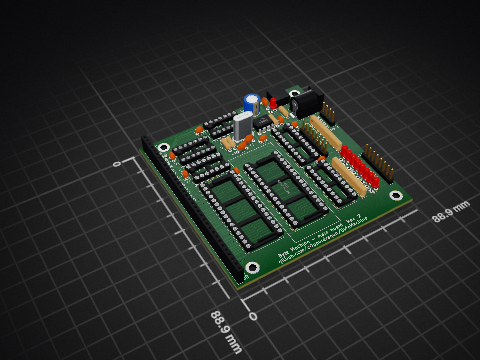

c0pperdragon/BreadBin
A CPU made of 7400 logic on breadboards - inside a bread bin ;-)

trcwm/HD6309-Computer
A computer based on the HD6309 CPU, done for the Retro Challenge 2017/04.
It measures 43.2 × 21.6 mm and has 4 copper layers, 4.69 mm thick.
39 parts, built around the 74HC574D. The full list of its parts is on this page, with links to each part's symbol and footprint where PCBKit's library has them.
From the eryjus/16bcfs repository on GitHub, at the commit this page was made from: the board is kicad/projects/16bcfs/instr-register-module/instr-register-module.kicad_pcb and its schematic kicad/projects/16bcfs/clock-module/adjustable.kicad_sch. PCBKit opens the board in the browser, with nothing to install.
Its repository states no licence, so its author keeps all rights: ask eryjus before reusing the design.