
2 layers40.6 × 108 mm
Useq1
Emute-Lab-Instruments/uSEQ
Hardware & firmware of the uSEQ Live Coding CV & Gate Sequencer
172 parts44

Hardware & firmware of the uSEQ Live Coding CV & Gate Sequencer
Useq is an open-source printed circuit board by Emute-Lab-Instruments, from the Emute-Lab-Instruments/uSEQ repository on GitHub. It is a 2-layer board of 40.6 × 108 mm with 60 parts on 84 nets, routed with 595 tracks and 54 vias.
It is built around the MMBT3904-TP, B3U-1000P and PEC11R-4215F-S0024. Its parts include 16 resistors, 13 diodes, 11 connectors, 8 capacitors and 6 switches. It belongs with the RP2040 boards of this library.


uSEQ is a livecodeable eurorack module.
There's a paper on it here:
Kyriakoudis, Dimitris, & Kiefer, Chris. (2023, April 19). uSEQ: A LISPy Modular Sequencer for Eurorack with a Livecodable Microcontroller. 7th International Conference on Live Coding (ICLC2023), Utrecht, The Netherlands. https://doi.org/10.5281/zenodo.7843874
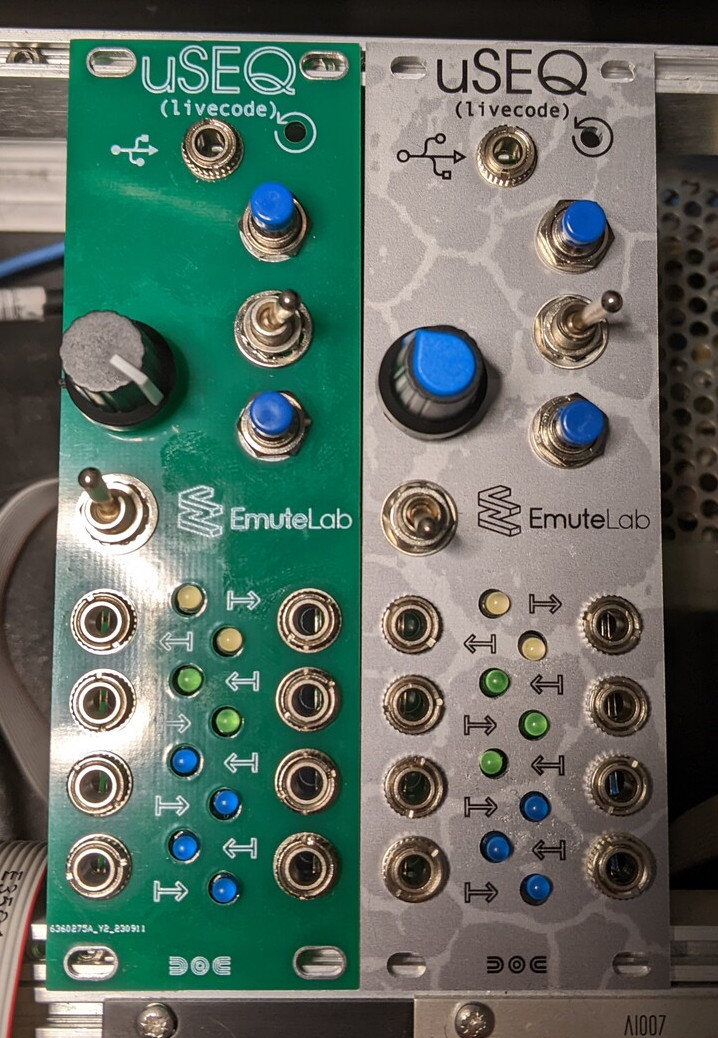
uSEQ modules, two panel designs (PCB, Aluminium)
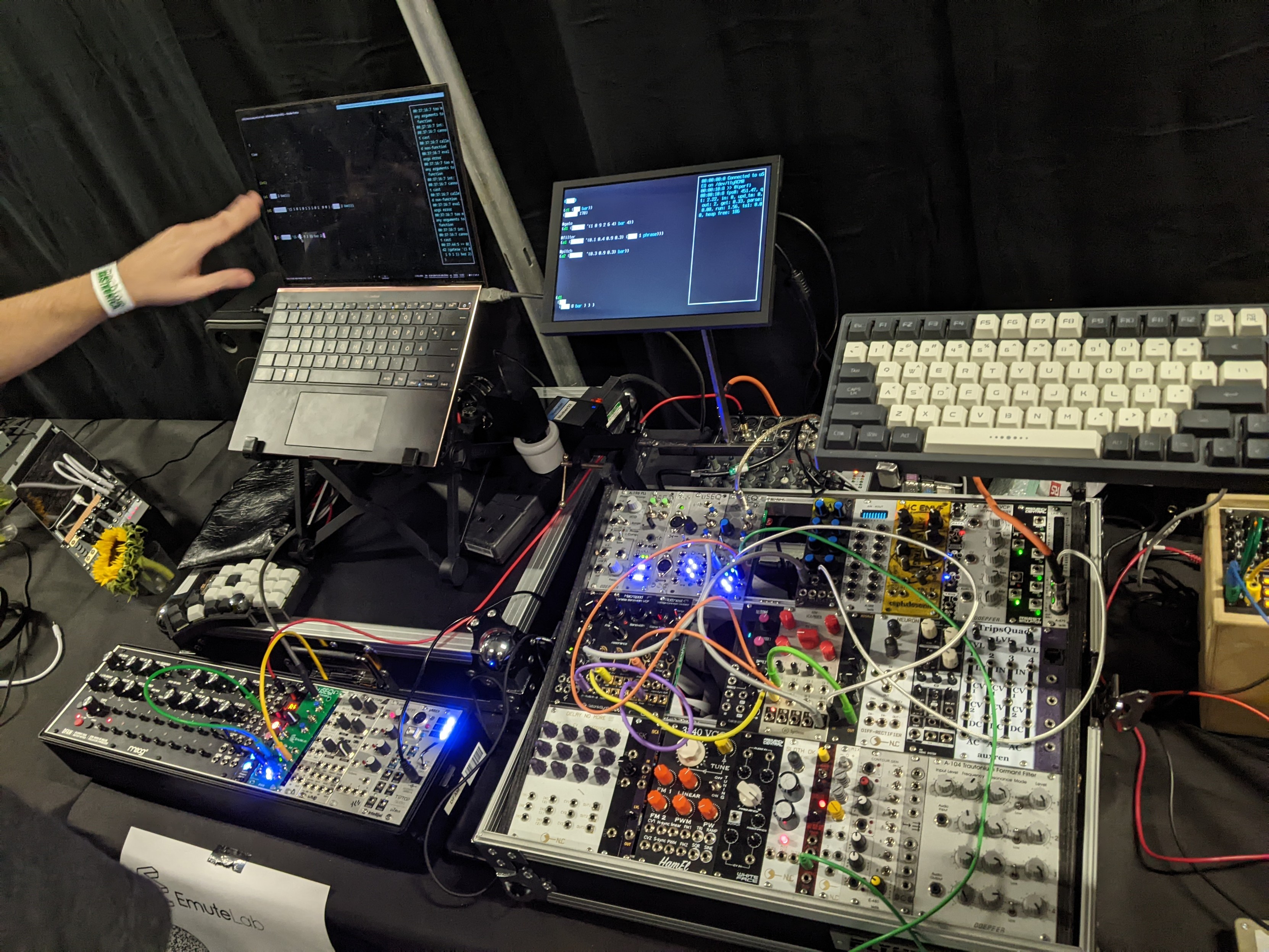
uSEQ modules set up within eurorack performance systems
More info from https://www.emutelabinstruments.co.uk/useq/
The firmware/language specs live in docs/specs/MAIN.md. Protocol details live in docs/specs/wire-protocol.md.
The firmware is in the uSEQ folder.
Build the firmware in Arduino IDE, using the Earle Philhower Pico core.
| Setting | Value |
|---|---|
| Board | Generic RP2040 |
| Boot Stage 2 | W25Q080 QSPI /2 |
| Flash Size | 8MB (Sketch 1MB, FS: 7MB) |
| CPU Speed | 250MHz (Overclock) |
| Optimize | Optimize Even More (-O3) |
Overclock the Pico at 250Mhz and set the optimisation level to -O3.
We welcome pull requests.
| Qty | Value | Footprint | References |
|---|---|---|---|
| 14 | 1k | Resistor_SMD:R_1206_3216Metric_Pad1.30x1.75mm_HandSolder | R3, R4, R5, R6, R7, R8, R9, R10, R11, R12, R13, R14, R15, R16 |
| 8 | AudioJack2_SwitchT | Connector_Audio:Jack_3.5mm_QingPu_WQP-PJ398SM_Vertical_CircularHoles | J1, J2, J3, J4, J5, J6, J7, J8 |
| 8 | LED | LED_THT:LED_D3.0mm | D6, D7, D8, D9, D10, D11, D12, D13 |
| 5 | 1N5819 | Diode_SMD:D_SOD-323 | D1, D2, D3, D4, D5 |
| 4 | (10n) | Capacitor_SMD:C_1206_3216Metric_Pad1.33x1.80mm_HandSolder | C5, C6, C7, C8 |
| 2 | 100k | Resistor_SMD:R_1206_3216Metric_Pad1.30x1.75mm_HandSolder | R1, R2 |
| 2 | 10n | Capacitor_SMD:C_1206_3216Metric_Pad1.33x1.80mm_HandSolder | C3, C4 |
| 2 | 2N3904 | digikey-footprints:SOT-23-3 | Q1, Q2 |
| 2 | SW_Push | Eurocad:PBS-105 | SW1, SW2 |
| 2 | SW_SPST | benjiaomodular:ToggleSwitch_MTS-101_SPST | SW3, SW4 |
| 1 | 100n | Capacitor_SMD:C_1206_3216Metric_Pad1.33x1.80mm_HandSolder | C2 |
| 1 | 10u | Capacitor_SMD:C_1206_3216Metric_Pad1.33x1.80mm_HandSolder | C1 |
| 1 | 4504 | Package_SO:SOIC-16_3.9x9.9mm_P1.27mm | U2 |
| 1 | B3U-1000P | digikey-footprints:Switch_Tactile_SMD_B3U-1000P | S2 |
| 1 | Conn_01x03 | Connector_PinSocket_2.54mm:PinSocket_1x03_P2.54mm_Vertical | J10 |
| 1 | Conn_01x05 | Connector_PinSocket_2.54mm:PinSocket_1x05_P2.54mm_Vertical | J11 |
| 1 | LOGO | LOGO | G*** |
| 1 | PEC11R-4215F-S0024 | digikey-footprints:Rotary_Encoder_Switched_PEC11R | S1 |
| 1 | PIN_HEADER_2x8 | Connector_IDC:IDC-Header_2x08_P2.54mm_Vertical | H1 |
| 1 | PJ366ST | w_connector:PJ366ST | J9 |
| 1 | Pico | MCU_RaspberryPi_and_Boards:RPi_Pico_Pinheaders | U1 |
Emute-Lab-Instruments/uSEQ
Hardware & firmware of the uSEQ Live Coding CV & Gate Sequencer

Emute-Lab-Instruments/uSEQ
Hardware & firmware of the uSEQ Live Coding CV & Gate Sequencer


lfantoniosi/CoCoTANG
CoCoTANG upgrades the Radio Shack/Tandy Color Computer with a Tang Nano 20K FPGA board and CoCo 3 video and memory features.

jjCSE113NMT/dsp-neutron-spectrometer
A place to keep all our material related to our senior design project.


ismaillgunes/IR_Programmer
A standalone, button-operated firmware programmer for STM32L0 microcontrollers, built on an STM32L073VBT. It stores a firmware image in its own flash and writes it to a target MCU over one of two links:

Sierra-Lobo/backplane-breakout-foras-promineo
breakout board for backplane use on foras promineo
It measures 40.6 × 108 mm and has 2 copper layers, 1.6 mm thick.
60 parts, built around the MMBT3904-TP, B3U-1000P and PEC11R-4215F-S0024. The full list of its parts is on this page, with links to each part's symbol and footprint where PCBKit's library has them.
From the Emute-Lab-Instruments/uSEQ repository on GitHub, at the commit this page was made from: the board is hardware/version0.2/kicad/useq.kicad_pcb and its schematic hardware/uSeqIns1.0/uSeqIns1.0.kicad_sch. PCBKit opens the board in the browser, with nothing to install.
Its repository states no licence, so its author keeps all rights: ask Emute-Lab-Instruments before reusing the design.