2 layers25.4 × 26 mm

 emmsey-square/PCB-Business-Card
Blog post, hardware & firmware files for my custom PCB business card
Business Card is an open-source printed circuit board by emmsey-square, from the emmsey-square/PCB-Business-Card repository on GitHub, published under the MIT licence. It is a 2-layer board of 90 × 55 mm with 44 parts on 47 nets, routed with 259 tracks and 47 vias.
It is built around the RT9080-33GJ5, 1N5819WS and BC847. Its parts include 17 resistors, 12 diodes, 3 capacitors, 3 switches and 2 ICs. It belongs with the RISC-V boards of this library.


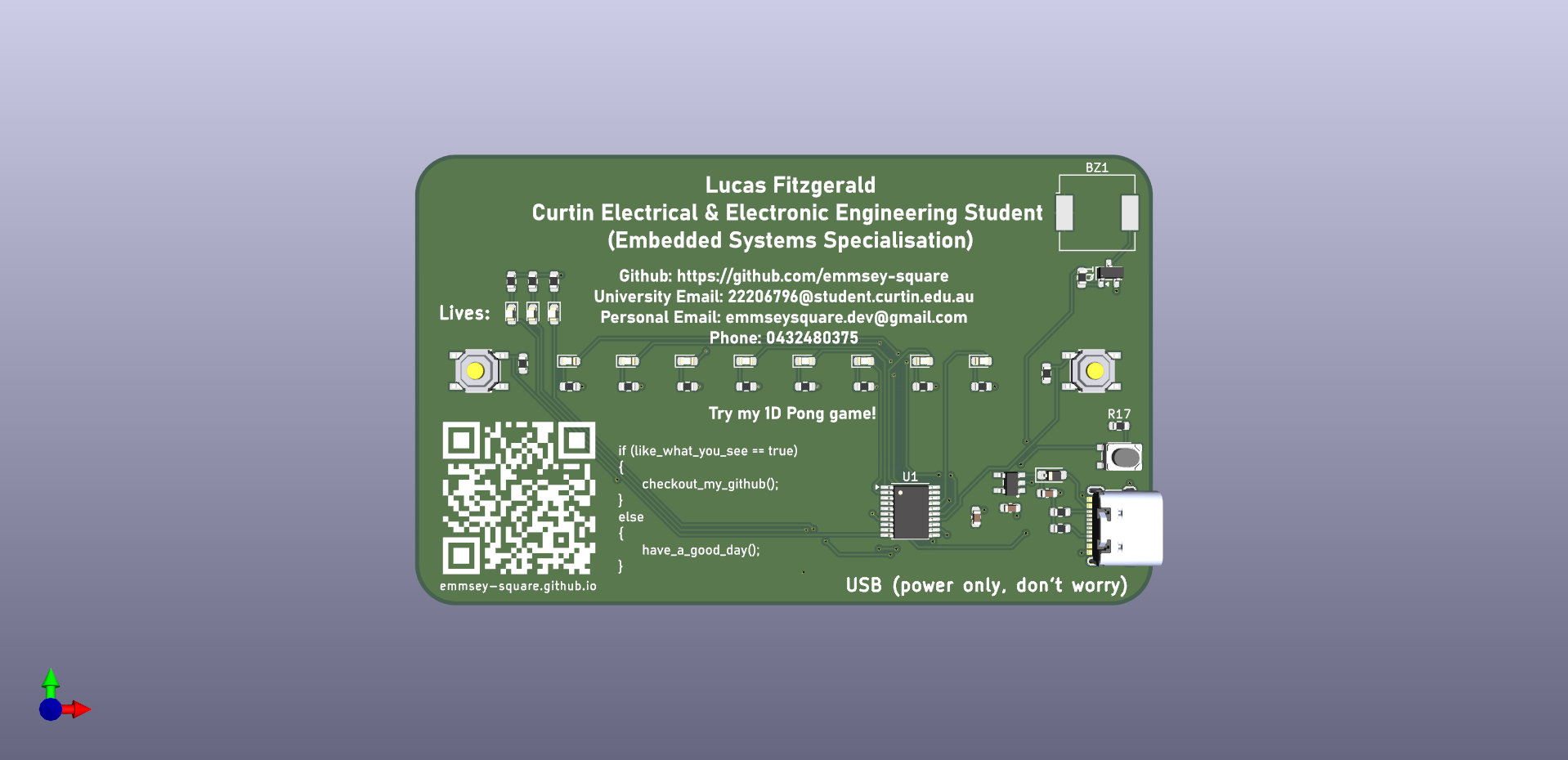
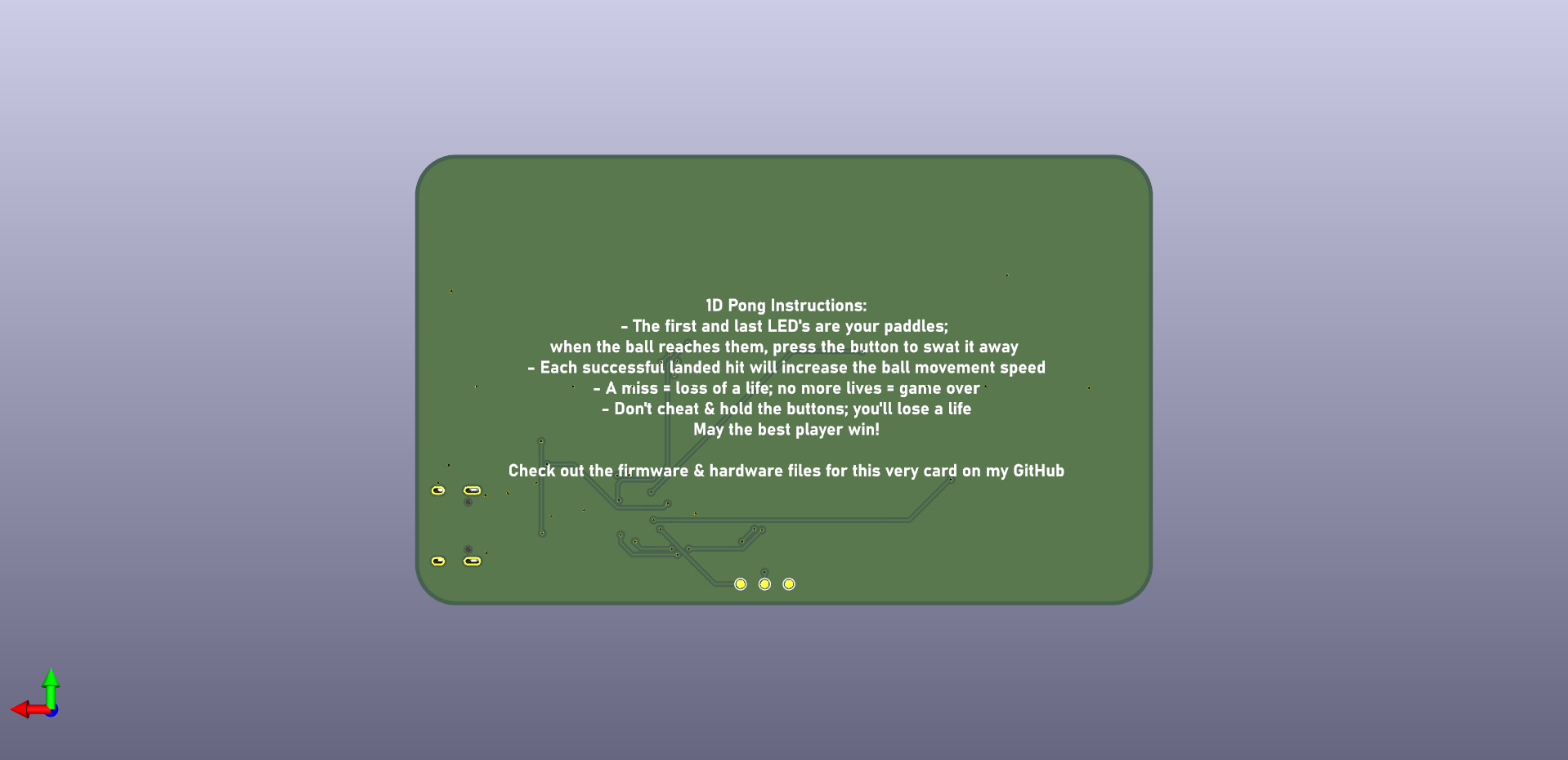
I've seen online heaps of people in the hobbyist/engineering field design their own business cards/badges to give out to people, and I wnated to make one of my own to help me stand out among my peers.
My spin on the PCB business card is a simple 1D Pong game; there's a string of LED's between two pushbutton switches, with one LED lighting up at a time and moving along the string in alternating directions. When the LED reaches the end of the string, the player must press the button on that side to 'swat' it away, otherwise they will lose 1 of their 3 lives. Each successful swat increases the speed of the LED movement, until eventually it's impossible to win. Additionally, holding the buttons the whole time (AKA cheating) results in a loss of a life. Losing all lives results in game over.
| Qty | Value | Footprint | References |
|---|---|---|---|
| 11 | LED | LED_SMD:LED_0603_1608Metric | D1, D2, D3, D4, D5, D6, D7, D8, D10, D11, D12 |
| 11 | R | Resistor_SMD:R_0603_1608Metric | R5, R6, R7, R8, R9, R10, R11, R12, R13, R14, R15 |
| 3 | 10k | Resistor_SMD:R_0603_1608Metric | R1, R2, R17 |
| 2 | 5.1k | Resistor_SMD:R_0603_1608Metric | R3, R4 |
| 2 | SMD_5.2x5.2mm_h1.9mm | PCM_SparkFun-Switch:Push_SMD_5.2x5.2mm_h1.9mm | SW1, SW2 |
| 1 | 0.1u | Capacitor_SMD:C_0603_1608Metric | C1 |
| 1 | 10u | Capacitor_SMD:C_0603_1608Metric | C3 |
| 1 | 1N5819WS | Diode_SMD:D_SOD-323_HandSoldering | D9 |
| 1 | 1u | Capacitor_SMD:C_0603_1608Metric | C2 |
| 1 | 3.3V | TestPoint:TestPoint_Pad_D1.0mm | TP2 |
| 1 | BC847 | Package_TO_SOT_SMD:SOT-23 | Q1 |
| 1 | Buzzer | Buzzer_Beeper:Buzzer_CUI_CPT-9019S-SMT | BZ1 |
| 1 | CH32V003FxPx | Package_SO:TSSOP-20_4.4x6.5mm_P0.65mm | U1 |
| 1 | GND | TestPoint:TestPoint_Pad_D1.0mm | TP3 |
| 1 | LOGO | LOGO | G*** |
| 1 | R | PCM_SparkFun-Resistor:R_0603_1608Metric | R16 |
| 1 | RT9080-3.3 | PCM_SparkFun-Semiconductor-Standard:SOT23-5 | U2 |
| 1 | SMD_4.2x3.2mm_h2.5mm | PCM_SparkFun-Switch:Push_SMD_4.2x3.2mm | SW3 |
| 1 | SWIO | TestPoint:TestPoint_Pad_D1.0mm | TP1 |
| 1 | USB_C_Receptacle | PCM_SparkFun-Connector:USB-C_16 | J1 |


rt-rtos/Grupparbete-IoT25S
Grupparbete för IoT25S Jensen, IoT-arkitektur och datakommunikation.

EdgeCoil/tune-button
BLE remote (ESP32-C3) that likes or playlists the current Spotify song through a companion Android app. Firmware, app, protocol and three PCBs: XIAO, four-key and JST-button.


backtail/ctrl-alt
6 HP Eurorack module and corresponding embedded framework

It measures 90 × 55 mm and has 2 copper layers, 1.6 mm thick.
44 parts, built around the RT9080-33GJ5, 1N5819WS and BC847. The full list of its parts is on this page, with links to each part's symbol and footprint where PCBKit's library has them.
From the emmsey-square/PCB-Business-Card repository on GitHub, at the commit this page was made from: the board is hardware/Business Card.kicad_pcb and its schematic hardware/Business Card.kicad_sch. PCBKit opens the board in the browser, with nothing to install.
Its repository publishes it under the MIT licence: you may reuse it on that licence's terms (keep the author's notice, and for a copyleft licence share your changes alike).