

4 layers95 × 55.5 mm
EinkPDA keyboard
TalismanDesign/PocketMage_PDA
An E-Ink PDA device using the ESP32 S3.
137 parts2kApache-2.0

 djarty24/hacker-card
Hacker card for hack club's Forge
Hacker card is an open-source printed circuit board by djarty24, from the djarty24/hacker-card repository on GitHub. It is a 2-layer board of 77.8 × 50.5 mm with 10 parts on 9 nets, routed with 86 tracks and 4 vias.
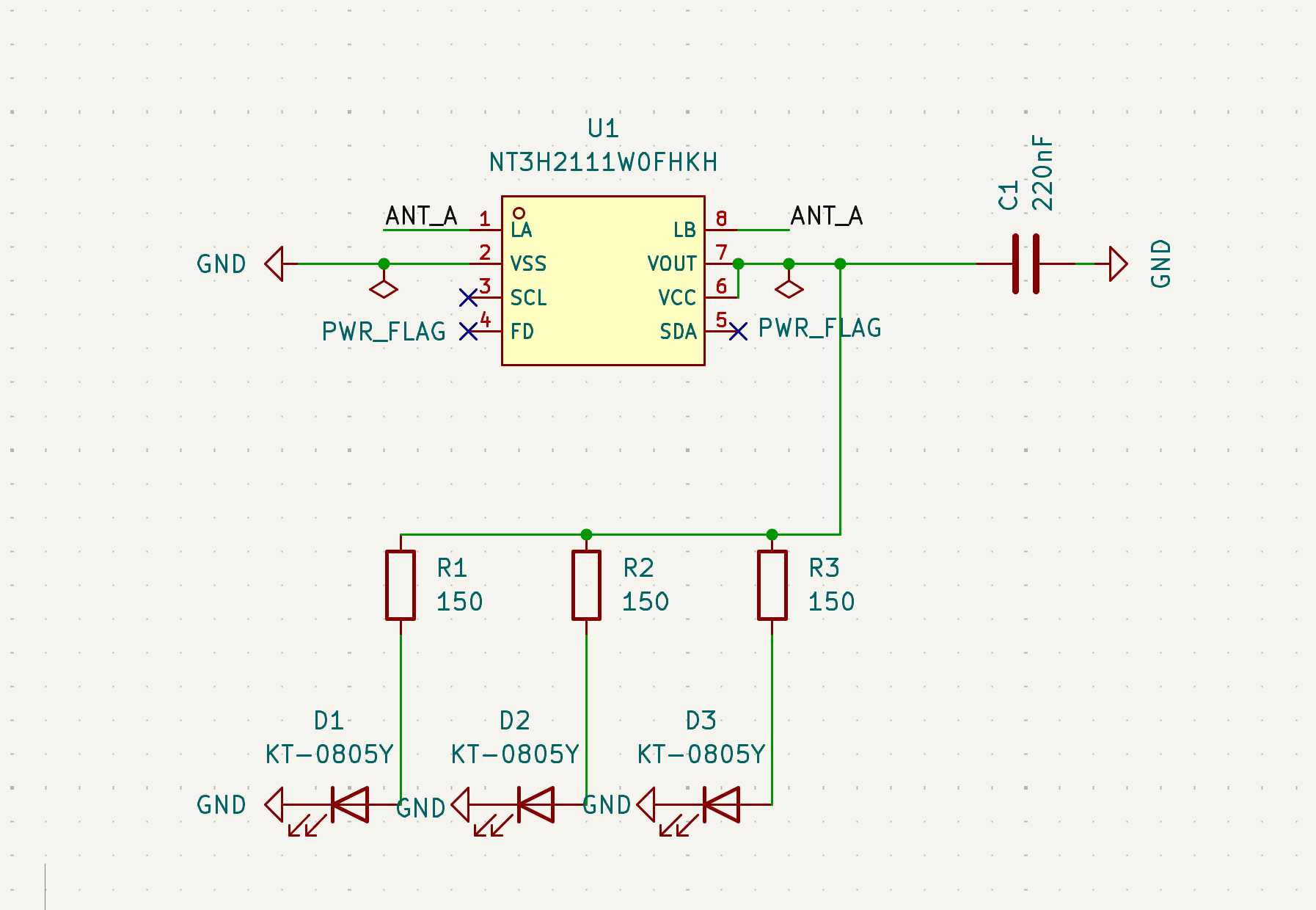
It is built around the NT3H2111W0FHKH and KT-0805Y. Its parts include 3 resistors, 3 diodes, 1 capacitor and 1 IC.
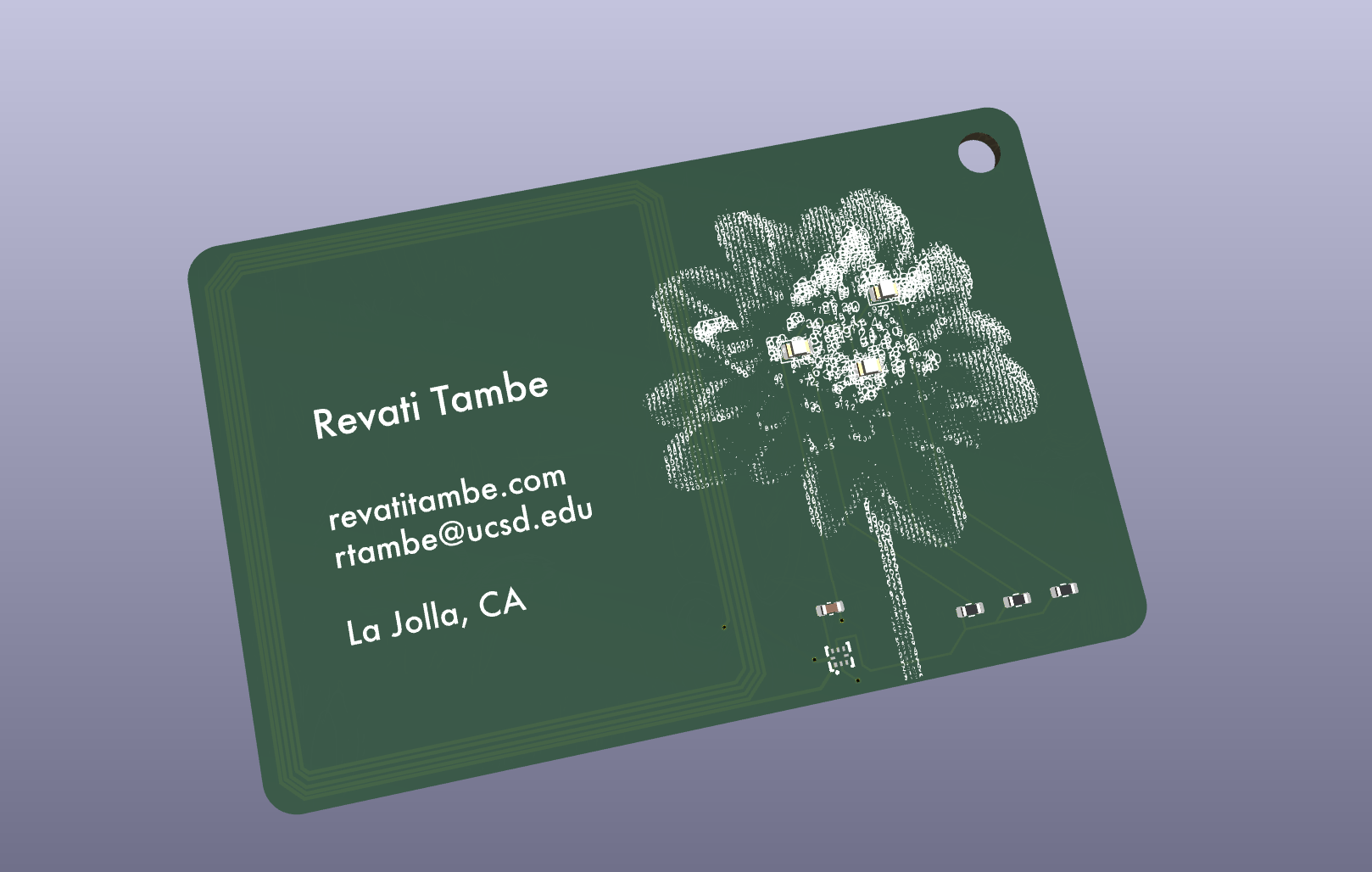
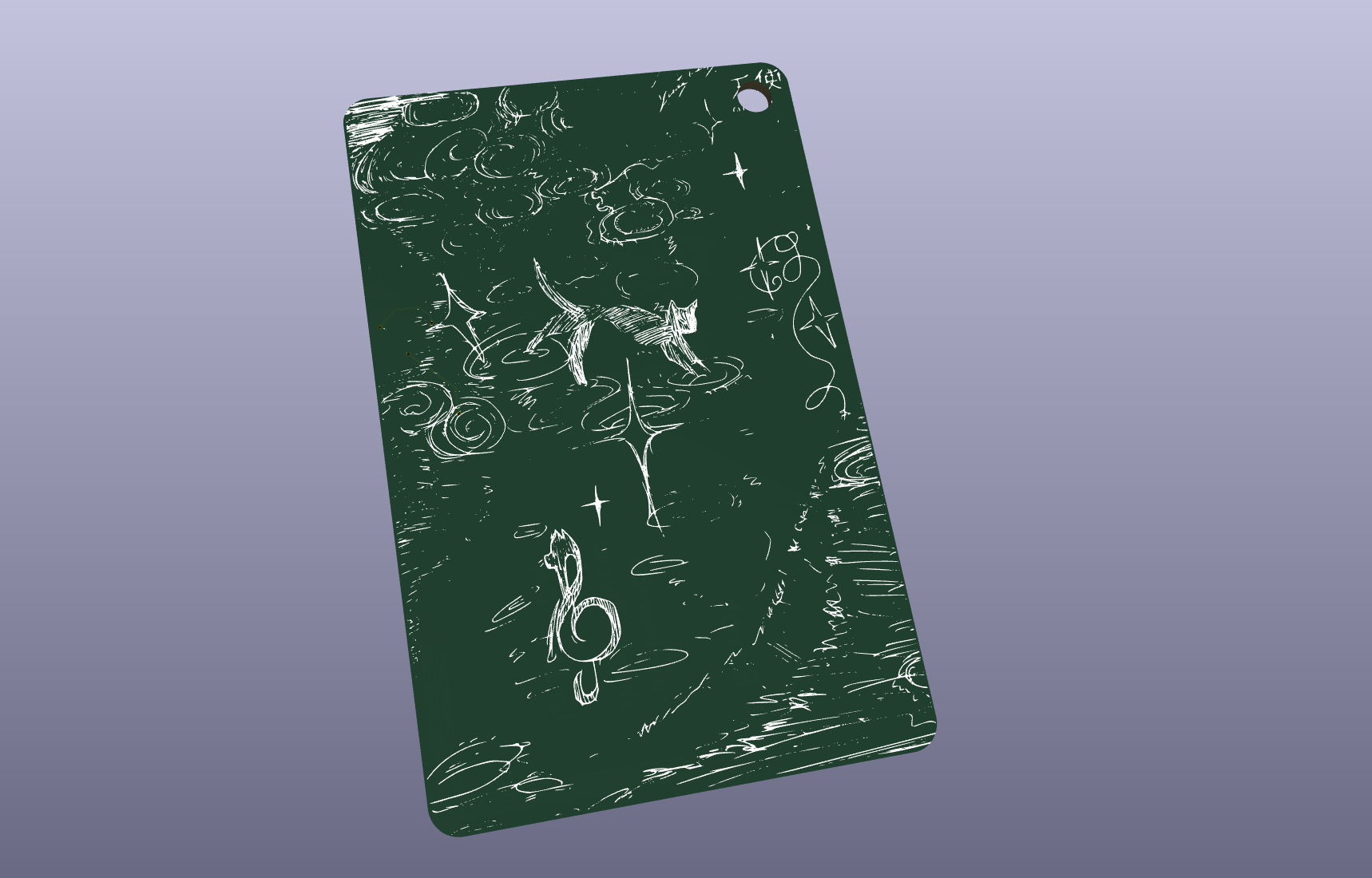
This is a hacker card I made for myself!
Front of Card:
Back of Card:
I mainly used this article from Hack Club as a starting point, but my project branched out in several ways. First, I used KiCad instead of EasyEDA. I choose to add two additional LEDs, and I also manually designed the NFC antenna. I learned a lot from this project like how to pick out hardware, what energy harvesting is, reading datasheets to find the capacitor I should use, and actually doing calculations for the resistance values based on the hardware I was using and how bright I wanted the circuit to be.
How it works is when you tap your phone to the card, the phone emits a small magnetic field. The antenna essentially converts this energy into electricity, which then is harvested by the capacitor to light up the three LEDs on the board. Then, the NFC chip will also use some of that electricity to transmit a link to my website directly to the phone without needing a battery.
| Link | Component | Footprint / Package | LCSC Part # | Qty (Total) | Total Cost |
|---|---|---|---|---|---|
| Link | 220nF | 0603 | C21120 | 5 | $0.0835 |
| Link | KT-0805Y (Yellow LED) | 0805 | C2296 | 15 | $0.2280 |
| Link | 150Ω Resistor | 0603 | C22808 | 15 | ~$0.03 |
| Link | NT3H2111W0FHKH (NFC Chip) | XQFN-8 | C710403 | 5 | $3.2115 |
Please Note: The individual component costs listed above aren't completely accurate. Because I used JLCPCB for the full assembly (which was required for the specific surface-mount parts I chose and ended up being the cheapest option overall) the individual component prices don't matter as much as the final fabricated total.
After submitting all of the info (gerber files, bom.csv, and positions.csv) to JLCPCB for assembly, this was the final price estimate I got.
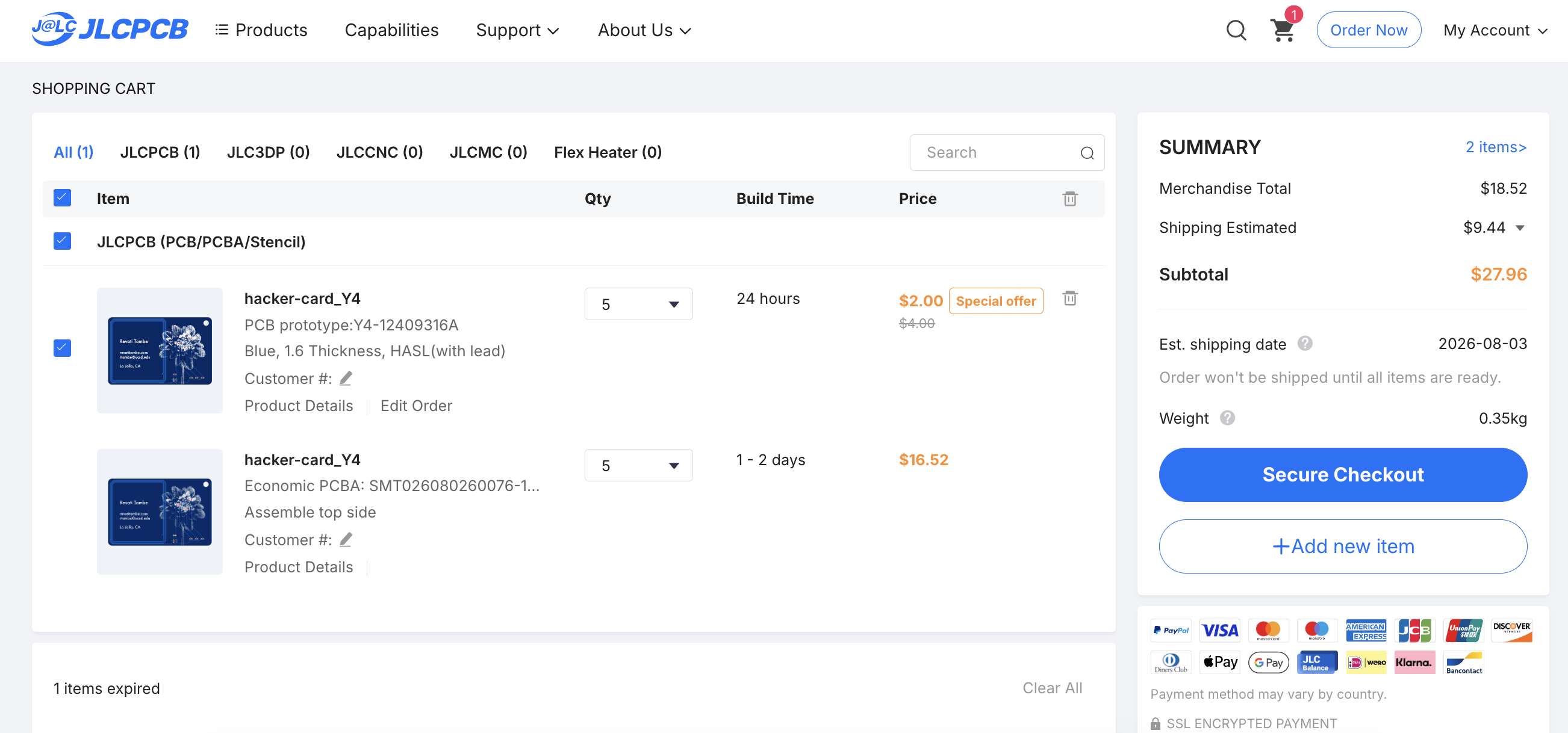
PCB Prototype (Fabrication): $2.00 Economic PCBA (Assembly): $16.52 Estimated Shipping: $9.44 Total Price: $27.96
This project was made for Hack Club's Forge!
| Qty | Value | Footprint | References |
|---|---|---|---|
| 3 | 150 | Resistor_SMD:R_0603_1608Metric | R1, R2, R3 |
| 3 | KT-0805Y | LED_SMD:LED_0805_2012Metric | D1, D2, D3 |
| 2 | LOGO | LOGO | ., G*** |
| 1 | 220nF | Capacitor_SMD:C_0603_1608Metric | C1 |
| 1 | NT3H2111W0FHKH | footprint:XQFN-8_L1.6-W1.6-P0.50-BL_NT3H2111W0FHKH | U1 |
It measures 77.8 × 50.5 mm and has 2 copper layers, 1.6 mm thick.
10 parts, built around the NT3H2111W0FHKH and KT-0805Y. The full list of its parts is on this page, with links to each part's symbol and footprint where PCBKit's library has them.
From the djarty24/hacker-card repository on GitHub, at the commit this page was made from: the board is hacker-card.kicad_pcb and its schematic hacker-card.kicad_sch. PCBKit opens the board in the browser, with nothing to install.
Its repository states no licence, so its author keeps all rights: ask djarty24 before reusing the design.
TalismanDesign/PocketMage_PDA
An E-Ink PDA device using the ESP32 S3.

demik/quack
Bluetooth and ADB Mouse Converter for Macintosh 128/512/Plus, Apple Lisa and Apple IIc

geezacoleman/owl-driver-board
Development of a board that receives GPIO input and allows on/off control of connected solenoids.


Janky-Jingle-Crew/SouthPoleLevitator
2025 Christmas card "South Pole Levitator"


igorilla666/water-controller
Scheda di controllo basata sul modulo Waveshare ESP32-S3-ETH, con ingressi sensore, RS-485, pilotaggio rele, buzzer e alimentazione/protezioni dedicate.