2 layers90 × 30.3 mm
Integrated25
juicebox6030/Nova-Link
NOVA-LINK is an open, low-latency wireless communication protocol and firmware stack designed for use in real-time live event environments.
178 partsGPL-3.0

 DhruvBhatia0/BlueBird
Five-column TOTEM TrackPoint keyboard with hot-swap Choc keys, underside RGB, and acrylic enclosure
Totem trackpoint is an open-source printed circuit board by DhruvBhatia0, from the DhruvBhatia0/BlueBird repository on GitHub, published under the CERN-OHL-P-2.0 licence. It is a 4-layer board of 258.8 × 94.4 mm with 144 parts on 96 nets, routed with 1,919 tracks and 229 vias.
It is built around the SN74LVC2G14DCKR, TPS2553DBVR-1 and WS2812C-2020-V1. Its parts include 19 capacitors, 13 resistors, 6 ICs and 3 connectors. It belongs with the keyboards and input boards and the RP2040 boards of this library.


[!IMPORTANT] This fork contains BlueBird, a wired five-column TOTEM variant with 37 hot-swap Choc keys, a Sprintek
SK8707-01-008TrackPoint in place of the outermost right thumb key, two direct-solder RP2040-Zero controllers, and ten underside RGB LEDs. It has no OLED. Start with the variant design record, electrical connection tables, shopping list, and revised case/acrylic package. The upstream build guide below describes the original 38-key XIAO board and is not a BlueBird assembly guide. Normal operation uses the right USB only; disconnect the inter-half cable before using the left USB for service. Flash either the BlueBird default UF2 or the BlueBird Vial UF2; see the verified build provenance. The prototype-r2 release record links the fabrication bundle, firmware, complete corresponding QMK source, and combined checksums. This is a prototype release candidate: complete the physical, USB-inrush, TrackPoint-axis, and exact-FFC gates before any bulk order. The immutable prototype-r1 record remains available for comparison; r2 replaces its long RGB routes through the 5 V plane with spatially ordered chains on the other copper layers. The older top-level QMK and ZMK UF2 files are upstream XIAO artifacts and are not compatible with BlueBird.
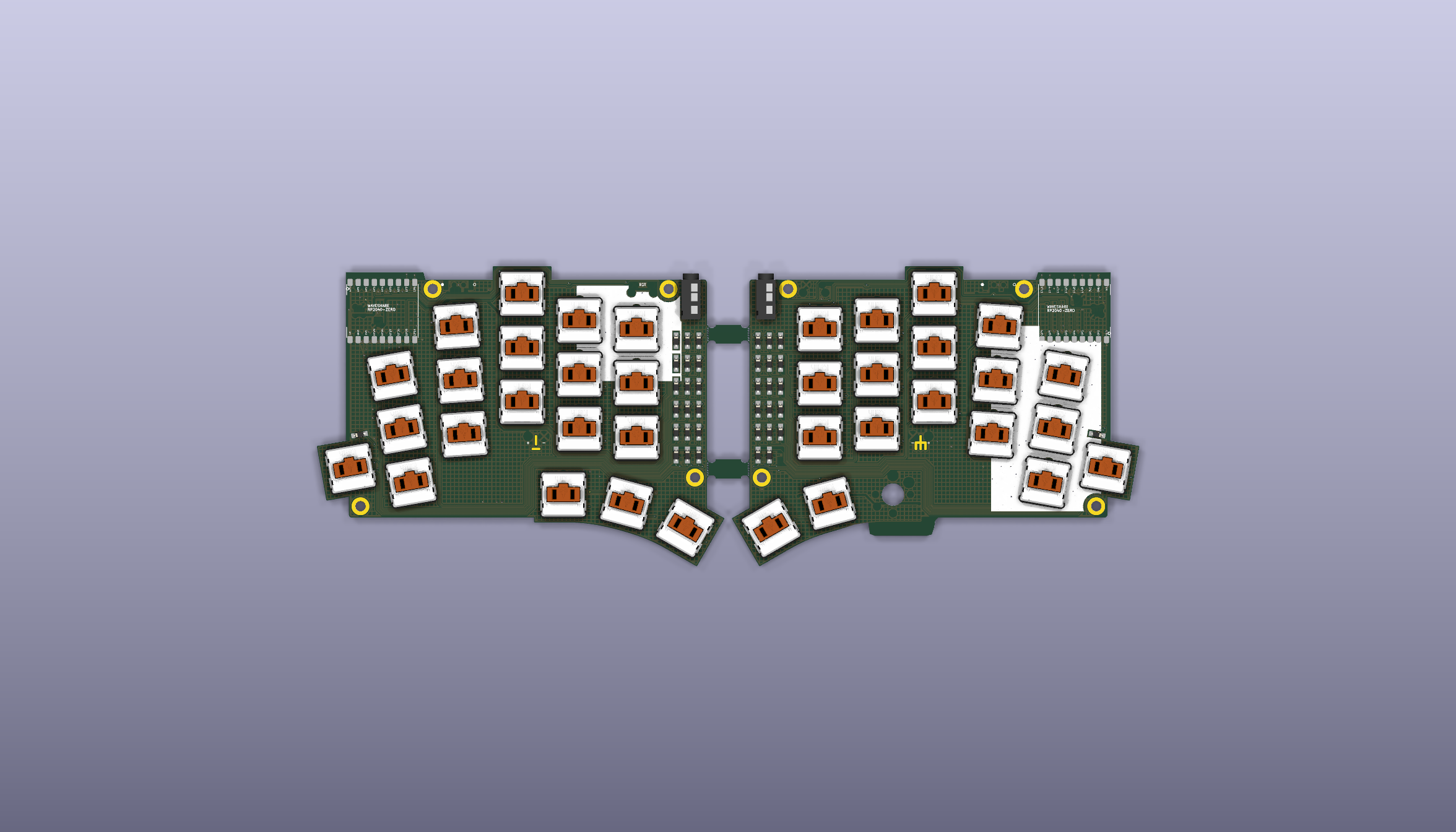
The round opening at the outer right thumb position is intentional: the
TrackPoint plate mounts to the acrylic carrier below the PCB, so its mechanical
assembly is not present in KiCad's PCB-only render. Bottom-side and enclosure
review renders are in docs/renders/ and
case/USB/trackpoint_acrylic/renders/.

TOTEM is a 38 key column-staggered choc split keyboard. It is meant to be used with a Seeed Studio XIAO nRF52840 BLE or XIAO RP2040.
It was created for the SEEED XIAO keyboard contest.
Here you can read about the process of making it.
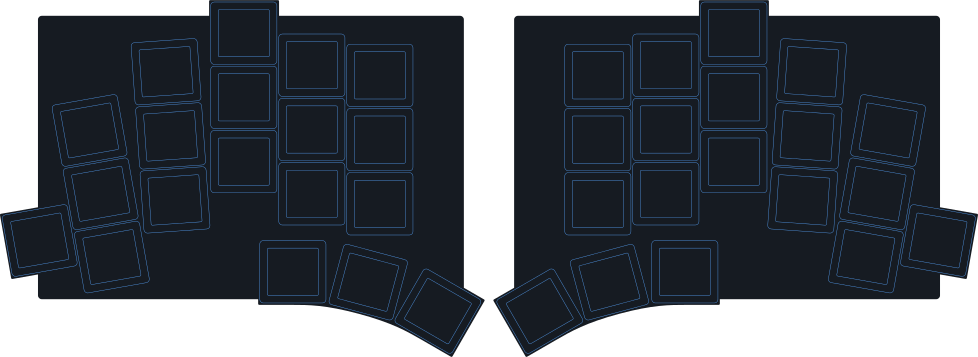
Here you can find the KiCad files and Gerbers for the TOTEM.
You can use the TOTEM without a case, but here you can find one I made for it.
The build guide for the TOTEM can be found here.
QMK (VIAL) precompiled or QMK (VIAL) source for the TOTEM (wired using the XIAO RP2040)
ZMK precompiled or ZMK source (outdated) for the TOTEM (wireless using the XIAO BLE)
You can buy TOTEM kits and finished builds on keeb.supply (based in Germany)
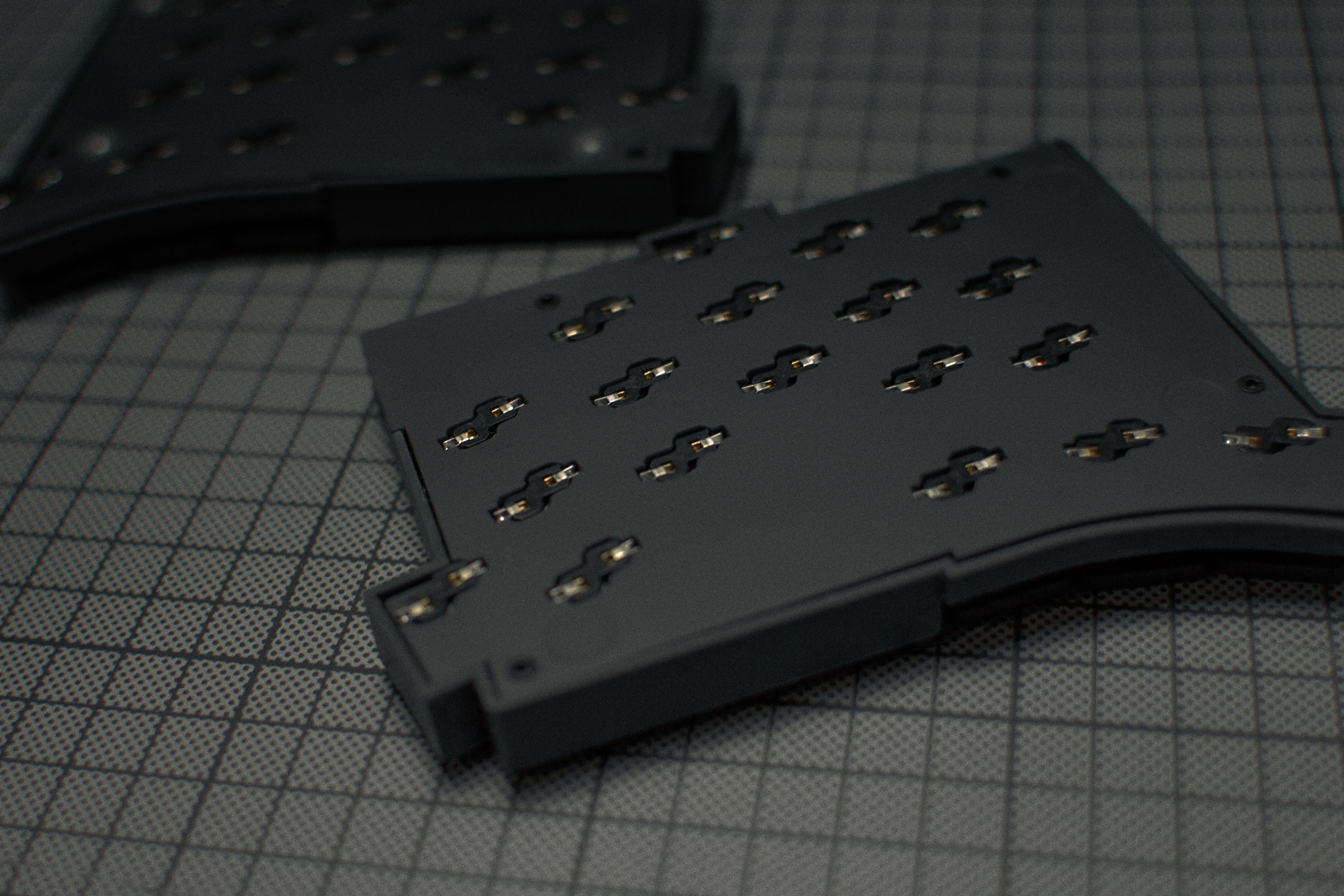
This is the TOTEM in a black resin case
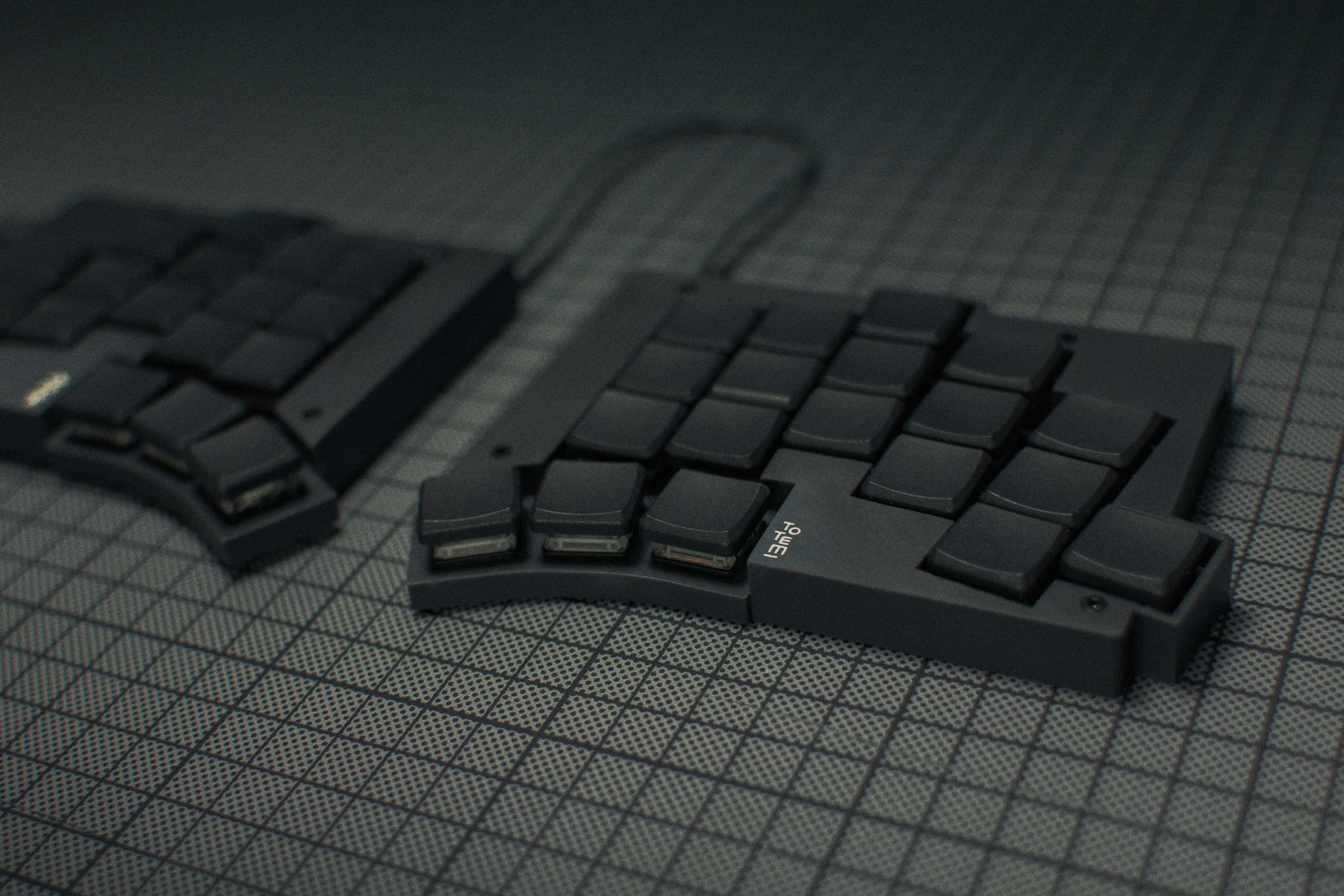
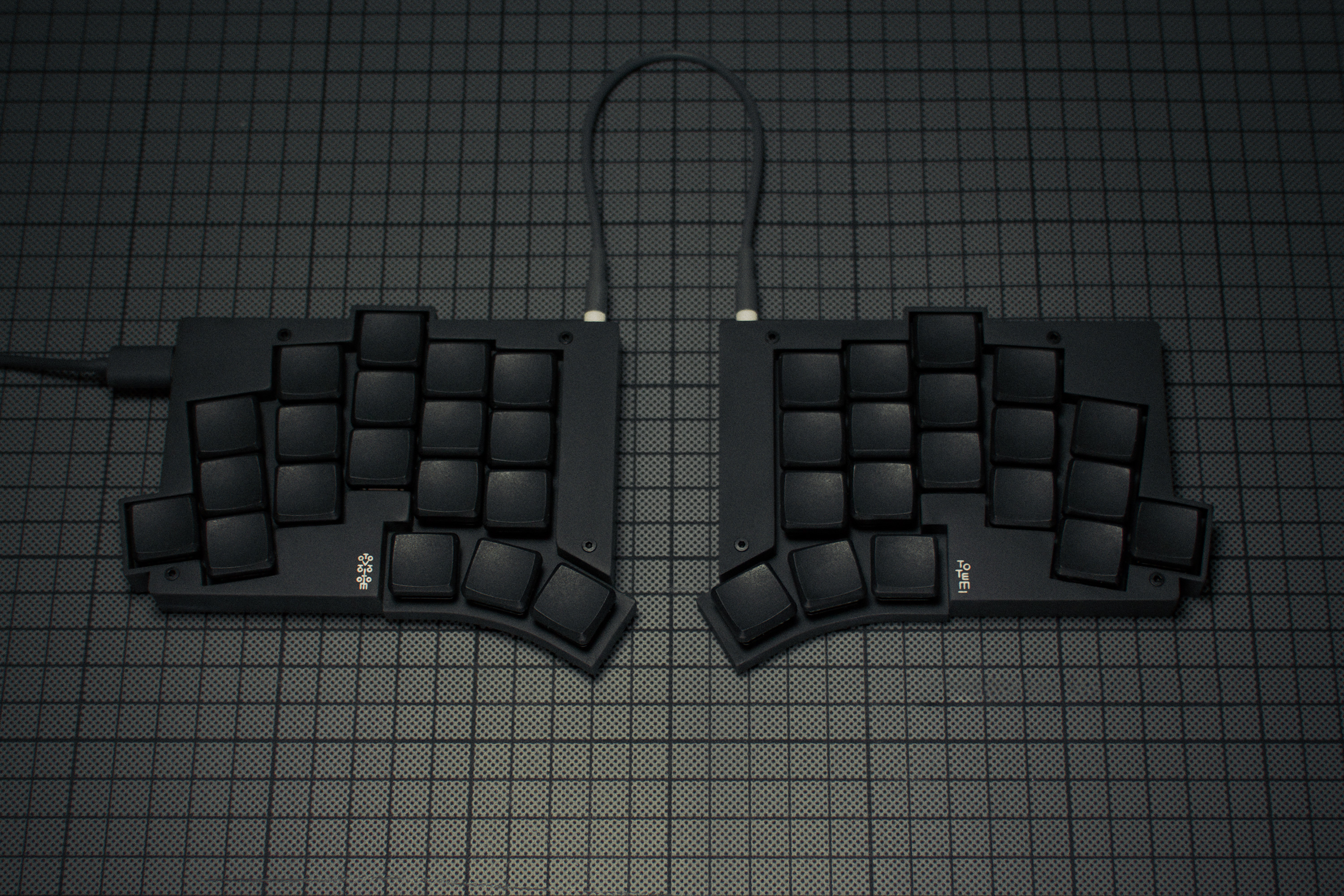
This is the TOTEM with a black resin tenting bottom plate
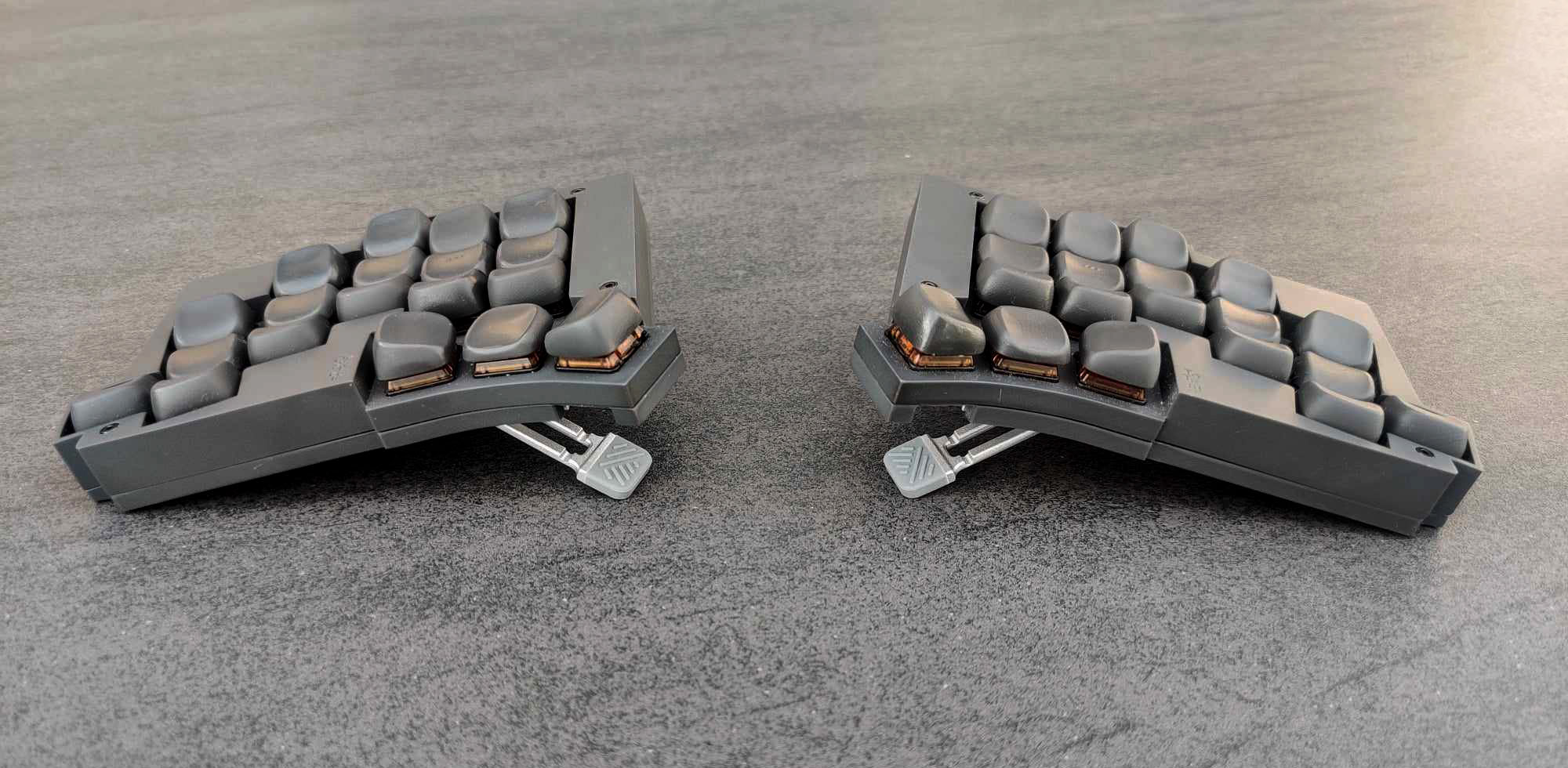
Video by Wolfgang's Channel showing the tenting system in action
I've added the additional pinky key to make the TOTEM compatible with the layout boards like the Balbuzard by Tom Brow and the Osprette by Sam Mohr use, where you put the keybinding of the top left and right keys on an outer pinky key.
People who helped me create this board and fix stuff
If you build a TOTEM I would be pretty happy to see some pictures. And if you want to leave me a tip you can do this here (but please don't feel pressured)
| Qty | Value | Footprint | References |
|---|---|---|---|
| 37 | D_Small | TOTEMlib:Diode_SOD123 | DL1, DL2, DL3, DL4, DL5, DL6, DL10, DL11, DL12, DL13, DL14, DL15, DL16, DL17, DL18, DL19 +21 |
| 37 | SW_Push_45deg | TOTEMlib:Kailh_socket_PG1350_optional | SWL1, SWL2, SWL3, SWL4, SWL5, SWL6, SWL10, SWL11, SWL12, SWL13, SWL14, SWL15, SWL16, SWL17, SWL18, SWL19 +21 |
| 15 | 100n X7R | C_0603_1608Metric | C202, C301, C302, C303, C304, CLEDL1, CLEDL2, CLEDL3, CLEDL4, CLEDL5, CLEDR1, CLEDR2, CLEDR3, CLEDR4, CLEDR5 |
| 10 | WS2812C-2020-V1 | Worldsemi_WS2812C-2020_PLCC4 | LEDL1, LEDL2, LEDL3, LEDL4, LEDL5, LEDR1, LEDR2, LEDR3, LEDR4, LEDR5 |
| 2 | 1.0k split RX contention limit | R_0603_1608Metric | R403, R404 |
| 2 | 100n X7R split buffer | C_0603_1608Metric | C401, C402 |
| 2 | 10u 10V X5R | C_0805_2012Metric | CLINKL1, CLINKR1 |
| 2 | 10u 10V X5R DNP - USB inrush limit | C_0805_2012Metric | CBULKL1, CBULKR1 |
| 2 | 330R | R_0603_1608Metric | RLEDL1, RLEDR1 |
| 2 | 330R split TX source | R_0603_1608Metric | R401, R402 |
| 2 | 47k 1% cable RX pull-down | R_0603_1608Metric | R411, R421 |
| 2 | 47k 1% local TX pull-up | R_0603_1608Metric | R412, R422 |
| 2 | 5.6k 1% | R_0603_1608Metric | R201, R202 |
| 2 | 59.0k 1% (500mA ILIM) | R_0603_1608Metric | R301, R302 |
| 2 | MJ-4PP-9 | TOTEMlib:MJ-4PP-9_1side | J1, J2 |
| 2 | SN74LVC2G14DCKR | SOT-363_SC-70-6 | U5, U6 |
| 2 | TPS2553DBVR-1 | SOT-23-6 | U3, U4 |
| 2 | Waveshare RP2040-Zero (castellated) | Waveshare_RP2040-Zero_Castellated_2x09 | U1, U2 |
| 1 | 100n DNP | C_0603_1608Metric | C201 |
| 1 | 10k DNP | R_0603_1608Metric | R203 |
| 1 | 1u X7R | C_0603_1608Metric | C203 |
| 1 | Molex 200528-0080 (SK8707 host) | Molex_200528-0080_1x08-1MP_P1.00mm_Horizontal | J3 |
| 1 | Sprintek SK8707-01-008 | Sprintek_SK8707-01-008_Mechanical_Mount | TP1 |
The 132 most common of 144 parts.
juicebox6030/Nova-Link
NOVA-LINK is an open, low-latency wireless communication protocol and firmware stack designed for use in real-time live event environments.

smartbank-inc/Board43
Board43 is an RP2350A-based microcontroller development board. Flash PicoRuby or your favorite firmware and start hacking.


ItsNotDaan/LiberBoard
LiberBoard: An open-source, modular platform for learning electronics. Offers LiBo ARM-based PCBs and add-on boards with practical exercises and code snippets. Designed for easy learning and project creation.

cepetr/blue2joy
Bluetooth HID adapter for Atari 8-bit computers: use modern BLE gamepads or mice to emulate the Atari joystick and paddles.
It measures 258.8 × 94.4 mm and has 4 copper layers, 1.6 mm thick.
144 parts, built around the SN74LVC2G14DCKR, TPS2553DBVR-1 and WS2812C-2020-V1. The full list of its parts is on this page, with links to each part's symbol and footprint where PCBKit's library has them.
From the DhruvBhatia0/BlueBird repository on GitHub, at the commit this page was made from: the board is PCB/totem_trackpoint/totem_trackpoint.kicad_pcb and its schematic PCB/totem_0-3/totem_0_3.kicad_sch. PCBKit opens the board in the browser, with nothing to install.
Its repository publishes it under the CERN-OHL-P-2.0 licence: you may reuse it on that licence's terms (keep the author's notice, and for a copyleft licence share your changes alike).