2 layers68.3 × 90 mm
ModuleController
dennis9819/split-flap-controller
Sourcecode and Schematics for the controller of my split-flap display
25 partsAGPL-3.0
 dennis9819/split-flap-controller
Sourcecode and Schematics for the controller of my split-flap display
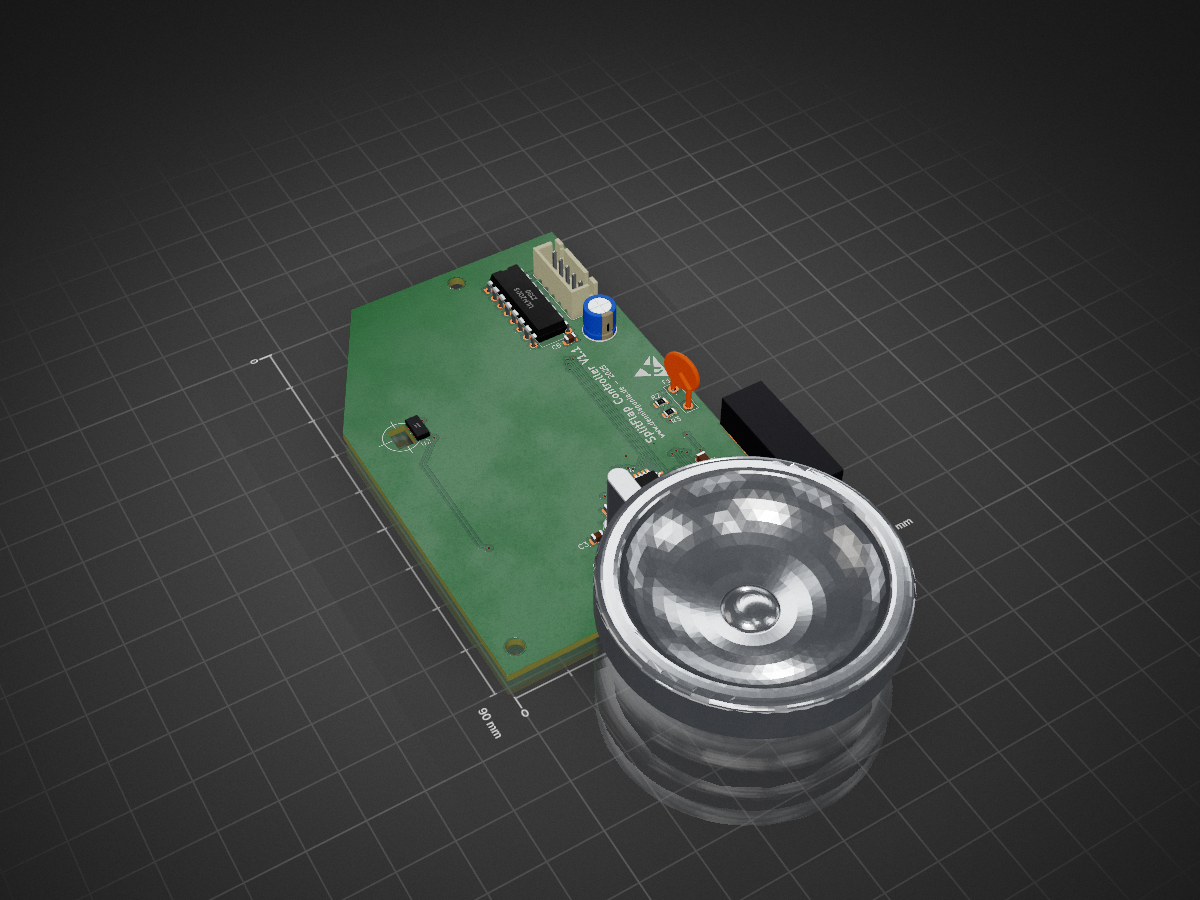
ModuleController old is an open-source printed circuit board by dennis9819, from the dennis9819/split-flap-controller repository on GitHub, published under the AGPL-3.0 licence. It is a 2-layer board of 68.3 × 90 mm with 25 parts on 42 nets, routed with 326 tracks and 55 vias.
It is built around the ATMEGA8A-AU, SN75176AP and ULN2003, with the RXEF010 among its other parts. Its parts include 8 capacitors, 4 resistors, 4 ICs, 2 connectors and 1 crystal. It belongs with the lEDs and displays boards and the AVR (ATmega, ATtiny) boards of this library.


Welcome to split-flap-controller, the firmware + hardware design for driving a modular, scalable split-flap display system.

Development of this project began in 2024 with the goal of creating a robust, DIY split-flap display that anyone can build and customize themselves. Inspired by the iconic Frankfurt Airport display, this project aims to recreate the nostalgic mechanical aesthetic and characteristic flipping sound that made those displays so memorable.
Ongoing Project! This repository is not final.
This display is designed in Fusion360. All schematics and boards are designed in KiCAD 9.
Most parts can be 3d printed. The modular backpanel needs to be fabricated from sheetmetal. You can use suppliers like JLCPCB for manufacturing or design a different 3d printable solution.
If you want to generate custom flaps, you can find my flap generator here: split-flap-generator
This project is open source and available under the AGPL-3.0 License.
Each Module pulls arround 110mA. This is roughly 1.4W of power. This can be reduced by turning off the motors in idle.
This is a 3D printable, expandable split flap display based on the original design of David Königsmann. This version uses his drum and flap design but completly redesigns the rest of the system.
The firmware as well as the Server is completly rewritten from scratch.
Feel free to checkout his more affordable and diy friendly design.
| Qty | Value | Footprint | References |
|---|---|---|---|
| 4 | 100n | Capacitor_SMD:C_0805_2012Metric | C5, C6, C7, C8 |
| 3 | 10k | Resistor_SMD:R_0805_2012Metric | R1, R2, R4 |
| 3 | MountingHole | MountingHole:MountingHole_3.2mm_M3 | H1, H2, H3 |
| 2 | 22p | Capacitor_SMD:C_0805_2012Metric | C3, C4 |
| 1 | 10u 16V | Capacitor_SMD:C_1206_3216Metric | C2 |
| 1 | 10u 35V | Capacitor_THT:CP_Radial_D6.3mm_P2.50mm | C1 |
| 1 | 16,0000-HC49U-S | Crystal:Crystal_HC49-U_Vertical | Y1 |
| 1 | 1k | Resistor_SMD:R_0805_2012Metric | R3 |
| 1 | 2x08 Edge Connector | Dennis:Card Edge 16 power | J6 |
| 1 | A1101 | Dennis:UA A1101 | U2 |
| 1 | ATmega8A-A | Package_QFP:TQFP-32_7x7mm_P0.8mm | U4 |
| 1 | JST B5B-XH-A | Connector_JST:JST_XH_B5B-XH-A_1x05_P2.50mm_Vertical | J1 |
| 1 | Jumper Addr-Reset | Jumper:SolderJumper-2_P1.3mm_Open_Pad1.0x1.5mm | JP1 |
| 1 | RXEF010 | Capacitor_THT:C_Disc_D7.5mm_W2.5mm_P5.00mm | F1 |
| 1 | SN75176AP | Package_DIP:DIP-8_W7.62mm | U3 |
| 1 | ULN2003 | Package_DIP:DIP-16_W7.62mm | U1 |
The 24 most common of 25 parts.
It measures 68.3 × 90 mm and has 2 copper layers, 1.6 mm thick.
25 parts, built around the ATMEGA8A-AU, SN75176AP, ULN2003 and RXEF010. The full list of its parts is on this page, with links to each part's symbol and footprint where PCBKit's library has them.
From the dennis9819/split-flap-controller repository on GitHub, at the commit this page was made from: the board is cad/Schematics/module_controller/ModuleController_old.kicad_pcb and its schematic cad/Schematics/module_controller/ModuleController.kicad_sch. PCBKit opens the board in the browser, with nothing to install.
Its repository publishes it under the AGPL-3.0 licence: you may reuse it on that licence's terms (keep the author's notice, and for a copyleft licence share your changes alike).
dennis9819/split-flap-controller
Sourcecode and Schematics for the controller of my split-flap display

dennis9819/split-flap-controller
Sourcecode and Schematics for the controller of my split-flap display


probably-Erwins-Cat/Circuit-Nodes
Circuit Nodes is an educational tool shared under CC BY-NC-SA 4.0 to help students understand electronic circuits by physically building them.

oomlout/oomlout_oomp_project_bot_v_2

KALTCHUK/Z80_Modular_Computer
"Anyone who has brought up CP/M on a homebuilt computer has felt this moment of elation. A myriad of connections are properly closed; bits are flying at lightning speeds over busses and through circuits and program…

thorpej/nabu-keyboard-usb
Adapter to connect to a NABU PC keyboard via USB

VirtualConcrete/HUB12Controller
The board is a simple Arduino Nano --> HUB12 adapter with DMX input using the SN75176 differential bus transciver. XLR 3 pin is used for DMX input. The power supply is +5V via screw terminals.

nichtrami/led_tube
A LED Tube that works wireless and runs on a ESP32 with Arduino Framework