2 layers40 × 50 mm
Módulo Patas
Deivs117/SALLI
SALLI: Open-source project for a bio-inspired autonomous salamander robot. Includes CAD designs, custom PCB hardware, and firmware for efficient land locomotion and stability.
9 parts

 Deivs117/SALLI
SALLI: Open-source project for a bio-inspired autonomous salamander robot. Includes CAD designs, custom PCB hardware, and firmware for efficient land locomotion and stability.
Módulo Cabeza is an open-source printed circuit board by Deivs117, from the Deivs117/SALLI repository on GitHub. It is a 2-layer board of 37.5 × 31.5 mm with 6 parts on 17 nets, routed with 13 tracks and 0 vias.
SALLI is an open-source, low-cost, and modular mechatronic platform designed to study bio-inspired terrestrial locomotion. Drawing inspiration from the sprawling gait of the salamander, this project integrates custom 3D-printed mechanical linkages, dedicated modular printed circuit boards (PCBs), lightweight embedded ESP-IDF firmware, and high-level Python control algorithms.
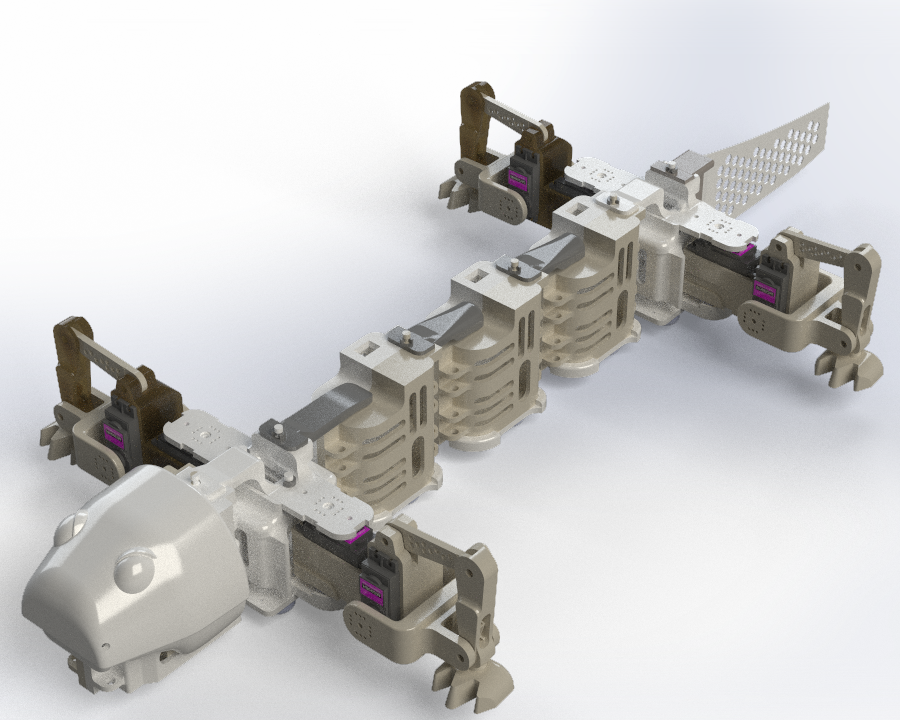
Traditional robotics platforms often suffer from high manufacturing costs, complex monolithic assemblies, and poor reparability. SALLI was conceived under a different paradigm:
The project is structurally divided into four cohesive domains:
graph TD
    A[Control Codes - Python PC] <-->|UDP over Wi-Fi| B[Firmware - ESP-IDF Master AP]
    B <-->|UDP Multicast / Serial Bus| C[Firmware - ESP-IDF Slave Node]
    B -->|PWM Signals| D[Custom PCBs / Power Rails]
    C -->|PWM Signals| D
    D -->|Actuation| E[CAD 3D - Physical Modules]
CAD_3D/ (Mechanical Architecture): Multi-segment structure utilizing bio-mimetic joint limits and sprawling kinematics.PCBs/ (Electrical Architecture): Modular bus system delivering isolated power lines (to prevent servo-induced voltage brownouts) and standardized signal traces.Firmware/ (Embedded Systems): High-efficiency ESP-IDF C-code implementing an Access Point control loop and UDP-based communication over ESP32-C3 chips.ControlCodes/ (High-Level Control & Autonomy): Python orchestrator supporting manual teleoperation, automatic parameter identification, and servo calibration.SALLI/
├── .gitignore # Global file and directory exclusions
├── README.md # Root-level project documentation (This file)
│
├── CAD_3D/ # Mechanical assemblies and components
│ ├── Cabeza V3/ # Sensory head module
│ ├── Cola/ # Stabilizing tail segment
│ ├── Ensamble Total/ # Master digital design assembly
│ ├── Módulo de Patas V3/ # Sprawling leg kinematics module
│ ├── Oscilatorio V4/ # Daisy-chainable spinal segments
│ └── Patines/ # Passive ground contact slide-pads
│
├── ControlCodes/ # High-level Python control ecosystem
│ ├── Calibration.py # Multi-servo offset calibration utility
│ ├── SALLI.py # Core autonomy and CPG state engine
│ └── Teleoperation.py # Human-in-the-loop manual controller
│
├── Firmware/ # Low-level ESP-IDF software
│ ├── Acces Point Sally/ # Master AP, computational control, and state processor
│ └── WIFI_Movement/ # Slave node receiver executing raw joint positions
│
└── PCBs/ # Electrical schematic and board layouts
├── Camera/ # Visual feedback capture module
├── HeadModule/ # Central micro-controller carrier PCB
├── Legs_Module/ # High-current servo driver PCB
└── Oscilatory/ # Passive signal-passthrough spine PCBSALLI's movement is mathematically governed by a Central Pattern Generator (CPG) model. This system represents networks of coupled neural oscillators that generate rhythmic patterns without sensory feedback.
The phase relation between the body segments ($i$) and limbs ($j$) is modeled using coupled differential equations:
$$\frac{d\theta_i}{dt} = 2\pi \nu_i + \sum_{j} w_{ij} \sin(\theta_j - \theta_i - \phi_{ij})$$
Where:
This math is processed in real-time between the ControlCodes layer and the Firmware layer to ensure fluid, life-like movements.
To clone the repository and initialize the project:
git clone [https://github.com/YourUsername/SALLI.git](https://github.com/YourUsername/SALLI.git)
cd SALLIThis project was developed at Universidad Autónoma de Occidente (UAO), Cali, Colombia, within the Faculty of Engineering. It serves as an open-source platform to advance research in bio-inspired robotics, kinetic efficiency, and distributed embedded networks.
| Qty | Value | Footprint | References |
|---|---|---|---|
| 4 | Supply | Connector_PinHeader_2.54mm:PinHeader_1x02_P2.54mm_Vertical | SUP1, SUP2, SUPCAM1, SWITCH1 |
| 2 | Conn_01x08 | Connector_PinSocket_2.54mm:PinSocket_1x08_P2.54mm_Vertical | ESP1, ESP2 |
Deivs117/SALLI
SALLI: Open-source project for a bio-inspired autonomous salamander robot. Includes CAD designs, custom PCB hardware, and firmware for efficient land locomotion and stability.

Deivs117/SALLI
SALLI: Open-source project for a bio-inspired autonomous salamander robot. Includes CAD designs, custom PCB hardware, and firmware for efficient land locomotion and stability.

Deivs117/SALLI
SALLI: Open-source project for a bio-inspired autonomous salamander robot. Includes CAD designs, custom PCB hardware, and firmware for efficient land locomotion and stability.

byrantech/laptop
anyon_e, a highly integrated, high end, open source laptop. Attempt the impossible.


Jcparkyn/dpoint
Open-source digital stylus using camera tracking and inertial measurements

VoronDesign/Voron-Hardware
Cool Hardware designed by the Voron Design group

hoglet67/RGBtoHDMI
Bare-metal Raspberry Pi project that provides pixel-perfect sampling of Retro Computer RGB/YUV video and conversion to HDMI

hackclub/OnBoard
💡 Join 1,000 teenagers and make your first PCB with a $100 grant!

Luos-io/luos_engine
Open-source and real-time orchestrator for cyber-physical-systems, to easily design, test and deploy embedded applications and digital twins.

It measures 37.5 × 31.5 mm and has 2 copper layers, 1.6 mm thick.
6 parts. The full list of its parts is on this page, with links to each part's symbol and footprint where PCBKit's library has them.
From the Deivs117/SALLI repository on GitHub, at the commit this page was made from: the board is PCBs/HeadModule/Módulo Cabeza.kicad_pcb and its schematic PCBs/Camera/Cámara.kicad_sch. PCBKit opens the board in the browser, with nothing to install.
Its repository states no licence, so its author keeps all rights: ask Deivs117 before reusing the design.