2 layers233.1 × 122.9 mm
 ddacot/fpga-cluster-framework1
This is
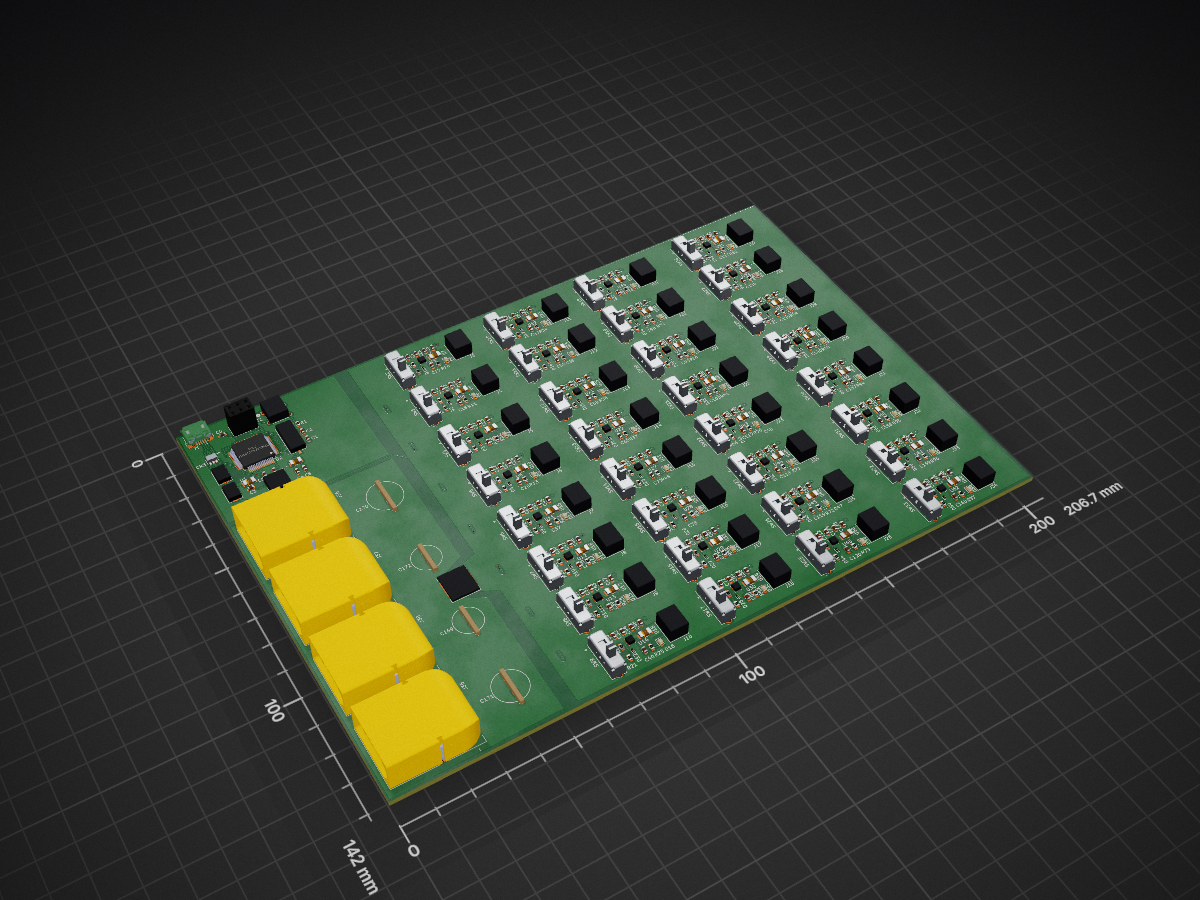
Power delivery is an open-source printed circuit board by ddacot, from the ddacot/fpga-cluster-framework repository on GitHub. It is a 4-layer board of 206.6 × 142 mm with 477 parts on 256 nets, routed with 2,240 tracks and 174 vias.
It is built around the B2B-XH-A, CPDQC5V0U-HF and XT90PW-M.G.Y, with the 3SMBJ5925B-TP, SC32S-7PF20PPM and TS02-66-50-BK-100-LCR-D among its other parts. Its parts include 172 capacitors, 97 resistors, 66 ICs, 64 diodes and 38 connectors. It belongs with the power boards and the STM32 boards of this library.


A scalable, FPGA-based cluster framework for parallel data acquisition and repeatable evaluation of hardware primitives (e.g., TRNGs, PUFs, and other custom bitstream-generating DUTs). The framework combines:
This repository is organized to include technical documentation, scripts, RTL, tooling, and PCB designs for the cluster setup.
If you are using this repository as part of a research portfolio, this README is written to be self-contained and reproducible for third parties who want to understand or rebuild the system.
This framework is designed to make it practical to collect large, statistically meaningful datasets from hardware primitives across many FPGA instances, enabling you to:
Typical use cases:
Data path (capture pipeline):
Control path (orchestration):
This framework typically targets FPGA boards with:
Update with your tested hardware:
Cluster setup notes (practical considerations):
Typical host environment requirements:
make, bash, tclTested tool versions (fill in):
Python requirements:
scripts/requirements.txtgit clone https://github.com/ddacot/fpga-cluster-framework.git
cd fpga-cluster-framework| Qty | Value | Footprint | References |
|---|---|---|---|
| 131 | 4.7uF | power_delivery_footprints:C_0603_1608Metric | C10, C11, C100, C101, C102, C103, C104, C105, C106, C107, C108, C109, C110, C111, C112, C117 +115 |
| 65 | 10k | power_delivery_footprints:R_0603_1608Metric | R1, R2, R3, R14, R15, R16, R17, R18, R19, R20, R21, R26, R27, R28, R29, R30 +49 |
| 33 | 0.1uF | power_delivery_footprints:C_0603_1608Metric | C13, C14, C15, C16, C113, C114, C115, C116, C133, C134, C135, C136, C153, C154, C155, C156 +17 |
| 33 | C1T 2.5 | power_delivery_footprints:0685T2500 | U1, U10, U15, U16, U17, U18, U23, U24, U25, U26, U31, U32, U33, U34, U39, U40 +17 |
| 32 | 100 | power_delivery_footprints:R_0603_1608Metric | R10, R11, R12, R13, R22, R23, R24, R25, R34, R35, R36, R37, R46, R47, R48, R49 +16 |
| 32 | B2B-XH-A | power_delivery_footprints:B2B-XH-A | J10, J11, J12, J13, J14, J15, J16, J17, J18, J19, J20, J21, J22, J23, J24, J25 +16 |
| 32 | CPDQC5V0U-HF | power_delivery_footprints:CPDQC5V0U-HF | D1, D2, D3, D10, D11, D12, D17, D18, D19, D20, D25, D26, D27, D28, D33, D34 +16 |
| 32 | LED | power_delivery_footprints:LED_0603_1608Metric | D13, D14, D15, D16, D21, D22, D23, D24, D29, D30, D31, D32, D37, D38, D39, D40 +16 |
| 32 | SW_SP3T | power_delivery_footprints:DIP4_SP3T-TOP_4P3X8P6_CNK | SW2, SW10, SW11, SW12, SW13, SW14, SW15, SW16, SW17, SW18, SW19, SW20, SW21, SW22, SW23, SW24 +16 |
| 32 | TPS22965NDSGR | power_delivery_footprints:TPS22965NDSGR | U3, U11, U12, U13, U14, U19, U20, U21, U22, U27, U28, U29, U30, U35, U36, U37 +16 |
| 4 | XT90PW-M | power_delivery_footprints:AMASS_XT90PW-M | J35, J36, J37, J38 |
| 2 | 15pF | power_delivery_footprints:C_0603_1608Metric | C4, C6 |
| 2 | 32pF | power_delivery_footprints:C_0603_1608Metric | C1, C2 |
| 2 | 3SMBJ5925B-TP | power_delivery_footprints:DIODE_DO-214AA_4P38X3P62_MCC | CR1, CR2 |
| 1 | 100uF | power_delivery_footprints:50ZLH100MEFC8X11.5 | C169 |
| 1 | 10uF | power_delivery_footprints:UVC2G100MPD | C171 |
| 1 | 2.2u | power_delivery_footprints:400LLE2R2MEFC8X11.5 | C172 |
| 1 | 220uF | power_delivery_footprints:ECA1HM221B | C170 |
| 1 | 3-140-172 | power_delivery_footprints:FUSE_3-140-172_SCH | F1 |
| 1 | Conn_02x03_Top_Bottom | power_delivery_footprints:PinSocket_2x03_P2.54mm_Vertical | J2 |
| 1 | ECS-250-18-5PX-F-TR | power_delivery_footprints:CRYSTAL_ECS-250-18-5PX-F-TR_ECS | XTAL1 |
| 1 | LP38692MP-3.3_NOPB | power_delivery_footprints:LP38692MP-3.3_NOPB | VR1 |
| 1 | SC32S-7PF20PPM | power_delivery_footprints:XTAL_SC32S-7PF20PPM_EPS | XTAL2 |
| 1 | STM32F401RCT6TR | power_delivery_footprints:STM32F401RCT6TR | U2 |
| 1 | TS02-66-50-BK-100-LCR-D | power_delivery_footprints:TS02-66-50-BK-100-LCR-D | SW1 |
| 1 | USBLC6-2SC6 | power_delivery_footprints:USBLC6-2SC6 | CR3 |
| 1 | USB_B_Micro | power_delivery_footprints:USB_Micro-B_Amphenol_10103594-0001LF_Horizontal | J1 |

hvtran21/SWAN
UMass Amherst ECE Senior Design Project - SWAN - A more secure and user centered solution to wireless access control.

ugv-dtu/electronics_2026
This repository contains 2 firmware projects, each for a different operational mode of the Rover. Only one folder is flashed to Teensy at a time — either autonomous or manual.

VTC-WISDOM/node_hardware
Schematic/PCB designs for WiSDOM nodes, also includes a few other related hardware projects


EcoApi/EcoApi_BeeHiveMonitoring
describ options with 0R resistors. etc ...

Rustaphor/LightRelay4Camping
Analog light sensor to night power up LED garland. For Camping use.

HYLDAIC/Flagshep-V1_Audio-Player
A high fidelity semi-portable audio player student project with provided PCB files, 3D files and Code
It measures 206.6 × 142 mm and has 4 copper layers, 1.73 mm thick.
477 parts, built around the B2B-XH-A, CPDQC5V0U-HF, XT90PW-M.G.Y and 3SMBJ5925B-TP. The full list of its parts is on this page, with links to each part's symbol and footprint where PCBKit's library has them.
From the ddacot/fpga-cluster-framework repository on GitHub, at the commit this page was made from: the board is hardware/power_delivery/power_delivery.kicad_pcb and its schematic hardware/jtag_pcb/connectors0.kicad_sch. PCBKit opens the board in the browser, with nothing to install.
Its repository states no licence, so its author keeps all rights: ask ddacot before reusing the design.