
2 layers69.4 × 113 mm
 DCentralTech/DCENT_ExpansionPack
It is built and produced at JLCPCB so anyone, anywhere can buy one, build one, or fork the design.
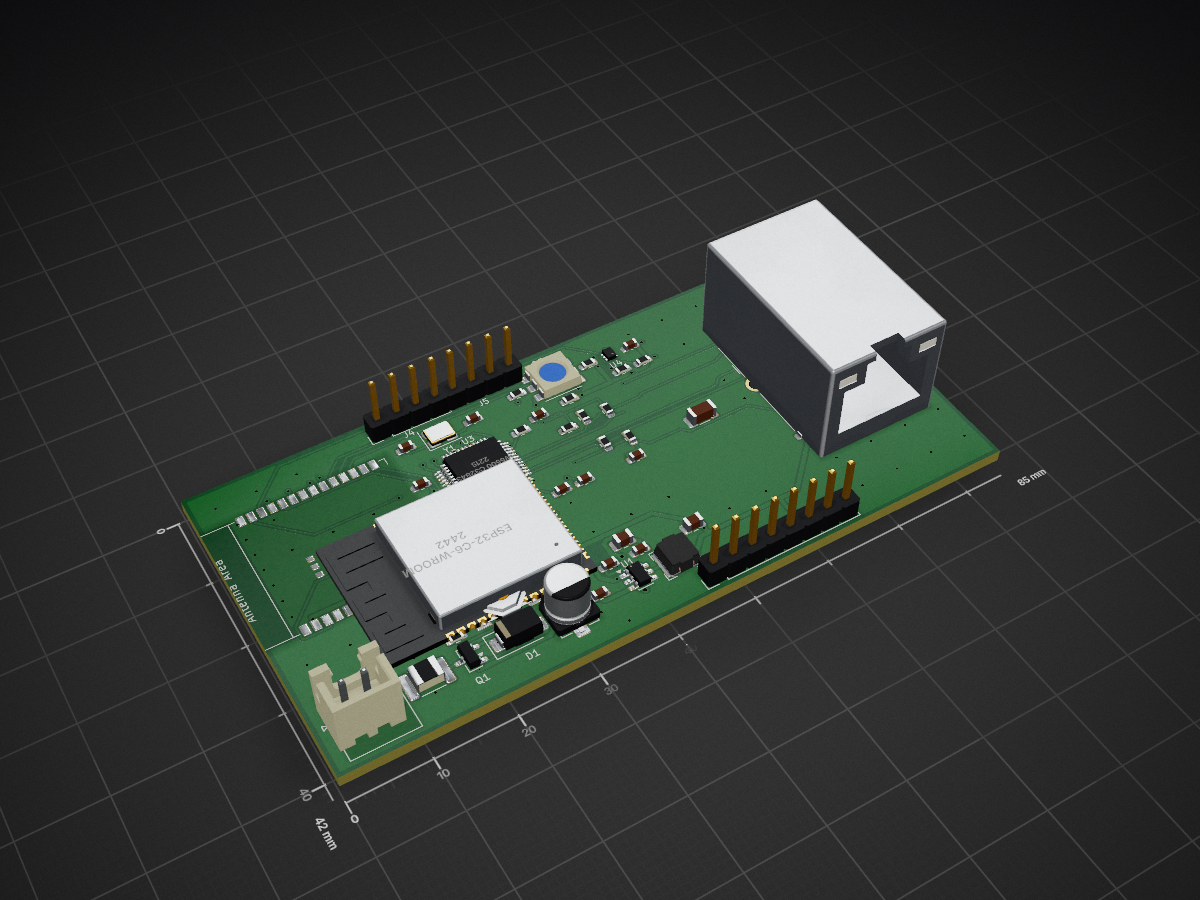
DCENT ExpansionPack is an open-source printed circuit board by DCentralTech, from the DCentralTech/DCENT_ExpansionPack repository on GitHub, published under the MIT licence. It is a 6-layer board of 85 × 42 mm with 59 parts on 47 nets, routed with 820 tracks and 148 vias.
It is built around the ESP32-C6-WROOM-1-N8. Its parts include 22 capacitors, 20 resistors, 5 connectors, 4 ICs and 3 diodes. It belongs with the ESP32 and RISC-V boards of this library.






The miner-side Expansion Pack for DCENT_OS. Plug it in, scan a QR code, and your Antminer is on Wi-Fi — no travel router, no IP hunting, no closed-source bridge firmware.
DCENT_ExpansionPack (a.k.a. DCENT_XPack) is a small, low-cost, open-source extension board for industrial Bitcoin miners running DCENT_OS. The name is a deliberate N64 joke: clip it onto your miner and DCENT_OS levels up — gaining home Wi-Fi, an OLED status display, optional Bitaxe Touch–style accessories, and external temperature feedback for Mining Heating mode.
It is built and produced at JLCPCB so anyone, anywhere can buy one, build one, or fork the design.
Open-hardware design freeze — PCB v0.1. The board design is complete and
fab-ready: a 6-layer ESP32-C6 + W5500 bridge, schematic ERC clean, DRC
error-clean, fully routed, with a JLCPCB-ready Gerber / BOM / CPL bundle and a
STEP 3D model in hardware/reports/. The next real-world
step is the first-article fab run and bench bring-up — no board has been
manufactured or hardware-validated yet. This is
an open invitation to build one, fork the design, or follow along.
The firmware is feature-complete on the ESP32-C6 (Wi-Fi STA + setup AP + captive portal + W5500 Ethernet + DHCP server + NAPT + mDNS + reverse proxy + signed-OTA scaffold + factory reset) and fits the flash budget with headroom.
| Rev | What | Status |
|---|---|---|
| v0.1 | 6-layer ESP32-C6 + W5500 bridge — the design in this repo | Fab-ready; first-article bring-up pending |
| v0.2 | Next revision — multi-SKU power inputs, USB-C, BAP-touch FFC, SHT30 temp/humidity | Planned |
See CHANGELOG.md for the v0.1 release notes.
| Top side (F.Cu + F.SilkS) | Bottom side (B.Cu + B.SilkS, mirrored) |
|---|---|
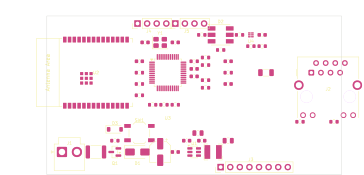 | 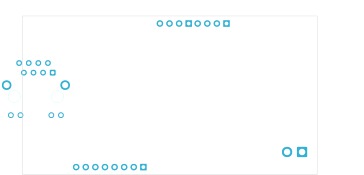 |
Regenerate with powershell -ExecutionPolicy Bypass -File scripts\render_pcb_preview.ps1.
Antminers, Avalons, and WhatsMiners ship with one network port and zero Wi-Fi. For institutional miners that's fine — they live in racks with structured cabling. For home miners, it's the single biggest onboarding pain point.
The status quo for "I want my Antminer on Wi-Fi" is:
None of these solve the real onboarding problem either: even after the miner is on the network, the user still has to find its IP address, log into the router admin page, and bookmark the right URL. New home miners get stuck here all the time.
DCENT_XPack replaces all of that with one small board that does four jobs:
http://dcent-pack-XXXX.local/. No IP lookups, ever.It is open hardware (KiCad sources in this repo) and open firmware (ESP-IDF sources in this repo), with a signed OTA path so the bridge stays updatable in the field without us touching it.
+--------------+        +-----------------------+        +----------------+
| Your home    |  Wi-Fi |  DCENT Expansion Pack | RJ45   |  Antminer /    |
| Wi-Fi router | <----> |  ESP32-C6 + W5500     | <----> |  Avalon /      |
| (2.4 GHz)    |        |  10.77.0.1/24         |        |  WhatsMiner    |
+--------------+        +-----------------------+        |  running       |
                                                         |  DCENT_OS      |
                                                         +----------------+
The bridge runs as a small managed router, not a fragile Layer-2 Wi-Fi bridge:
10.77.0.0/24) with a built-in
DHCP server and NAPT so the miner gets internet access transparently.dcent-pack-XXXX.local so you and DCENT_OS find the
miner without ever knowing its IP address.Your Wi-Fi password lives only on the bridge — the miner never sees it. A factory-reset button on the bridge wipes credentials cleanly without bricking anything.
dcent-pack-XXXX.local redirects to the miner.Bill of materials is JLCPCB-native — assembled basic and extended parts only, no hand-soldering required for a working board.
| Block | Part |
|---|---|
| Wi-Fi MCU | ESP32-C6-WROOM module (Wi-Fi 6 capable, 2.4 GHz) |
| Ethernet PHY | W5500 SPI Ethernet controller |
| Connector | RJ45 MagJack (HR911105A-class) |
| Power input | Protected 12 V → 3.3 V buck, 1 A min, 2 A preferred |
| Temperature | TMP102-class digital I²C sensor |
| Local display | Optional I²C OLED accessory plug |
| Touch display | Optional BAP UART accessory header |
| Setup UX | Per-unit QR sticker, setup/reset button, status RGB LED |
| Factory / dev | USB-C or UART header for flashing and serial logs |
Power input options are SKU-configurable (2-pin locking harness, 2.1 mm barrel, or Mini-Fit-style) so the same board fits different miner families and cable kits.
See hardware/ for the KiCad sources, the JLCPCB-ready fab bundle
(Gerbers / BOM / CPL), and the STEP 3D model.
DCENT_XPack pairs with any miner running DCENT_OS. Stock Bitmain firmware, BraiinsOS, VNish, and LuxOS are not pairing targets — the bridge is built around DCENT_OS's pairing contract.
| Miner family | Status |
|---|---|
| Antminer S9 (Zynq) | Supported (DCENT_OS sustained mining proven) |
| Antminer S17 / S19 / S19j Pro / S21 | Supported (DCENT_OS Zynq + Amlogic) |
| Antminer S19k Pro (Amlogic) | DCENT_OS port in progress |
| AvalonMiner (Canaan, K230 RISC-V) | Roadmap — DCENT_OS-Avalon in development |
| WhatsMiner M-series (H616 ARM) | Roadmap — DCENT_OS-WhatsMiner in development |
The bridge itself is miner-agnostic at the hardware level (12 V in, RJ45 out) and at the protocol level (the pairing contract is HTTP, not vendor-specific). As DCENT_OS expands to new platforms, DCENT_XPack picks them up for free.
DCENT_OS does not need to know anything about your Wi-Fi. It keeps Ethernet DHCP enabled and adds a tiny pairing client that:
10.77.0.2).10.77.0.1).http://<gateway>/pair.That's it. No custom kernel modules on the miner, no Wi-Fi drivers, no
credentials stored on the miner side. See
docs/DCENT_OS_BRIDGE_CLIENT.md for the
reference client implementation and
docs/PAIRING_FLOW.md for the full state machine.
See docs/ROADMAP.md for the full plan.
dcent-expansion-pack/
├── hardware/      KiCad schematic + PCB, BOM, JLCPCB review notes
├── firmware/      ESP-IDF C firmware for the ESP32-C6 bridge
├── docs/          Pairing flow, customer onboarding, API contracts, roadmap
├── scripts/       PCB preview + bench bring-up helper scripts
└── tools/         Bench tools and bring-up utilities
Highlights:
docs/CUSTOMER_ONBOARDING.md — five-minute
setup walkthrough (also in
French).docs/BRIDGE_API.md — REST API surface.docs/HOMEASSISTANT_INTEGRATION.md and
docs/ESPHOME_INTEGRATION.md — home-automation
hooks.D-Central Technologies is Canada's leading Bitcoin mining technology company. Founded in 2016 in Laval, Québec. Self-described Mining Hackers. 2,500+ miners repaired, 400+ products, and a stubborn belief that every industrial ASIC deserves a second life as a home space heater.
DCENT_XPack is part of the broader DCENT ecosystem:
Issues and pull requests are welcome. For hardware changes, please run
the KiCad ERC/DRC checks and attach the generated ERC/DRC/BOM report.
For firmware changes, please run the test suite under firmware/ and include
a serial log from a flashed board if your change touches Wi-Fi, Ethernet, or
the pairing flow.
If you find a security issue (auth bypass, credential leak, OTA-signing flaw), please email security@d-central.tech instead of opening a public issue.
| Qty | Value | Footprint | References |
|---|---|---|---|
| 7 | 100nF | C_0402_1005Metric | C16, C17, C18, C19, C20, C21, C22 |
| 2 | 12pF C0G | C_0603_1608Metric | C5, C6 |
| 1 | 1.1A hold/2.2A trip 30V 1812 polyfuse | Fuse_1812_4532Metric | F1 |
| 1 | 100nF 50V | C_0603_1608Metric | C2 |
| 1 | 100nF ETH_CT_BIAS | C_0603_1608Metric | C10 |
| 1 | 100nF TEMP local | C_0603_1608Metric | C7 |
| 1 | 100nF X7R 50V 0603 | C_0603_1608Metric | C15 |
| 1 | 100nF bootstrap | C_0603_1608Metric | C3 |
| 1 | 10R 1% ETH_CT_BIAS_FEED | R_0603_1608Metric | R15 |
| 1 | 10k ESP_BOOT_GPIO9_PULLUP | R_0603_1608Metric | R19 |
| 1 | 10k ESP_EN_PULLUP | R_0603_1608Metric | R18 |
| 1 | 10k Q1 gate pulldown 0603 | R_0603_1608Metric | R20 |
| 1 | 10k W5500_PMODE0_PULLUP | R_0603_1608Metric | R10 |
| 1 | 10k W5500_PMODE1_PULLUP | R_0603_1608Metric | R9 |
| 1 | 10k W5500_PMODE2_PULLUP | R_0603_1608Metric | R8 |
| 1 | 10k W5500_RST_STRAP_PULLUP | R_0603_1608Metric | R6 |
| 1 | 10nF W5500_1V2O | C_0603_1608Metric | C9 |
| 1 | 10uF ETH_CT_BIAS | C_0603_1608Metric | C11 |
| 1 | 12.4k 1% W5500_EXRES | R_0603_1608Metric | R7 |
| 1 | 12V Zener Vgs clamp SOD-123 | D_SOD-123 | D3 |
| 1 | 12V_IN (JST VH 2P 3.96mm) | JST_VH_B2P-VH_1x02_P3.96mm_Vertical | J1 |
| 1 | 1k BLUE | R_0603_1608Metric | R3 |
| 1 | 1k GREEN | R_0603_1608Metric | R2 |
| 1 | 1k RED | R_0603_1608Metric | R1 |
| 1 | 1nF 2kV CHASSIS_GND | C_1206_3216Metric | C12 |
| 1 | 1uF ESP_EN_RC | C_0603_1608Metric | C13 |
| 1 | 22uF 10V | C_0805_2012Metric | C4 |
| 1 | 22uF 25V | C_0805_2012Metric | C1 |
| 1 | 25MHz 9pF C0G | Crystal_SMD_3225-4Pin_3.2x2.5mm | Y1 |
| 1 | 330R RJ45_ACT_LED | R_0603_1608Metric | R17 |
| 1 | 330R RJ45_LINK_LED | R_0603_1608Metric | R16 |
| 1 | 4.7k I2C_SCL_PULLUP | R_0603_1608Metric | R4 |
| 1 | 4.7k I2C_SDA_PULLUP | R_0603_1608Metric | R5 |
| 1 | 4.7uF W5500_TOCAP | C_0603_1608Metric | C8 |
| 1 | 4.7uH 1.5A shielded | L_Bourns-SRN4018 | L1 |
| 1 | 47uF 25V SMD polymer bulk | CP_Elec_5x5.4 | C14 |
| 1 | 49R9 1% ETH_RXN_TERM | R_0603_1608Metric | R14 |
| 1 | 49R9 1% ETH_RXP_TERM | R_0603_1608Metric | R13 |
| 1 | 49R9 1% ETH_TXN_TERM | R_0603_1608Metric | R12 |
| 1 | 49R9 1% ETH_TXP_TERM | R_0603_1608Metric | R11 |
| 1 | AO3401A P-FET -30V SOT-23 | SOT-23 | Q1 |
| 1 | AP63203WU-7 3V3/2A | TSOT-23-6 | U1 |
| 1 | BAP_TOUCH_UART (1x4 hand-place; DNP v0.1, requires +5V buck) | PinHeader_1x04_P2.54mm_Vertical | J5 |
| 1 | ESP32-C6-WROOM-1-N8 | ESP32-C6-WROOM-1 | U2 |
| 1 | HR911105A C12074 | RJ45_Hanrun_HR911105A_Horizontal | J2 |
| 1 | OLED_I2C_QWIIC (1x4 2.54mm hand-place) | PinHeader_1x04_P2.54mm_Vertical | J4 |
| 1 | RGB_STATUS | LED_RGB_5050-6 | D2 |
| 1 | SETUP/RESET | SW_SPST_TL3342 | SW1 |
| 1 | SMAJ14CA bidir TVS Vrwm 14V | D_SMA | D1 |
| 1 | TMP102AIDRLR C99269 | TI_DRL0006A_SOT-563 | U4 |
| 1 | UART_USB_FACTORY (1x6 2.54mm hand-place) | PinHeader_1x08_P2.54mm_Vertical | J3 |
| 1 | W5500 C32843 | LQFP-48_7x7mm_P0.5mm | U3 |
It measures 85 × 42 mm and has 6 copper layers, 1.6 mm thick.
59 parts, built around the ESP32-C6-WROOM-1-N8. The full list of its parts is on this page, with links to each part's symbol and footprint where PCBKit's library has them.
From the DCentralTech/DCENT_ExpansionPack repository on GitHub, at the commit this page was made from: the board is hardware/kicad/dcent-expansion-pack/dcent-expansion-pack.kicad_pcb and its schematic hardware/kicad/dcent-expansion-pack/dcent-expansion-pack.kicad_sch. PCBKit opens the board in the browser, with nothing to install.
Its repository publishes it under the MIT licence: you may reuse it on that licence's terms (keep the author's notice, and for a copyleft licence share your changes alike).

jfm92/everAliveSensor
Solar-powered BLE environmental sensor (temp, humidity, pressure) with a 50F supercapacitor — potentially infinite lifetime, 19-day dark autonomy. ESP32 + BME680. Experimental.


Nicolai-Electronics/tanmatsu-hardware
Hardware design of the Tanmatsu mainboard


Abean2k/WizServoTester
A servo controller PCB that can control up to 4 servos using onboard controls and a simple web app.