Skip to the content
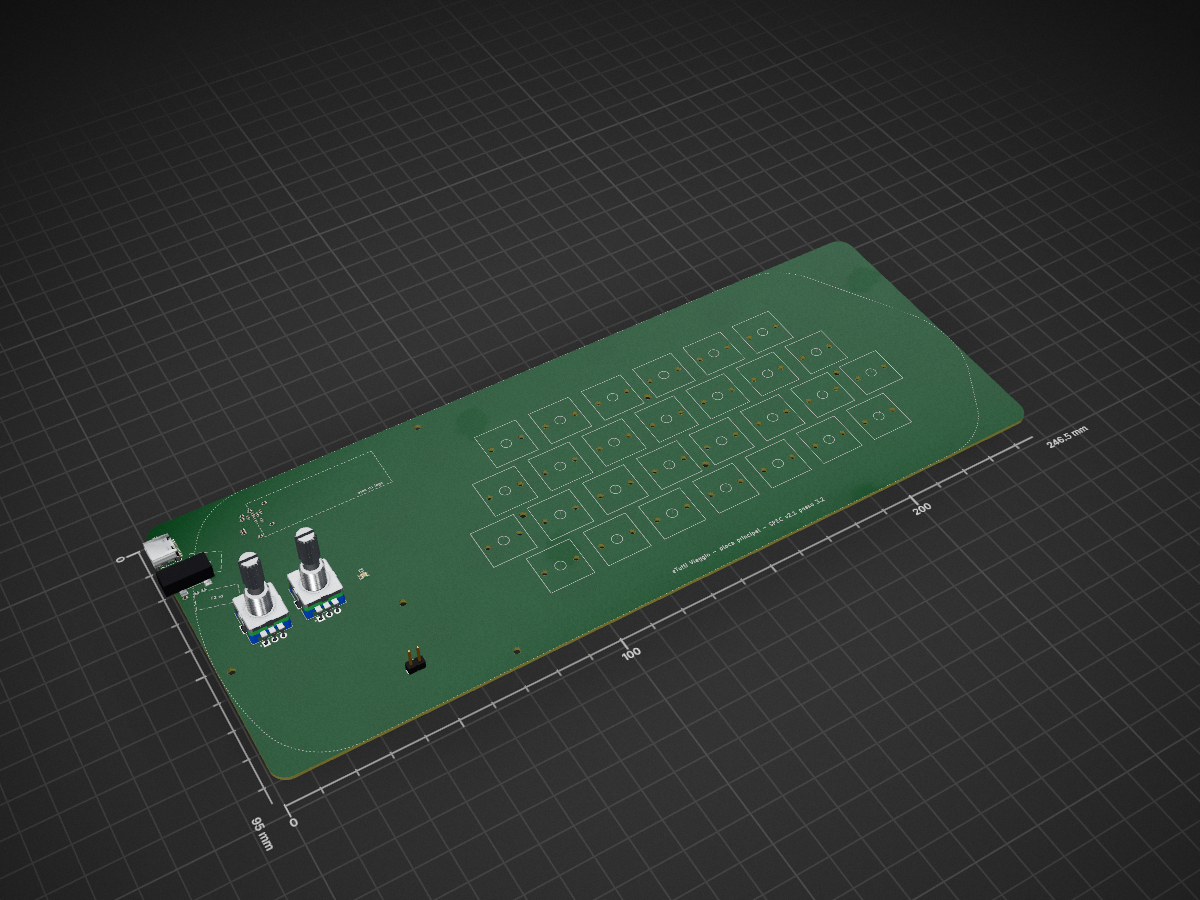
4 layers246.5 × 95 mmViaggio, the printed circuit board in 3D

A small web studio of fast, elegant, install-free music tools. Every tool is plain HTML, CSS and vanilla JavaScript with the Web Audio API — no build step, no dependencies, no accounts, works offline after first load.

Size
246.5 × 95 mm
Copper layers
4
Thickness
1.2 mm
Parts
215
Nets
249
Pads
956
Tracks, vias
0, 0
Pours
15
Routed
Yes
KiCad
KiCad 10.0 (file 20260206)
Created
17 Jun 2026
Updated
28 Oct 2026

Overview

Viaggio is an open-source printed circuit board by dataehora, from the dataehora/beatconfused repository on GitHub. It is a 4-layer board of 246.5 × 95 mm with 215 parts on 249 nets.

It is built around the MIMXRT1062DVJ6B, TMAG5253BA3IQDMRR and MAX98357AETE+T, with the SGTL5000XNLA3, W25Q64JVSSIM and 74LVC1G08Z among its other parts. Its parts include 79 capacitors, 46 ICs, 31 switches, 28 resistors and 10 diodes. It belongs with the NXP (LPC, Kinetis, i.MX RT) boards of this library.

Main components

12

README

README.md

BeatConfused

A small web studio of fast, elegant, install-free music tools. Every tool is plain HTML, CSS and vanilla JavaScript with the Web Audio API — no build step, no dependencies, no accounts, works offline after first load.

Live at beatconfused.com.

Tools

ToolPathWhat it does
Metronome/metronome/Tap tempo, organized time signatures, beat subdivisions, counting modes, sound styles, and pulse / number / pendulum visuals.
Tuner/tuner/Chromatic instrument tuner with needle, strobe and LED-meter displays, an adjustable A4 reference pitch, historical tuning standards, a test-tone generator, and a spectrum analyser.
Octave Strobe Tuner/strobetuner/Identifies the note being played and shows its tuning across every octave at once on a single strobe disc.
Chromatic Strobe Tuner/multistrobe/One dedicated strobe wheel per note, laid out like a piano keyboard, each with a ring per octave across the 88-key range.
Luthier Tuning/luthier/Live spectrogram for luthiers and tuners: a slowly decaying live spectrum over a peak-hold record of every frequency, a sustain waterfall, harmonic guides, and a full-range / audible-only toggle.

Repository layout

text
index.html            Studio landing page (tool cards + JSON-LD)
styles.css             Landing-page styles
metronome/             Metronome — index.html, script.js, styles.css, Assets/
tuner/                 Tuner — index.html, script.js, styles.css
strobetuner/           Octave Strobe Tuner — index.html, script.js, styles.css
multistrobe/           Chromatic Strobe Tuner — index.html, script.js, styles.css
luthier/               Luthier Tuning (spectrogram) — index.html, script.js, styles.css
etutti/                eTutti (work in progress, unlisted) — Web MIDI page, Teensy firmware/,
                       hardware/ (eTuttino board v0.7 + case SPEC v9), manuais/, models/
binfacevsfarage/       Standalone browser game (not linked from the studio)
shared/                Assets shared across tools
CNAME, robots.txt, sitemap.xml   Hosting + crawl metadata

Metronome controls

Tempo

  • Slider / input field — smooth or direct BPM entry (40–240)
  • +/- buttons — step by 5 BPM
  • Tap tempo — tap the button or press T to detect BPM
  • Arrow keys — Up / Down to adjust BPM

Beat settings

  • Time signature — organized simple, compound and odd meters
  • Beat subdivision — split each beat into more pulses
  • Tempo counting — beat count, measure + beat, or hidden
  • Beat visual — pulse, numbers, or pendulum
  • Sound style — electronic, bossa, jazz, wood, cymbal, cowbell
  • Sound / vibration toggles and volume control

Keyboard shortcuts

  • Space — start / stop
  • Arrow Up / Down — BPM ±5
  • T — tap tempo

Custom sounds

Drop {style}_{accent|beat|subdivision} audio files (.mp3, then .ogg, then .wav) into metronome/Assets/ and they replace the synthesised click for that combination. Anything not supplied keeps the built-in sound, so the metronome always has audio even with no custom assets.

Tuner controls

  • Start Tuner — vintage-style slide switch above the display; turns the microphone on. A "no signal" sign appears below the display after ~3s of silence while running.
  • Display — needle, strobe or LED meter
  • Input Monitor and Test Tone — collapsed by default; microphone gain boost and a live level meter, plus a pure tone (with its own frequency, fine-tuning and volume controls) fed straight into the tuner and the speakers, no mic needed — the same panel /strobetuner/ and /multistrobe/ use too
  • Spectrum Analyser — vintage or modern style
  • Tuning Standard and Reference Pitch — Equal Temperament plus Vallotti, Young II, 1/4-comma meantone and Just Intonation (each built from first principles), and an A4 reference from 392–466 Hz with historical presets (French Baroque, Baroque, Verdi, Standard, Modern, Italian Renaissance)
  • Frequency Table — every note of an 88-key piano (octaves down the rows, notes across the columns) under the selected Tuning Standard and Reference Pitch, with a live cents deviation next to whichever note is sounding

Luthier Tuning controls

  • Start Listening — the same slide switch as the tuners (or Space)
  • Full range / Audible only — everything the microphone captures (up to half its sample rate, with infrasound and ultrasound shaded) or just 20 Hz – 20 kHz
  • Live curve — the current spectrum; each frequency falls back at the Decay speed (dB/s) so a note's ring-out stays visible
  • Peak hold — the pale-blue background graph: the loudest level each frequency has reached since the last Reset peak hold. On keeps it until reset; Temporary holds each maximum for 2 s, then lets it fall at the same Decay speed as the live curve; Off hides it
  • Sustain history — a 12-second waterfall under the display
  • Cursor — hover / tap for frequency, nearest note, live and peak dB, plus dashed guides at 2×, 3×, 4×… to judge inharmonicity
  • Input gain — boosts quiet instruments

Technical stack

  • HTML5 / CSS3 — semantic structure, gradients and animations
  • Web Audio API — high-precision timing, autocorrelation pitch detection, Goertzel per-octave analysis for the strobe tools
  • Vanilla JavaScript — no dependencies, no build step
  • Structured data + crawl files — JSON-LD, robots.txt, sitemap.xml

Development

Everything is static — serve the repo root with any static file server:

bash
git clone https://github.com/dataehora/beatconfused.git
cd beatconfused
python3 -m http.server 8000
# then open http://localhost:8000/

Deployment

Served via GitHub Pages on the beatconfused.com domain (CNAME). Any static host with HTTPS works — no server-side code.

License

MIT License — feel free to use and modify.

Contributing

Contributions are welcome. Please open a Pull Request.

Parts

215
QtyValueFootprintReferences
40100nFCapacitor_SMD:C_0402_1005MetricC204, C205, C209, C212, C302, C304, C305, C308, C502, C601, C602, C603, C701, C702, C703, C704 +24
28Gateron_Magnetic_MX_1uviaggio:Gateron_Magnetic_MX_1uSW1, SW2, SW10, SW11, SW12, SW13, SW14, SW15, SW16, SW17, SW18, SW19, SW20, SW21, SW22, SW23 +12
28TMAG5253BA3IQDMRRPackage_SON:Texas_X2SON-4-1EP_1.1x1.4mm_P0.5mm_EP0.8x0.6mmU701, U702, U703, U704, U705, U706, U707, U708, U709, U710, U711, U712, U713, U714, U715, U716 +12
11220nFCapacitor_SMD:C_0402_1005MetricC103, C106, C110, C113, C115, C116, C118, C119, C124, C125, C126
8100kResistor_SMD:R_0402_1005MetricR101, R104, R206, R210, R211, R213, R215, R303
8MountingHole_2.2mm_M2MountingHole:MountingHole_2.2mm_M2H1, H2, H3, H4, H5, H6, H7, H8
710uFCapacitor_SMD:C_0805_2012MetricC201, C202, C203, C206, C207, C208, C501
7BAT54CPackage_TO_SOT_SMD:SOT-23D101, D102, D202, D203, D204, D205, D402
41MResistor_SMD:R_0402_1005MetricR208, R209, R212, R304
42.2uFCapacitor_SMD:C_0402_1005MetricC108, C301, C303, C306
474LVC1G08Package_TO_SOT_SMD:SOT-23-5U203, U206, U604, U605
34.7uFCapacitor_SMD:C_0402_1005MetricC109, C112, C114
2100Resistor_SMD:R_0402_1005MetricR105, R216
210kResistor_SMD:R_0402_1005MetricR205, R214
210nFCapacitor_SMD:C_0402_1005MetricC107, C111
210uFCapacitor_SMD:C_0603_1608MetricC101, C104
212pFCapacitor_SMD:C_0402_1005MetricC120, C121
21uFCapacitor_SMD:C_0402_1005MetricC210, C211
22.2kResistor_SMD:R_0402_1005MetricR301, R302
220pFCapacitor_SMD:C_0402_1005MetricC122, C123
24.7uFCapacitor_SMD:C_0603_1608MetricC102, C105
25.1kResistor_SMD:R_0402_1005MetricR201, R202
274HC4067PWPackage_SO:TSSOP-24_4.4x7.8mm_P0.65mmU601, U602
2AO3401APackage_TO_SOT_SMD:SOT-23Q201, Q203
2EC11E18244A5Rotary_Encoder:RotaryEncoder_Alps_EC11E-Switch_Vertical_H20mmSW401, SW402
11.5kResistor_SMD:R_0402_1005MetricR204
11.8kResistor_SMD:R_0402_1005MetricR203
110uFCapacitor_SMD:C_0402_1005MetricC117
1120R@100MHzInductor_SMD:L_0603_1608MetricL101
1150nFCapacitor_SMD:C_0402_1005MetricC307
11kResistor_SMD:R_0402_1005MetricR207
12.2MResistor_SMD:R_0402_1005MetricR102
12.2uHInductor_SMD:L_Changjiang_FNR4020SL201
124MHzCrystal:Crystal_SMD_3225-4Pin_3.2x2.5mmY101
1270Resistor_SMD:R_0402_1005MetricR401
132.768kHzCrystal:Crystal_SMD_3215-2Pin_3.2x1.5mmY102
1330Resistor_SMD:R_0402_1005MetricR402
14.7uHInductor_SMD:L_0805_2012MetricL102
1470Resistor_SMD:R_0402_1005MetricR103
1600R@100MHzInductor_SMD:L_0603_1608MetricFB301
1680kResistor_SMD:R_0402_1005MetricR501
174LVC1G04Package_TO_SOT_SMD:SOT-23-5U603
1AO3400APackage_TO_SOT_SMD:SOT-23Q202
1APS6404L-3SQR-ZRPackage_SON:Winbond_USON-8-1EP_3x2mm_P0.5mm_EP0.2x1.6mmU104
1BQ24074RGTRPackage_DFN_QFN:VQFN-16-1EP_3x3mm_P0.5mm_EP1.6x1.6mmU202
1MAX98357AETE+TPackage_DFN_QFN:TQFN-16-1EP_3x3mm_P0.5mm_EP1.23x1.23mmU501
1MIMXRT1062DVJ6Bviaggio:BGA-196_12x12mm_P0.8mm_RT1062U101
1PJ-327A 5JJviaggio:Jack_3.5mm_PJ-327A_SMDJ301
1PJRC MKL02 bootloader (Teensy 4.1)Package_DFN_QFN:QFN-16-1EP_3x3mm_P0.5mm_EP1.9x1.9mmU102
1ProgramButton_Switch_SMD:SW_Push_1P1T_XKB_TS-1187ASW403
1S3B-PH-SM4-TBConnector_JST:JST_PH_S3B-PH-SM4-TB_1x03-1MP_P2.00mm_HorizontalJ202
1SGTL5000XNLA3Package_DFN_QFN:QFN-20-1EP_3x3mm_P0.4mm_EP1.65x1.65mmU301
1SMF5.0ADiode_SMD:D_SOD-123FD201
1TJ-S1615SW6TGLCRG-A5viaggio:LED_1615_RG_4padD401
1TPS63001DRCRPackage_SON:Texas_DRC0010JU204
1TYPE-C-31-M-12Connector_USB:USB_C_Receptacle_HRO_TYPE-C-31-M-12J201
1USBLC6-2SC6Package_TO_SOT_SMD:SOT-23-6U201
1W25Q64JVSSIMPackage_SO:SOIC-8_5.3x5.3mm_P1.27mmU103
1XC6206P182MRPackage_TO_SOT_SMD:SOT-23-3U302
1XC6206P332MRPackage_TO_SOT_SMD:SOT-23-3U205
1alto-falante (fios)Connector_Wire:SolderWire-0.127sqmm_1x02_P3.7mm_D0.48mm_OD1mmJ501
1vermelhoLED_SMD:LED_0603_1608MetricD103

More from dataehora/beatconfused

6
  • 4 layers246.5 × 95 mmViaggio micromod, the printed circuit board in 3D

    Viaggio micromod

    dataehora/beatconfused

    A small web studio of fast, elegant, install-free music tools. Every tool is plain HTML, CSS and vanilla JavaScript with the Web Audio API — no build step, no dependencies, no accounts, works offline after first load.

    178 parts1
  • 4 layers242.2 × 94 mmPocket, the printed circuit board in 3D

    Pocket

    dataehora/beatconfused

    A small web studio of fast, elegant, install-free music tools. Every tool is plain HTML, CSS and vanilla JavaScript with the Web Audio API — no build step, no dependencies, no accounts, works offline after first load.

    155 parts1
  • 2 layers321.8 × 91 mmEtuttino, the printed circuit board in 3D

    Etuttino

    dataehora/beatconfused

    A small web studio of fast, elegant, install-free music tools. Every tool is plain HTML, CSS and vanilla JavaScript with the Web Audio API — no build step, no dependencies, no accounts, works offline after first load.

    148 parts1
  • 2 layers27.4 × 17.5 mmPocket controls, the printed circuit board in 3D

    Pocket controls

    dataehora/beatconfused

    A small web studio of fast, elegant, install-free music tools. Every tool is plain HTML, CSS and vanilla JavaScript with the Web Audio API — no build step, no dependencies, no accounts, works offline after first load.

    15 parts1
  • 2 layers12 × 16 mmPocket pot, the printed circuit board in 3D

    Pocket pot

    dataehora/beatconfused

    A small web studio of fast, elegant, install-free music tools. Every tool is plain HTML, CSS and vanilla JavaScript with the Web Audio API — no build step, no dependencies, no accounts, works offline after first load.

    12 parts1
  • 2 layers41.5 × 25.5 mmEtuttino controls, the printed circuit board in 3D

    Etuttino controls

    dataehora/beatconfused

    A small web studio of fast, elegant, install-free music tools. Every tool is plain HTML, CSS and vanilla JavaScript with the Web Audio API — no build step, no dependencies, no accounts, works offline after first load.

    6 parts1

Similar boards

  • 4 layers50 × 40 mmTokenKey RT, the printed circuit board in 3D

    TokenKey RT

    anand2532/TokenKey-RT

    The whole KiCad project for the TokenKey RT board lives here: TokenKey-RT.kicadpro, TokenKey-RT.kicadsch (plus sub-sheets), the 4-layer TokenKey-RT.kicadpcb and TokenKey-RT.kicaddru.

    103 parts
  • 10 layers21.3 × 70 mmTemplate plus, the printed circuit board in 3D

    Template plus

    nguyenmihn/Library-Custom-Kicad

    A professional documentation template for KiCad projects inspired by industrial engineering document standards.

    247 parts
  • 4 layers172 × 145.6 mmNs-1, the printed circuit board in 3D

    Ns-1

    FerretCode/ns-1

    Lo-fi first hardware sampler

    147 parts
  • 4 layers65 × 30.9 mmElec RPI Robot HAT, the printed circuit board in 3D

    Elec RPI Robot HAT

    armature-ai-labs/indieduck

    Open robot prototype: editable FreeCAD CAD, printable parts and fit-test documentation. Adapted from Open Duck Mini.

    132 partsApache-2.0
  • 4 layers65 × 30.9 mmElec RPI Robot HAT, the printed circuit board in 3D

    Elec RPI Robot HAT

    modewang/elec_RPI_Robot_HAT

    The RPIRobotHAT can be power from 5 to 28V. It is designed to use of the motor connector as an power input.

    127 partsApache-2.0
  • 4 layers30.5 × 82.6 mmCircuit board design, the printed circuit board in 3D

    Circuit board design

    ImperialSpaceSociety/Project-Mach-1

    This is the code and hardware designs for the high powered rocketry project at the Imperial College Space Society

    89 parts12
  • 4 layers100 × 96 mmMagfield hub, the printed circuit board in 3D

    Magfield hub

    airpocket-soundman/magfield-nodes

    173 partsMIT

Questions

How big is the Viaggio PCB?

It measures 246.5 × 95 mm and has 4 copper layers, 1.2 mm thick.

What parts does the Viaggio use?

215 parts, built around the MIMXRT1062DVJ6B, TMAG5253BA3IQDMRR, MAX98357AETE+T and SGTL5000XNLA3. The full list of its parts is on this page, with links to each part's symbol and footprint where PCBKit's library has them.

Where can I download the Viaggio KiCad files?

From the dataehora/beatconfused repository on GitHub, at the commit this page was made from: the board is etutti/hardware/viaggio/pcb/kicad/viaggio.kicad_pcb and its schematic etutti/hardware/viaggio/pcb/kicad/viaggio.kicad_sch. PCBKit opens the board in the browser, with nothing to install.

Can I use the Viaggio design in my own project?

Its repository states no licence, so its author keeps all rights: ask dataehora before reusing the design.