2 layers57.3 × 19 mm
 DarkSystemGit/Corallium
A non-interoprable reimagening of the Atto-24 in rust.
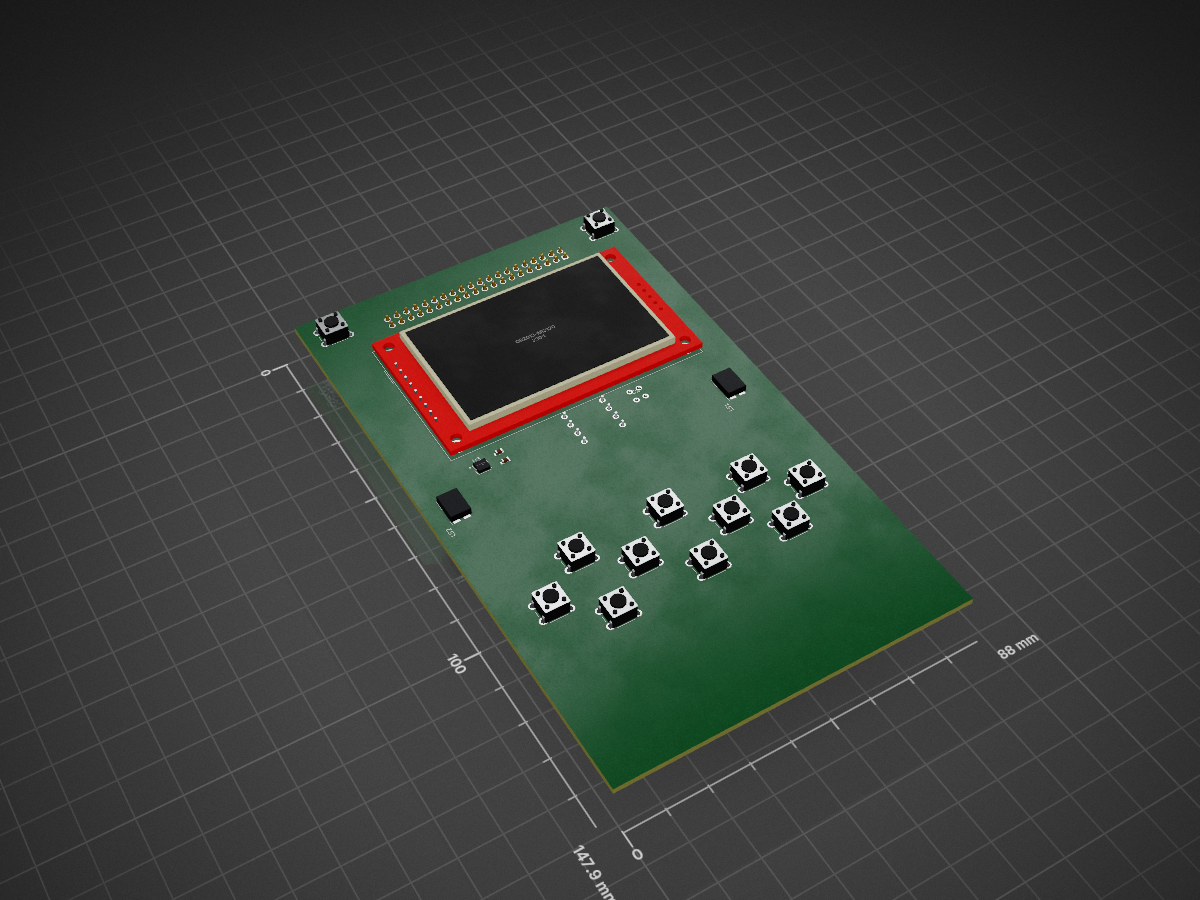
Corallium is an open-source printed circuit board by DarkSystemGit, from the DarkSystemGit/Corallium repository on GitHub. It is a 2-layer board of 88 × 147.9 mm with 26 parts on 68 nets.
Its parts include 12 switches, 4 capacitors, 4 resistors, 3 ICs and 1 connector.
Corallium is a fantasy console, similar to a previous project of mine, Atto-24. It supports Coral, a C-like language with Rust-inspired syntax, plus built-in graphics, sound, disk, and clock devices.
This repository contains a Coral Compiler, an executable/linking layer, and the VM.
chmod +x ./install.sh && ./install.shThis script should work for both linux and MacOS, though Mac is untested, along with Windows. Read over the script carefully before running it.
Compile to a cartridge (.cart):
corallium compile --file test/importTest.coralLink one or more extra files or directories into the cartridge:
corallium compile --file test/importTest.coral --link path/to/file1 path/to/dirRun from a cartridge:
corallium run --file test/importTest.cartEnable the runtime debugger:
corallium run --file test/importTest.cart --debugShow CLI help:
corallium --help.csfxcorallium sdk convert_music path/to/song.midOptional preview WAV:
corallium sdk convert_music path/to/song.mid --wav-previewconvert_music writes path/to/song.csfx with this exact layout:
CSFX FILE
+------------------------------+
| Header (48 bytes total)      |
| 8 channel records, each:     |
|   pan        : f32 (4 bytes) |
|   event_count: i16 (2 bytes) |
+------------------------------+
| Event Body                   |
| Channel 0 events             |
| Channel 1 events             |
| ...                          |
| Channel 7 events             |
+------------------------------+
Each event entry is 10 bytes:
+----------------------------+
| timestamp_ms : i32 (4)     |
| frequency_hz : f32 (4)     |
| volume       : i16 (2)     |
+----------------------------+
All numeric fields are little-endian.
.cbmpcorallium sdk convert_image path/to/image.pngconvert_image writes path/to/image.cbmp with this exact layout:
CBMP FILE
+------------------------------+
| width  : i16 (2 bytes)       |
| height : i16 (2 bytes)       |
+------------------------------+
| pixels : width*height*u32    |
|          row-major order     |
+------------------------------+
Each pixel is one u32 value stored little-endian, where the packed color is:
0xRRGGBBAACoral currently includes:
let bindings, arithmetic, bitwise ops, and as castsif/else, while, for, break, and continuematch expressions with literal, wildcard, enum, union, struct, and optional patternsstruct, union, enum, and type declarationsT?) with Some, None, and try ... catchdefer, function calls, pointers, arrays, and sizeof(...)Example:
fn main() -> void {
  let x: i16=1+2+3;
  let y: i16=4*5*6;
  let z: i32=(y as i32)/(x as i32);
  return;
}
Polyp is the assembly language for Corallium. See docs/polyp.md for the syntax, instruction reference, and examples.
Device I/O is invoked as IO(device_id, command_id), with command arguments passed on the VM stack.
| Device ID | Device | Command IDs |
|---|---|---|
0 | Disk | 0=read, 1=write, 2=loadSectors |
1 | Audio | 0=pause, 1=unpause, 2=volume, 3=pan, 4=frequency, 5=masterVolume, 6=loadSound, 7=setLoop, 8=schedule, 9=masterClock |
2 | Clock | 0=read |
3 | Graphics | 0=registerAtlas, 1=registerLayer, 2=registerSprite, 3=render, 4=pullControls, 5=setPixel, 6=getPixel, 7=removeSprite, 8=removeLayer, 9=registerBitmap, 10=removeBitmap, 11=deltaTime |
4 | Serial | 0=write (null-terminated string ptr), 1=writeNum (i32) |
Graphics control mapping:
A/S/D/F -> A/B/X/YSpace -> StartQ/E -> Left/Right triggerimport "module.coral"; loads Coral source modules relative to the importing file.h path loads symbols from the header and links a matching precompiled .bin librarydisk::linkedFileStart() returns the first sector after executable code/data, useful for reading files linked with --linksrc/compiler/ - Coral frontend, AST, IR generation, and backend loweringsrc/std/ - Coral standard libarysrc/assembler/ - Polyp frontend, AST, and Code Generationsrc/executable.rs - bytecode/function packing, constants, disk image buildsrc/vm.rs - VM execution engine, stack/memory model, debug consolesrc/devices/ - disk, audio, clock, graphics, and serial driverstest/ - small Coral examples & testsYou can run a demo game made for corralium in demos/strider/strider.cart. You can run:
corallium run --file demos/strider/strider.cartCredit to Subspace Audio for the start up sound (sourced from this pack: 512 8-bit sounds).
| Qty | Value | Footprint | References |
|---|---|---|---|
| 12 | Push_Button | Button_Switch_THT:SW_PUSH_6mm | SW1, SW2, SW3, SW4, SW5, SW6, SW7, SW8, SW9, SW10, SW11, SW12 |
| 2 | 10uF | PCM_SparkFun-Capacitor:C_0603_1608Metric | C2, C3 |
| 2 | 150ohm | Resistor_THT:R_Axial_DIN0207_L6.3mm_D2.5mm_P10.16mm_Horizontal | R1, R3 |
| 2 | 270ohm | Resistor_THT:R_Axial_DIN0207_L6.3mm_D2.5mm_P10.16mm_Horizontal | R6, R7 |
| 2 | 33nF_Ceramic | Capacitor_THT:C_Disc_D5.0mm_W2.5mm_P2.50mm | C1, C4 |
| 2 | Speaker | PCM_fab:PinHeader_01x02_P2.54mm_Horizontal_SMD | LS1, LS2 |
| 1 | CR2013-MI2120 | Display:CR2013-MI2120 | U5 |
| 1 | Conn_02x20_Odd_Even | Connector_IDC:IDC-Header_2x20_P2.54mm_Vertical | J1 |
| 1 | MAX98306xDT | Package_DFN_QFN:TDFN-14-1EP_3x3mm_P0.4mm_EP1.78x2.35mm | U3 |
| 1 | MCP23017x-x-SO | Package_SO:SOIC-28W_7.5x17.9mm_P1.27mm | U1 |
It measures 88 × 147.9 mm and has 2 copper layers, 1.6 mm thick.
26 parts. The full list of its parts is on this page, with links to each part's symbol and footprint where PCBKit's library has them.
From the DarkSystemGit/Corallium repository on GitHub, at the commit this page was made from: the board is pcb/corallium/corallium.kicad_pcb and its schematic pcb/corallium/corallium.kicad_sch. PCBKit opens the board in the browser, with nothing to install.
Its repository states no licence, so its author keeps all rights: ask DarkSystemGit before reusing the design.

hackclub/OnBoard
💡 Join 1,000 teenagers and make your first PCB with a $100 grant!


harbaum/galagino
A Galaga, Pac-Man and Donkey Kong arcade emulator for the ESP32

Luos-io/luos_engine
Open-source and real-time orchestrator for cyber-physical-systems, to easily design, test and deploy embedded applications and digital twins.

google/walt
A device for measuring latency of physical sensors and outputs on phones and computers
