

2 layers70 × 50 mm
Robot sumo
cszcszczs/robots
Este repositorio se utilizara para llevar las versiones de los robots, velocista y sumo.
24 parts

 cszcszczs/robots
Este repositorio se utilizara para llevar las versiones de los robots, velocista y sumo.
Robot sumo is an open-source printed circuit board by cszcszczs, from the cszcszczs/robots repository on GitHub. It is a 2-layer board of 70 × 45 mm with 28 parts on 44 nets, routed with 286 tracks and 36 vias.
It is built around the ROB-14450, QRE1113 and A000005. Its parts include 7 resistors and 1 switch. It belongs with the robots and motor control boards of this library.
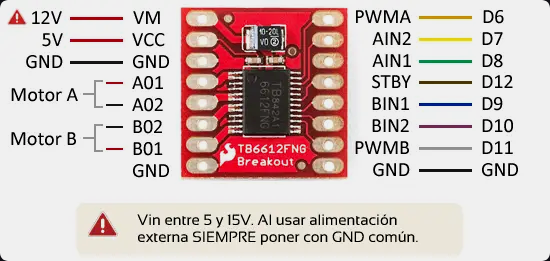
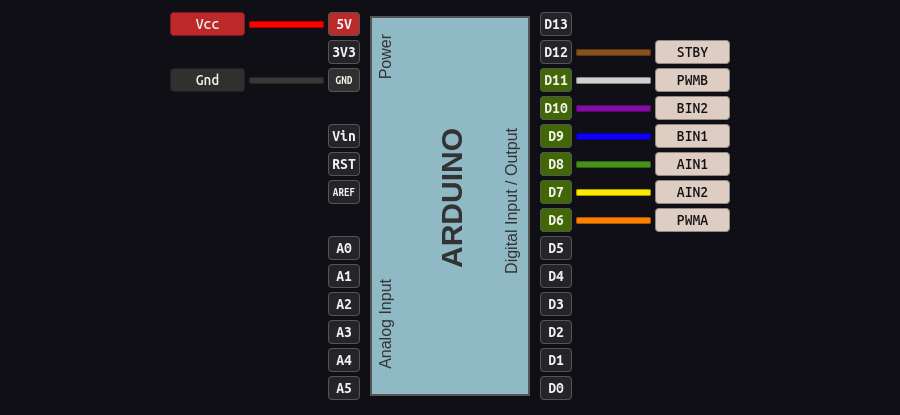
| Qty | Value | Footprint | References |
|---|---|---|---|
| 8 | Conn_01x01_Pin | Connector_PinHeader_1.00mm:PinHeader_1x01_P1.00mm_Vertical | AO1, AO2, BO1, BO2, IN-1, IN+1, OUT-1, OUT+1 |
| 3 | 330 | Resistor_THT:R_Axial_DIN0204_L3.6mm_D1.6mm_P7.62mm_Horizontal | R1, R4, R7 |
| 2 | 10k | Resistor_THT:R_Axial_DIN0204_L3.6mm_D1.6mm_P7.62mm_Horizontal | R2, R3 |
| 2 | QRE1113 | QRE1113:DIP400W50P180L360H200Q4 | IR1, IR2 |
| 1 | 1k | Resistor_THT:R_Axial_DIN0204_L3.6mm_D1.6mm_P7.62mm_Horizontal | R5 |
| 1 | 2k | Resistor_THT:R_Axial_DIN0204_L3.6mm_D1.6mm_P7.62mm_Horizontal | R6 |
| 1 | A000005 | A000005:MODULE_A000005 | AR1 |
| 1 | CAL_LED | LED_THT:LED_D5.0mm | CAL_LED1 |
| 1 | Conn_01x02_Socket | Connector_AMASS:AMASS_XT60-M_1x02_P7.20mm_Vertical | CON_S1 |
| 1 | Conn_01x03_Pin | Connector_PinHeader_1.00mm:PinHeader_1x03_P1.00mm_Vertical | SW1 |
| 1 | Conn_01x04_Socket | Connector_PinHeader_2.00mm:PinHeader_1x04_P2.00mm_Vertical | ULT1 |
| 1 | LOGO | Images:mr_mime | G*** |
| 1 | LOGO | Images:mudkip | G*** |
| 1 | LOGO | Images:arceus | G*** |
| 1 | ROB-14450 | ROB-14450:MODULE_ROB-14450 | BH1 |
| 1 | ZC142200 | ZC142200:MODULE_ZC142200 | BLE1 |
The 27 most common of 28 parts.
cszcszczs/robots
Este repositorio se utilizara para llevar las versiones de los robots, velocista y sumo.


Kokiri-AK/tools_nano-breakout
Arduino Nano sensor breakout board. Useful for a variety of simple prototyping needs.


bismarx-v1/Sumec-MiniSumo-HW
SUMEC is a MiniSumo robot designed by SPŠ na Proseku students. This repository contains hardware source for this project - PCB files and other electronics.


fwachsmuth/Filmkorn-Raw-Scanner
The Filmkorn Raw Scanner, turning 8mm and 16mm films into lossless 12-bit CinemaDNG
It measures 70 × 45 mm and has 2 copper layers, 1.6 mm thick.
28 parts, built around the ROB-14450, QRE1113 and A000005. The full list of its parts is on this page, with links to each part's symbol and footprint where PCBKit's library has them.
From the cszcszczs/robots repository on GitHub, at the commit this page was made from: the board is sumo-architecture/robot-sumo.kicad_pcb and its schematic sumo-architecture/robot-sumo-backups/robot-sumo-2025-10-06_191441/robot-sumo.kicad_sch. PCBKit opens the board in the browser, with nothing to install.
Its repository states no licence, so its author keeps all rights: ask cszcszczs before reusing the design.