6 layers113 × 99 mm

 csl-taipeitech/85RF
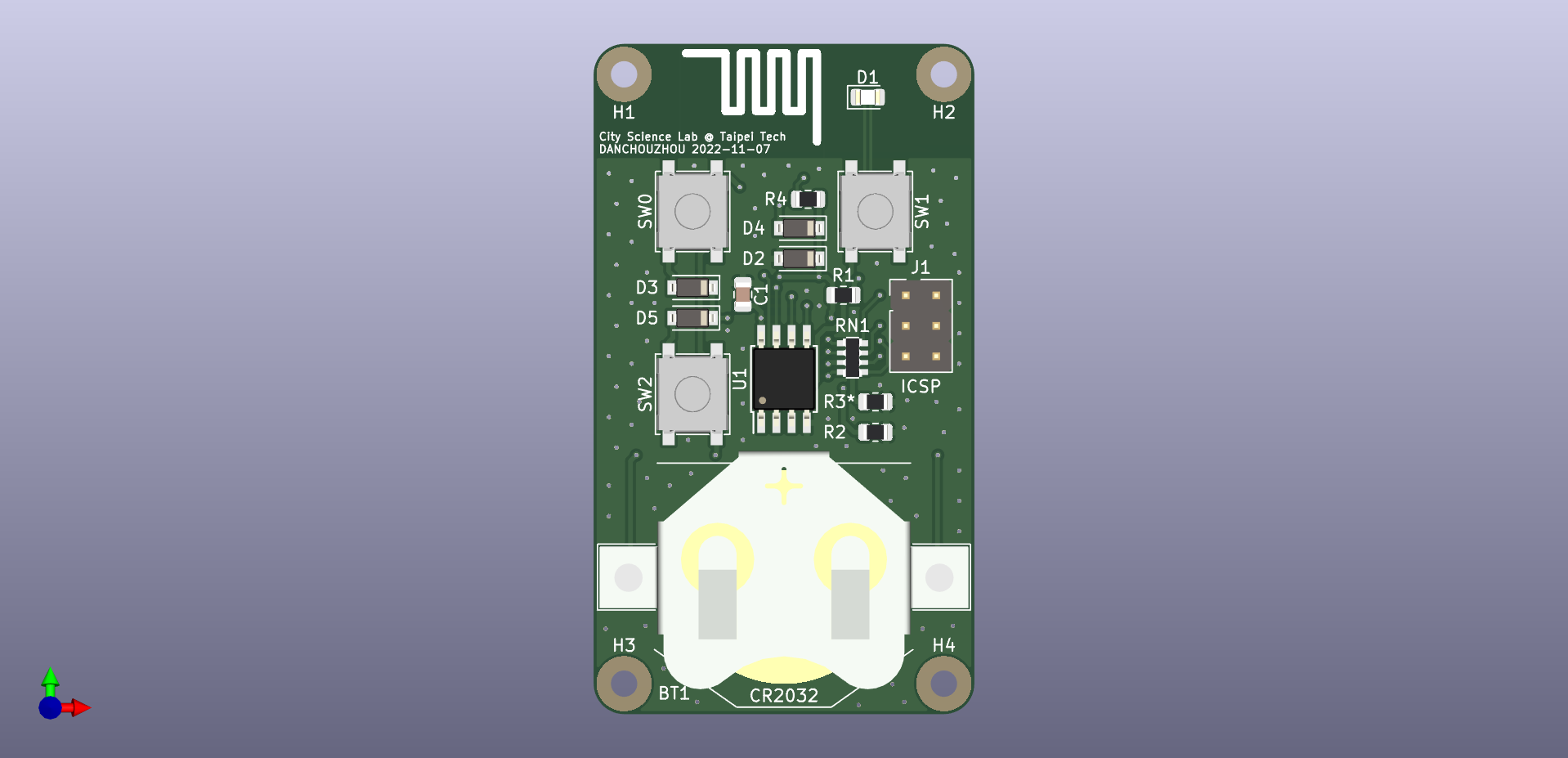
A 2.4G remote control made with ATtiny85
Remote is an open-source printed circuit board by csl-taipeitech, from the csl-taipeitech/85RF repository on GitHub. It is a 2-layer board of 31.8 × 55.9 mm with 23 parts on 17 nets, routed with 160 tracks and 125 vias.
It is built around the ATTINY85-20SU, EVQ-Q2K02W and LTST-C170KFKT. Its parts include 5 diodes, 4 resistors, 3 switches, 2 ICs and 1 capacitor. It belongs with the AVR (ATmega, ATtiny) boards of this library.


A 2.4G remote control made with ATtiny85
Check out the installation guide of ATTinyCore by Spence Konde (aka Dr. Azzy)
This project uses RF24 by 2bndy5, it's a famous library of nRF24L01. It is possible to install the library directly from the library manager.
| Qty | Value | Footprint | References |
|---|---|---|---|
| 4 | MountingHole | MountingHole:MountingHole_2.2mm_M2 | H1, H2, H3, H4 |
| 3 | D | Diode_SMD:D_SOD-123 | D3, D4, D5 |
| 3 | EVQ-Q2K02W | Button_Switch_SMD:SW_SPST_EVQP0 | SW0, SW1, SW2 |
| 2 | 10K | Resistor_SMD:R_0805_2012Metric | R2, R3* |
| 1 | Battery:BatteryHolder_Keystone_3002_1x2032 | BT2 | |
| 1 | 100nF | Capacitor_SMD:C_0805_2012Metric | C1 |
| 1 | 22R | Resistor_SMD:R_0805_2012Metric | R4 |
| 1 | 3.3V | Diode_SMD:D_SOD-123 | D2 |
| 1 | 36R | Resistor_SMD:R_0805_2012Metric | R1 |
| 1 | 4*200R | Resistor_SMD:R_Array_Convex_4x0603 | RN1 |
| 1 | ATtiny85-20S | Package_SO:SOIC-8W_5.3x5.3mm_P1.27mm | U1 |
| 1 | Ai-Thinker NF-03 | NF-03:Ai-Thinker-NF-03 | U2 |
| 1 | ICSP | Connector_PinHeader_2.54mm:PinHeader_2x03_P2.54mm_Vertical | J1 |
| 1 | Keystone_3002 | Battery:BatteryHolder_Keystone_3002_1x2032 | BT1 |
| 1 | LTST-C170KFKT | LED_SMD:LED_0805_2012Metric | D1 |


aminewe898/nexus-pear-reva
NEXUS PEAR Rev A hardware design, schematics, PCB, manufacturing review exports and engineering documentation

BrownSpaceEngineering/PVDX-EPS_V1
Avionics files related to new overhauled EPS schematics, pcb design, and documentation


It measures 31.8 × 55.9 mm and has 2 copper layers, 1.6 mm thick.
23 parts, built around the ATTINY85-20SU, EVQ-Q2K02W and LTST-C170KFKT. The full list of its parts is on this page, with links to each part's symbol and footprint where PCBKit's library has them.
From the csl-taipeitech/85RF repository on GitHub, at the commit this page was made from: the board is kicad/remote.kicad_pcb and its schematic kicad/remote.kicad_sch. PCBKit opens the board in the browser, with nothing to install.
Its repository states no licence, so its author keeps all rights: ask csl-taipeitech before reusing the design.