
2 layers124 × 112 mm

 cschopfer/DualAmpOP
Un petit PCB pour avoir un ampli-op double disponible pour vos bricolages sur breadboard.
DualAmpOP is an open-source printed circuit board by cschopfer, from the cschopfer/DualAmpOP repository on GitHub. It is a 2-layer board of 50.8 × 25.4 mm with 21 parts on 13 nets, routed with 160 tracks and 11 vias.
It is built around the MCP6002-I/P. Its parts include 16 resistors, 2 capacitors, 2 connectors and 1 IC.
Un petit PCB pour avoir un ampli-op double disponible pour vos bricolages sur breadboard.
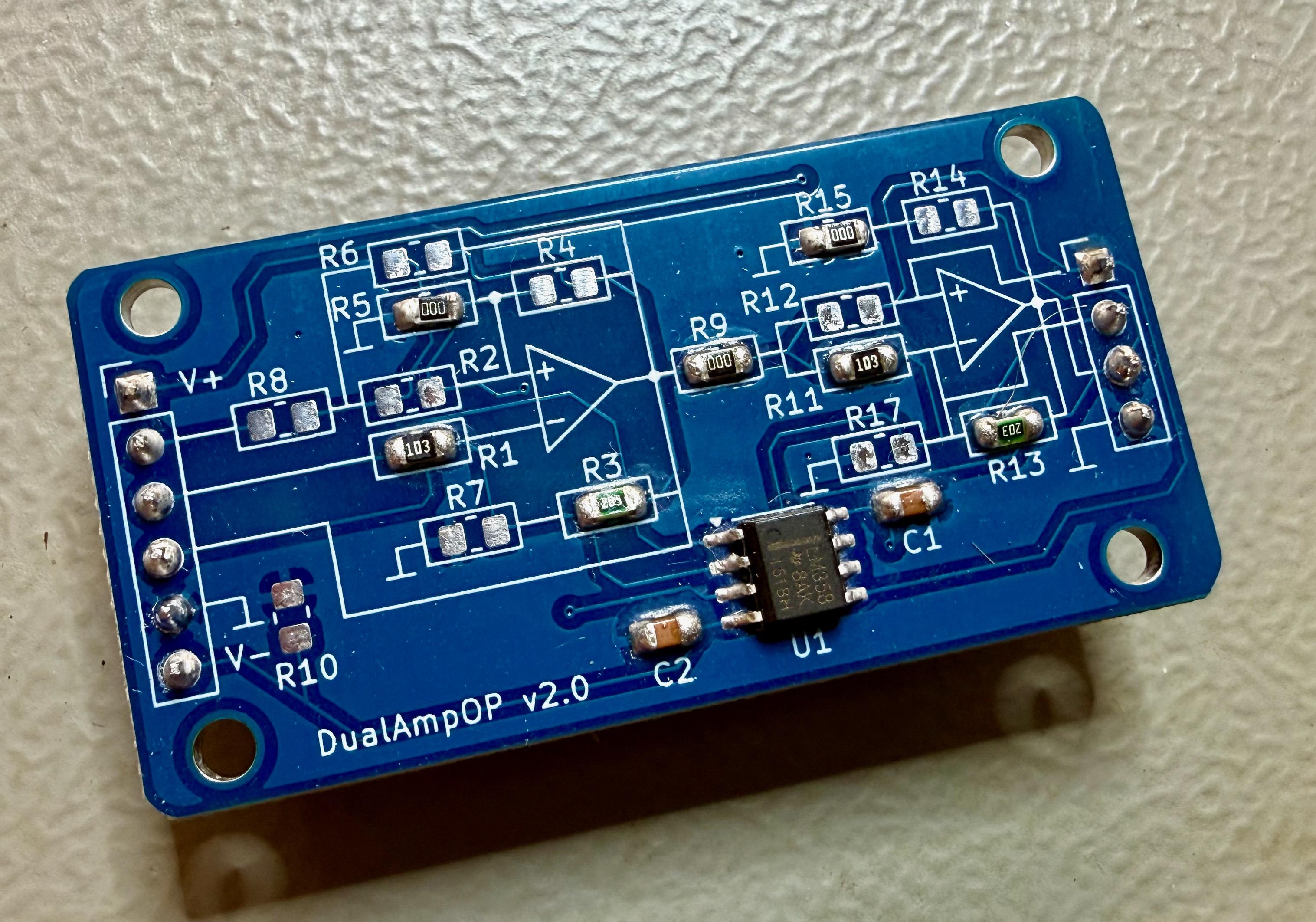
Statut : prototype v2.0 monté et testé, fonctionne très bien. Cette v2.0 remplace une v1 qui n'a jamais été produite.
Le PCB accepte tout double ampli-op compatible broche à broche en boîtier SOIC-8 — LM358, MCP6002, etc.
Chaque étage dispose d'un réseau de résistances (R1 à R8 pour le premier étage, R9 à R17 pour le second, sur le même principe) qu'il suffit de câbler pour obtenir la topologie voulue :
| Montage | R1 | R2 | R3 | R4 | R5 | R6 | R7 | R8 | Gain / formule |
|---|---|---|---|---|---|---|---|---|---|
| Inverseur | valeur | n.m. | valeur | n.m. | 0 Ω | n.m. | n.m. | n.m. | Vout = −Vin·(R3/R1) |
| Non-inverseur | n.m. | 0 Ω | valeur | n.m. | n.m. | n.m. | valeur | 0 Ω | Vout = Vin·(1 + R3/R7) |
| Transimpédance | 0 Ω | n.m. | Rf | n.m. | 0 Ω | n.m. | n.m. | n.m. | Vout = −Iin·R3 |
| Suiveur | n.m. | 0 Ω | 0 Ω | n.m. | n.m. | n.m. | n.m. | 0 Ω | Vout = Vin |
| Passe-bas actif (intégrateur) | R | n.m. | C* | n.m. | n.m. | n.m. | n.m. | n.m. | fc = 1/(2πRC) |
| Passe-haut actif | — | — | — | — | — | — | — | — | à venir |
| Sallen-Key | — | — | — | — | — | — | — | — | à venir |
* Pour les filtres actifs, la résistance concernée est remplacée par un condensateur céramique 0805 de même taille.
R10 relie le rail V- à la masse.
hardware/
  DualAmpOP.kicad_pro
  exports/
    PDF/
    gerbers/
    3D/
docs/
  images/
IMG_3928.jpegÀ définir.
| Qty | Value | Footprint | References |
|---|---|---|---|
| 8 | R | Resistor_SMD:R_0805_2012Metric_Pad1.20x1.40mm_HandSolder | R1, R2, R3, R5, R11, R12, R13, R15 |
| 8 | value | Resistor_SMD:R_0805_2012Metric_Pad1.20x1.40mm_HandSolder | R4, R6, R7, R8, R9, R10, R14, R17 |
| 2 | value | 00_Capacitor:C_0805_2012Metric_Pad1.18x1.45mm_HandSolder | C1, C2 |
| 1 | MCP6002 | 00_Package_SO:SOIC-8_3.9x4.9mm_P1.27mm | U1 |
| 1 | ~ | Connector_PinHeader_2.54mm:PinHeader_1x06_P2.54mm_Vertical | J1 |
| 1 | ~ | Connector_PinHeader_2.54mm:PinHeader_1x04_P2.54mm_Vertical | J2 |
It measures 50.8 × 25.4 mm and has 2 copper layers, 1.6 mm thick.
21 parts, built around the MCP6002-I/P. The full list of its parts is on this page, with links to each part's symbol and footprint where PCBKit's library has them.
From the cschopfer/DualAmpOP repository on GitHub, at the commit this page was made from: the board is hardware/DualAmpOP.kicad_pcb and its schematic hardware/DualAmpOP.kicad_sch. PCBKit opens the board in the browser, with nothing to install.
Its repository states no licence, so its author keeps all rights: ask cschopfer before reusing the design.

GaudiLabs/OpenLaserScanningMicroscope
Open Source Laser Scanning Microscope


GuitarML/GuitarPedalSTM32
Guitar pedal using a stm32h7 microcontroller programmed with CubeIDE (PCB and Firmware)

thawney/PedalPiV2
Pedal Pi V2 by Thawney is an all new and regularly maintained Pedal-Pi by electrosmash; a lo-fi programmable guitar pedal that works with the Raspberry Pi ZERO Board.

CCHS-Melbourne/ESPlant
Environmental Sensor Plant - solar WiFi gardening/meteorological sensor using ESP8266

