6 layers95.9 × 90.2 mm
Cpb
OakwoodEngineering/ObiWanKomputer
The Obi Wan Komputer and Combined Payload Boards from the NyanSat project.
251 parts10
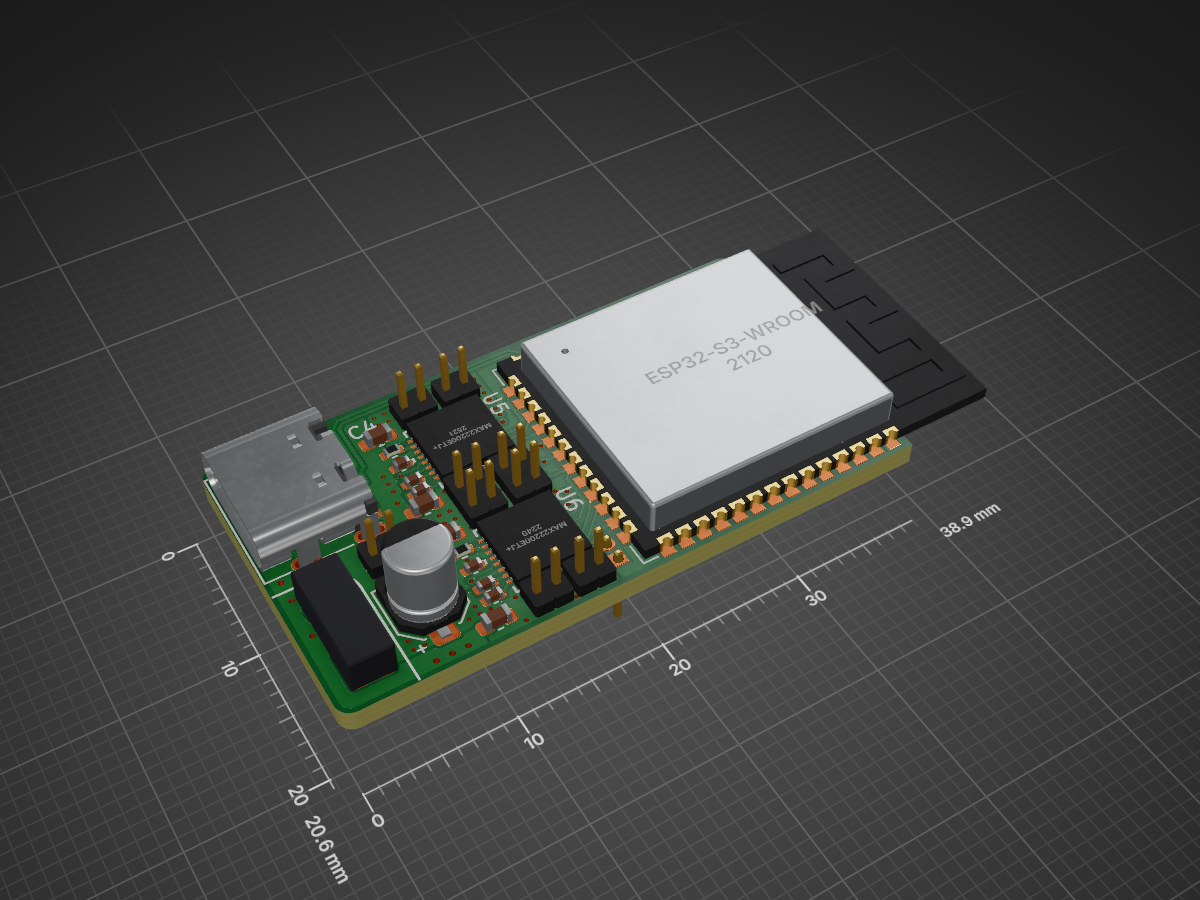
 cryptoAlgorithm/HapticDriver2
Compact and over-engineered board capable of driving 12 solenoids bi-directionally.
HapticDriver is an open-source printed circuit board by cryptoAlgorithm, from the cryptoAlgorithm/HapticDriver repository on GitHub. It is a 4-layer board of 38.9 × 20.6 mm with 50 parts on 89 nets, routed with 267 tracks and 133 vias.
It is built around the MAX22200ETJ+ and TPS561201DDCR. Its parts include 16 capacitors, 12 resistors, 12 connectors, 5 ICs and 2 switches. It belongs with the radio and wireless boards and the ESP32 boards of this library.


Compact and over-engineered solenoid driver board for the purpose of generating localised haptic feedback.
This is a work in progress driver board which has the capability to drive 12 solenoids bi-directionally for the purpose of providing focused and precise haptic feedback. It's intended to be used in tendem with a host application communicating over either WiFi or Bluetooth.
Due to the ESP module's limited number of GPIO, 3 8-bit shift registers over I2S were used to effectively expand 3 I2S GPIO into 24 individually assignable outputs. This corresponds to the 24 H-bridge driver inputs, which allow powering 12 electromagnets (forming solenoids) with regulated current of either direction.
There is a 3V3 LDO regulator onboard for powering the logic bus - including the ESP32, shift registers and motor driver logic power. It's powered through the battery power input, and provides up to 800mA and has an absolute maximum voltage of 15V. Although the drivers tolerate a power input of up to 18V, the LDO effectively limits the maximum battery input voltage to 15V. Care should be taken not to exceed this.
| Qty | Value | Footprint | References |
|---|---|---|---|
| 8 | Conn_01x02_Pin | SolderWires:SolderWire_1x02 | J2, J4, J5, J6, J7, J8, J9, J10 |
| 5 | 0.1uF | Capacitor_SMD:C_0603_1608Metric | C1, C3, C4, C11, C12 |
| 4 | 22nF | Capacitor_SMD:C_0402_1005Metric | C2, C5, C13, C15 |
| 3 | 16K | Resistor_SMD:R_0402_1005Metric | R4, R5, R7 |
| 3 | 5K1 | Resistor_SMD:R_0603_1608Metric | R14, R15, R16 |
| 2 | 10uF | Capacitor_SMD:C_1206_3216Metric_Pad1.33x1.80mm_HandSolder | C7, C8 |
| 2 | 1K | Resistor_SMD:R_0402_1005Metric | R6, R8 |
| 2 | 1uF | Capacitor_SMD:C_0402_1005Metric | C6, C9 |
| 2 | Conn_01x02_Socket | SolderWires:SolderWire_1x02 | J1, J12 |
| 2 | MAX22200ETJ+ | AnalogDevices:21-0140AK_T3255_8C_MXM | U5, U6 |
| 2 | R | Resistor_SMD:R_0402_1005Metric | R3, R9 |
| 2 | R | Resistor_SMD:R_0603_1608Metric | R1, R2 |
| 1 | 100nF | Capacitor_SMD:C_0603_1608Metric | C10 |
| 1 | 10uF | Capacitor_SMD:CP_Elec_4x5.4 | C18 |
| 1 | 10uF | Capacitor_SMD:C_0603_1608Metric | C14 |
| 1 | 3.3uH | Changjiang:L_Changjiang_FXL0530-3R3-M | L1 |
| 1 | BATT PWR | Connector_Wire:SolderWire-1sqmm_1x02_P5.4mm_D1.4mm_OD2.7mm | J3 |
| 1 | BOOT | Button_Switch_SMD:SW_Push_1P1T_XKB_TS-1187A | SW1 |
| 1 | EN | Button_Switch_SMD:SW_Push_1P1T_XKB_TS-1187A | SW2 |
| 1 | ESP32-S3-WROOM-2 | RF_Module:ESP32-S3-WROOM-1 | U1 |
| 1 | MAX98357A | Package_DFN_QFN:TQFN-16-1EP_3x3mm_P0.5mm_EP1.23x1.23mm | U4 |
| 1 | RX | TestPoint:TestPoint_Pad_1.5x1.5mm | TP2 |
| 1 | TPS561201DDCR | Ti:DDC0006A_N | U2 |
| 1 | TX | TestPoint:TestPoint_Pad_1.5x1.5mm | TP1 |
| 1 | USB_C_Receptacle_USB2.0_16P | Connector_USB:USB_C_Receptacle_G-Switch_GT-USB-7010ASV | J11 |
It measures 38.9 × 20.6 mm and has 4 copper layers, 1.6 mm thick.
50 parts, built around the MAX22200ETJ+ and TPS561201DDCR. The full list of its parts is on this page, with links to each part's symbol and footprint where PCBKit's library has them.
From the cryptoAlgorithm/HapticDriver repository on GitHub, at the commit this page was made from: the board is HapticDriver.kicad_pcb and its schematic HapticDriver.kicad_sch. PCBKit opens the board in the browser, with nothing to install.
Its repository states no licence, so its author keeps all rights: ask cryptoAlgorithm before reusing the design.
OakwoodEngineering/ObiWanKomputer
The Obi Wan Komputer and Combined Payload Boards from the NyanSat project.

murexrobotics/electrical
Highly integrated electronics design and printed circuit boards (PCBs) for the MATE ROV Competition. Attempt the impossible.

brown-studios/minuet
Minuet upgrades your MAXXAIR Maxxfan with a brushless DC motor, home automation features, and accessories.

Cheesylorry/Quantum-Demonstrator-Lite
A Repository for the Quantum Demonstrator Lite, a Plug and play Quantum Algorythm for Students. Integrates into SpinDrops, a software for simmulating up to three Qubits.


Mouse-GYM/auto-trainer-hardware
Repository for hardware, firmware, and software related to the Mouse-GYM modules
