2 layers109.2 × 91.4 mm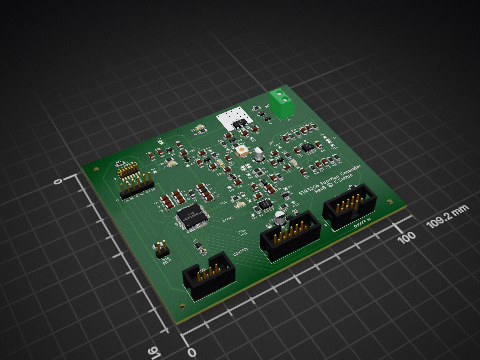
FunctionGeneratorCortexM4
cracked-machine/FunctionGeneratorCortexM4_HW
A function generator powered by ARM Cortex M4
119 parts2MIT
 cracked-machine/FunctionGeneratorCortexM4_HW2
A function generator powered by ARM Cortex M4
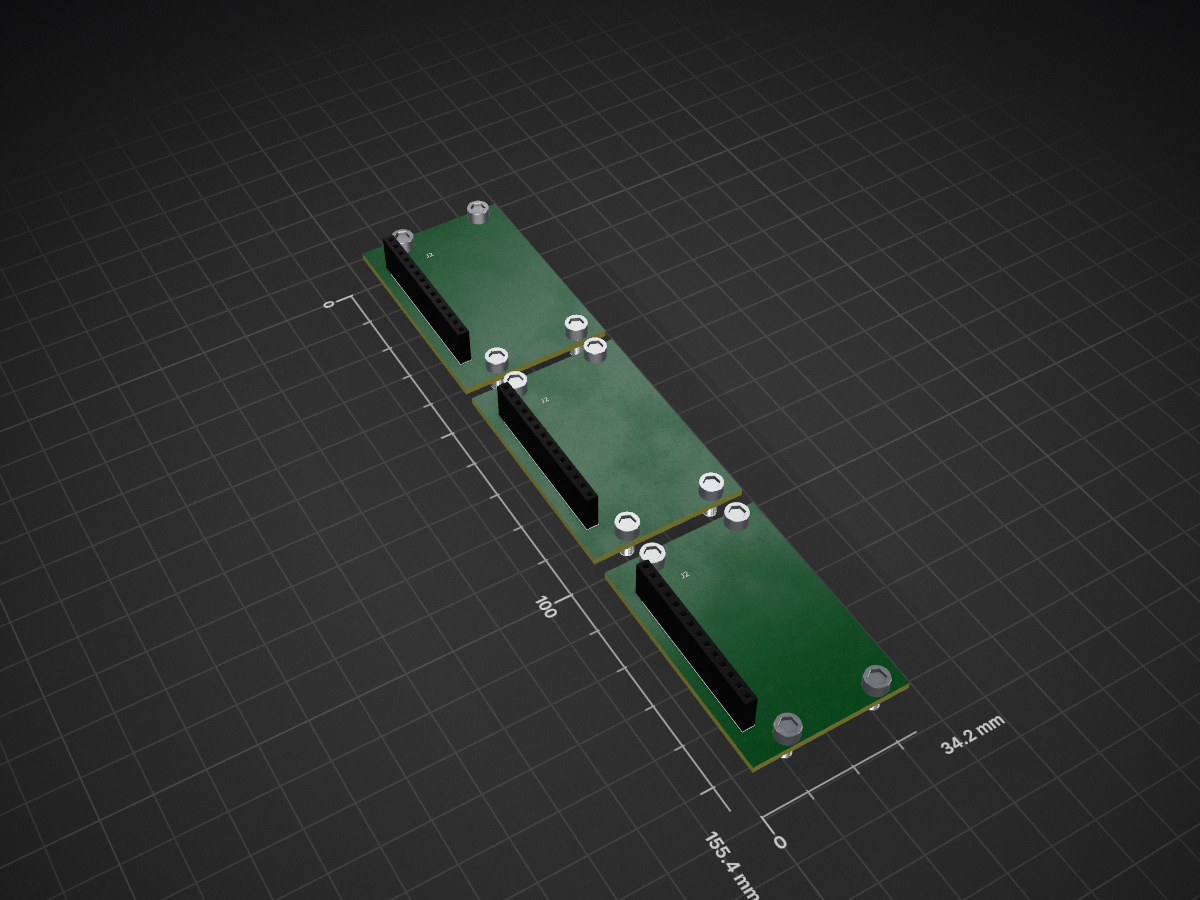
DisplayBoard is an open-source printed circuit board by cracked-machine, from the cracked-machine/FunctionGeneratorCortexM4_HW repository on GitHub, published under the MIT licence. It is a 2-layer board of 34.2 × 155.4 mm with 18 parts on 14 nets, routed with 129 tracks and 0 vias.
It belongs with the STM32 boards of this library.
A function generator powered by STM32 G4.
Required Kicad Hardware library: https://github.com/cracked-machine/KicadLibrary
For details of the MCU configuration and firmware refer to FunctionGeneratorCortexM4_SW
Note, RevB was the final design. RevC was not built and is an untested future proposal.
Input signals can be used as a trigger, capturing on voltage level or edge detection.
DAC1 synthesises the main output signal waveform and sends it to a voltage gain amplifier (LTC6910-3). The signal is then mixed with the DC offset signal from DAC2. The signal is then passes through a lowpass filter to remove any high frequency noise.
DAC2 is a DC signal 0-3.3V. This is sent to a buffer and inverting buffer. Either output is selected using the MCU-controlled SPDT switch IC (TS12A12511DCNR). This applies a software configurable DC offset between +3.3V and -3.3V to the main output signal.
DAC3 is an output signal synchronised to DAC1 to be used for triggering purposes.

The display, controls and i/o connectors are connected via daughter boards to the main board via ribbon cable. An example of the display daughter board and its ribbon cable can be seen in the video below:
https://www.instagram.com/p/CA5NSdBhmBY/?utm_source=ig_web_copy_link
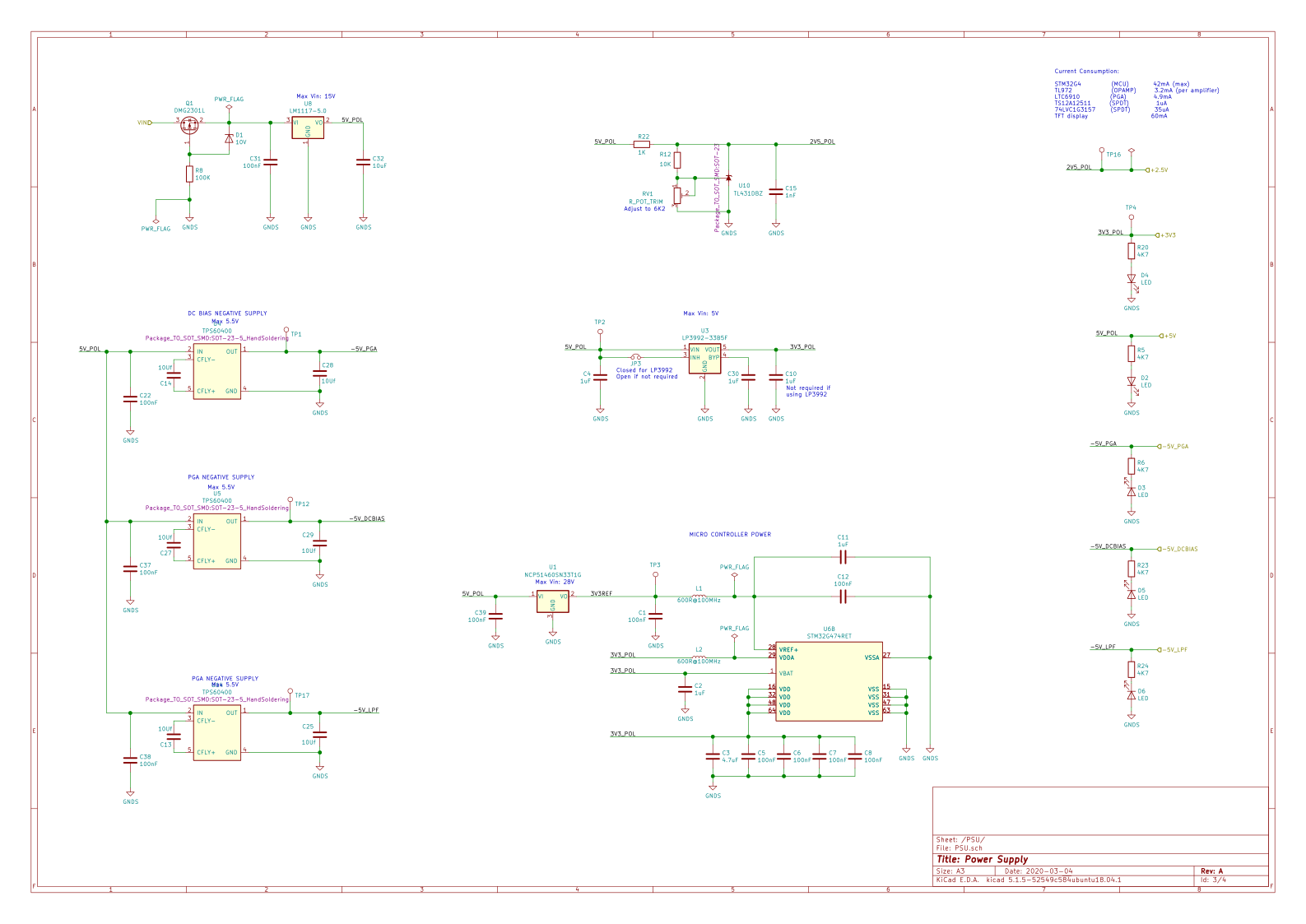
| Component | Type | Current |
|---|---|---|
| STM32G4 | MCU | 42mA (max) |
| TL972 | OPAMP | 3.2mA (per amplifier) |
| LTC6910-3 | PGA | 4.9mA |
| TS12A12511 | SPDT | 1uA |
| 74LVC1G3157 | SPDT | 35uA |
| LCD TFT | display | 60mA |
| Total | 120mA |
The 9V input is regulated down to 3.3V and 5V for the MCU and LCD display.
Dual supply for the VGA and opamps are provided using multiple TPS60400 charge pumps. TPS60400 are rated at 60mA output but in testing was found to be less. Therefore, multiple TPS60400 were required to provide "point-of-load" regulation.
Additional filtering is provided at the MCU supply pins with L1 and L2 ferrite beads and C1-C12 bypass capacitors.
A midpoint reference 2.5V voltage is provided to the LTC6910-3 VGA using a TL431DBZ precision programmable reference.
The power supply limits the output to 9Vp-p. The output swing of the VGA limits this further.
The VGA output current is limited to ~25mA. This is also limited by the power supply.
Due to the settling time of the VGA, smooth sweeps between output amplitude levels using this IC was not possible. As such, the output is fixed to the maximum VGA level. Output amplitude control was handled by the firmware instead.
See LTC6910-3 datasheet for more information.
| Qty | Value | Footprint | References |
|---|---|---|---|
| 3 | Conn_01x14 | Connector_PinSocket_2.54mm:PinSocket_1x14_P2.54mm_Vertical | J2, J2, J2 |
| 3 | Conn_02x04_Odd_Even | Connector_PinHeader_2.54mm:PinHeader_2x04_P2.54mm_Vertical_SMD | J1, J1, J1 |
The 6 most common of 18 parts.
It measures 34.2 × 155.4 mm and has 2 copper layers, 1.6 mm thick.
18 parts. The full list of its parts is on this page, with links to each part's symbol and footprint where PCBKit's library has them.
From the cracked-machine/FunctionGeneratorCortexM4_HW repository on GitHub, at the commit this page was made from: the board is HW/DisplayBoard/RevA/DisplayBoard/DisplayBoard.kicad_pcb. PCBKit opens the board in the browser, with nothing to install.
Its repository publishes it under the MIT licence: you may reuse it on that licence's terms (keep the author's notice, and for a copyleft licence share your changes alike).
cracked-machine/FunctionGeneratorCortexM4_HW
A function generator powered by ARM Cortex M4

cracked-machine/FunctionGeneratorCortexM4_HW
A function generator powered by ARM Cortex M4

cracked-machine/FunctionGeneratorCortexM4_HW
A function generator powered by ARM Cortex M4

cracked-machine/FunctionGeneratorCortexM4_HW
A function generator powered by ARM Cortex M4

cracked-machine/FunctionGeneratorCortexM4_HW
A function generator powered by ARM Cortex M4

cracked-machine/FunctionGeneratorCortexM4_HW
A function generator powered by ARM Cortex M4

cracked-machine/FunctionGeneratorCortexM4_HW
A function generator powered by ARM Cortex M4


VoronDesign/Voron-Hardware
Cool Hardware designed by the Voron Design group


hackclub/OnBoard
💡 Join 1,000 teenagers and make your first PCB with a $100 grant!

VoronDesign/Voron-Tap
Tap is a nozzle-based z-probe for the V2 and Trident printer designs. The entire toolhead moves to trigger an optical switch. Tap offers many advantages:

Luos-io/luos_engine
Open-source and real-time orchestrator for cyber-physical-systems, to easily design, test and deploy embedded applications and digital twins.


Twotoz/C5VRX
Ultra-minimal, zero-CPU 5.8 GHz analog FPV video receiver using ESP32-C5 Wi-Fi 6 PHY MODEM_DIAG, BitScrambler WBFM demodulation & resistor DAC CVBS