4 layers119.4 × 119.4 mm
 computer-whisperer/acoustic_array
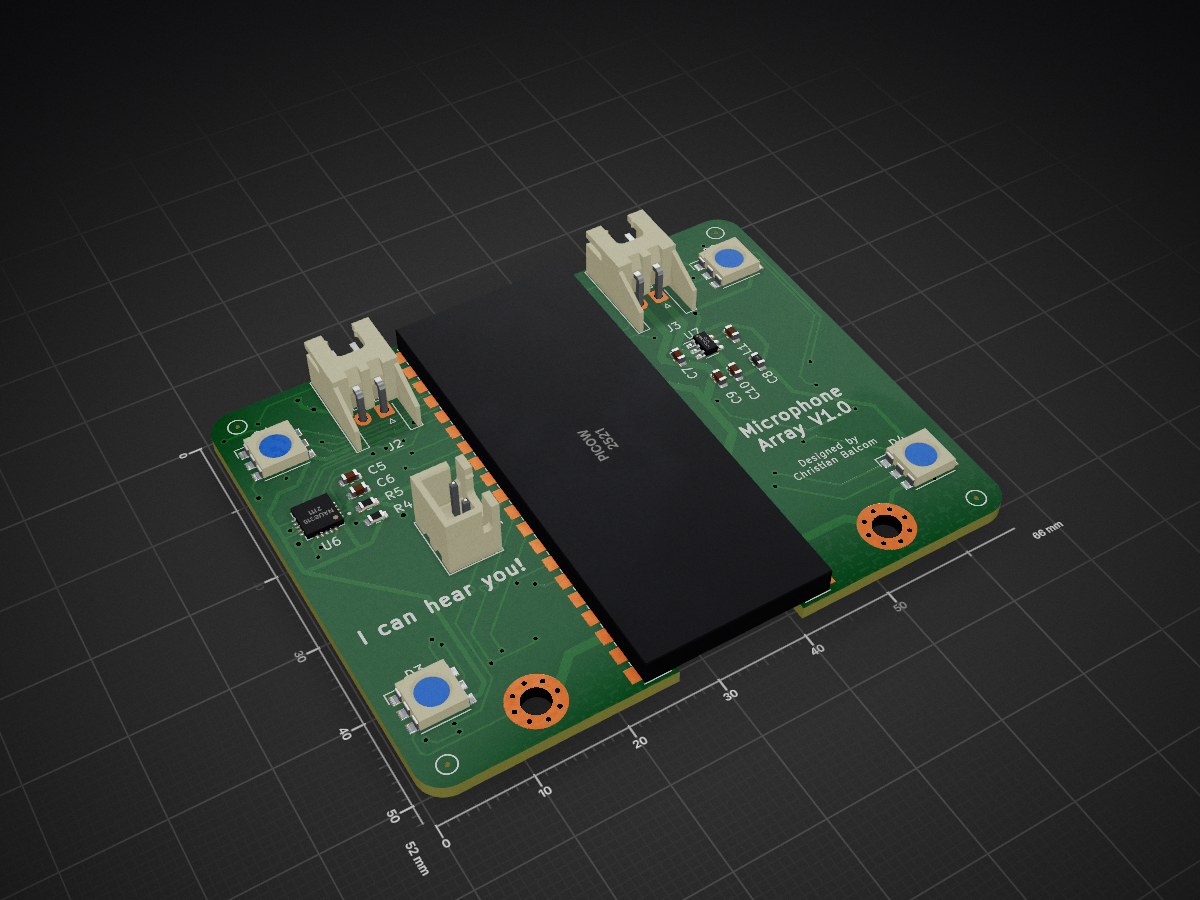
Pi pico microphone is an open-source printed circuit board by computer-whisperer, from the computer-whisperer/acoustic_array repository on GitHub. It is a 2-layer board of 66 × 52 mm with 31 parts on 47 nets, routed with 676 tracks and 63 vias.
It is built around the AP63205WU, NAU8315YG and ICS-43434. Its parts include 10 capacitors, 7 ICs, 4 resistors, 4 diodes and 3 connectors. It belongs with the audio and music boards and the RP2040 boards of this library.


| Qty | Value | Footprint | References |
|---|---|---|---|
| 4 | 0.1uF | Capacitor_SMD:C_0603_1608Metric | C1, C2, C3, C4 |
| 4 | APA102 | LED_SMD:LED_RGB_5050-6 | D1, D2, D3, D4 |
| 4 | ICS-43434 | Library:MIC_ICS-43434 | U1, U2, U3, U4 |
| 2 | 0 | Resistor_SMD:R_0603_1608Metric | R4, R5 |
| 2 | 100k | Resistor_SMD:R_0603_1608Metric | R1, R2 |
| 2 | 22uF | Capacitor_SMD:C_0603_1608Metric | C9, C10 |
| 2 | Conn_01x02 | Connector_JST:JST_XH_S2B-XH-A-1_1x02_P2.50mm_Horizontal | J2, J3 |
| 2 | MountingHole_Pad | MountingHole:MountingHole_3mm_Pad_Via | H3, H4 |
| 1 | .1uF | Capacitor_SMD:C_0603_1608Metric | C5 |
| 1 | 100nF | Capacitor_SMD:C_0603_1608Metric | C8 |
| 1 | 10uF | Capacitor_SMD:C_0603_1608Metric | C7 |
| 1 | 4.7uF | Capacitor_SMD:C_0603_1608Metric | C6 |
| 1 | 4.7uH | Inductor_SMD:L_0603_1608Metric | L1 |
| 1 | AP63205WU | Package_TO_SOT_SMD:TSOT-23-6 | U7 |
| 1 | Conn_01x02 | Connector_JST:JST_XH_B2B-XH-A_1x02_P2.50mm_Vertical | J1 |
| 1 | NAU8315 | Library:QFN50P400X400X80-21N | U6 |
| 1 | PicoW | RPi_Pico:RPi_PicoW_SMD_TH | U5 |
It measures 66 × 52 mm and has 2 copper layers, 1.6 mm thick.
31 parts, built around the AP63205WU, NAU8315YG and ICS-43434. The full list of its parts is on this page, with links to each part's symbol and footprint where PCBKit's library has them.
From the computer-whisperer/acoustic_array repository on GitHub, at the commit this page was made from: the board is pcb/pi_pico_microphone.kicad_pcb and its schematic pcb/libs/picow_vga_sd_aud.kicad_sch. PCBKit opens the board in the browser, with nothing to install.
Its repository states no licence, so its author keeps all rights: ask computer-whisperer before reusing the design.

meh2481/beatsequencer
Beat sequencer/soundboard with Adafruit MultiTrellis


DhamuVkl/ESP32S3-AI-Voice-Assistant
This project is a complete DIY AI voice assistant built around the ESP32-S3 microcontroller. It combines custom PCB design, advanced audio processing, and cloud-based AI to create a device that rivals commercial smart…

mikelawrence/esphome-indoor-multi-sensor-hardware
ESPHome Indoor Multi-Sensor hardware. This design supports Radar/PIR Presence, Temperature, Humidity, Pressure, Light, CO2, CO, VOC, NOX and PM sensors.

rowr111/blinky-badge-light
lighting badge with unique patterns and sound reactivity

DetectiveMittens/Cooee
An open-source phone that can operate without GSM or LTE coverage. Utilising LoRa modulation and mesh networking to enable long range "off-grid" communication