
2 layers65 × 56 mm
 CMorooney/clippi
reaspberry pi clip player for video synth fodder
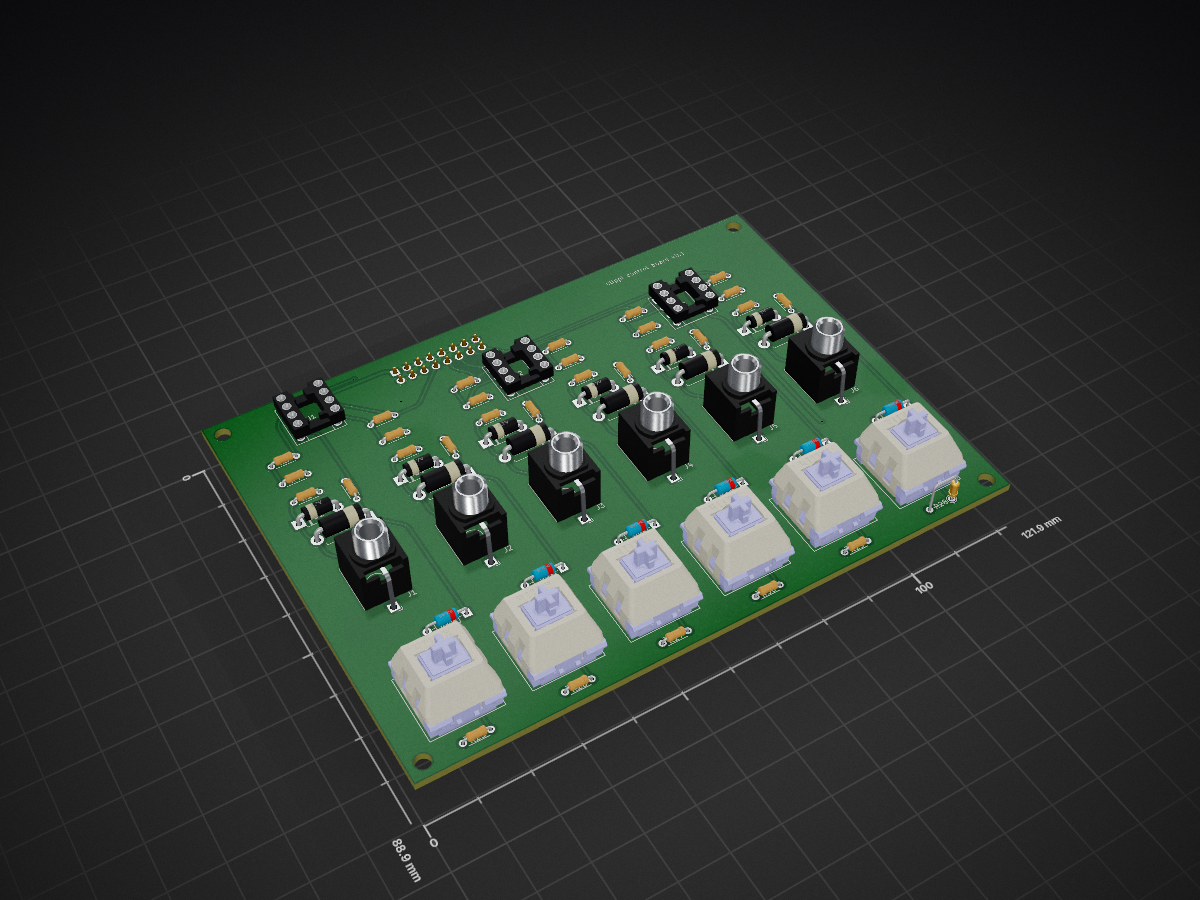
Input array is an open-source printed circuit board by CMorooney, from the CMorooney/clippi repository on GitHub. It is a 2-layer board of 121.9 × 88.9 mm with 64 parts on 44 nets, routed with 242 tracks and 3 vias.
It is built around the MCP6002-I/P. Its parts include 30 resistors, 18 diodes, 7 connectors, 6 switches and 3 ICs.


sudo and passing env variables to the virtual env
/boot/config.txt
dtoverlay=gpio-shutdown,gpio_pin=21.env file at repo rootplayer.service (the actual clip looper):
[Unit]
Description=clippi.player

[Service]
User=calvin
ExecStart=sudo -E env PATH=$PATH /home/calvin/env/bin/python3 /home/calvin/App/app.py
StartLimitIntervalSec=8
StartLimitBurst=1
Restart=always

[Install]
WantedBy=multi-user.target
app.service (the web-app):
[Unit]
Description=clippi

[Service]
ExecStart=/home/calvin/env/bin/python3 /home/calvin/App/web/RaspWebInterface.py
Restart=always

[Install]
WantedBy=default.target
I more/less followed instructions here to set up the system services
the content in the .env file you created should look like this:
WEB_APP_SECRET_KEY=your_secret_key
BANK_COUNT=number
BANK_SIZE=number
APP_PATH=path_to_root_of_application
BANKS_PATH=path_to_banks
for my working prototype the values (outside of the secret, lol) are:
BANK_COUNT=12
BANK_SIZE=12
APP_PATH='/home/calvin/App'
BANKS_PATH='/home/calvin/App/__CONTENT'
theoretically they should be able to be defined as whatever but the .gitignore importantly include the __CONTENT directory that is my BANKS_PATH. An important but unenforced coupling so just make sure whatever you use as your BANKS_PATH is in your .gitignore
consoleblank=1 vt.global_cursor_default=0 was appended to /boot/cmdline.txt to remove boot splash image and console/cursor
| Qty | Value | Footprint | References |
|---|---|---|---|
| 23 | 10k | Resistor_THT:R_Axial_DIN0204_L3.6mm_D1.6mm_P5.08mm_Horizontal | R1, R2, R10, R11, R12, R13, R14, R15, R18, R19, R20, R22, R23, R24, R25, R26 +7 |
| 6 | 1N4148 | Diode_THT:D_DO-35_SOD27_P7.62mm_Horizontal | D5, D8, D11, D14, D17, D20 |
| 6 | 1k | Resistor_THT:R_Axial_DIN0204_L3.6mm_D1.6mm_P5.08mm_Horizontal | R4, R8, R9, R16, R17, R21 |
| 6 | 4.7v | Diode_THT:D_DO-41_SOD81_P7.62mm_Horizontal | D1, D3, D6, D9, D12, D15 |
| 6 | SW_Push | Button_Switch_Keyboard:SW_Cherry_MX_1.00u_PCB | SW1, SW2, SW3, SW4, SW5, SW6 |
| 6 | T.Input.01 | Connector_Audio:Jack_3.5mm_QingPu_WQP-PJ398SM_Vertical_CircularHoles | J1, J2, J3, J4, J5, J6 |
| 6 | ~ | Diode_THT:D_DO-15_P10.16mm_Horizontal | D2, D4, D7, D10, D13, D16 |
| 2 | MCP6002-xSN | Package_DIP:DIP-8_W7.62mm_Socket | U2, U3 |
| 1 | 10k | Resistor_THT:R_Axial_DIN0204_L3.6mm_D1.6mm_P5.08mm_Vertical | R28 |
| 1 | Conn_01x16 | Connector_IDC:IDC-Header_2x08_P2.54mm_Vertical | J7 |
| 1 | MCP6002 | Package_DIP:DIP-8_W7.62mm_Socket | U1 |
It measures 121.9 × 88.9 mm and has 2 copper layers, 1.6 mm thick.
64 parts, built around the MCP6002-I/P. The full list of its parts is on this page, with links to each part's symbol and footprint where PCBKit's library has them.
From the CMorooney/clippi repository on GitHub, at the commit this page was made from: the board is hardware/KiCad/input array/input array.kicad_pcb and its schematic hardware/KiCad/clippi/clippi.kicad_sch. PCBKit opens the board in the browser, with nothing to install.
Its repository states no licence, so its author keeps all rights: ask CMorooney before reusing the design.


GaudiLabs/OpenLaserScanningMicroscope
Open Source Laser Scanning Microscope


GuitarML/GuitarPedalSTM32
Guitar pedal using a stm32h7 microcontroller programmed with CubeIDE (PCB and Firmware)

thawney/PedalPiV2
Pedal Pi V2 by Thawney is an all new and regularly maintained Pedal-Pi by electrosmash; a lo-fi programmable guitar pedal that works with the Raspberry Pi ZERO Board.

CCHS-Melbourne/ESPlant
Environmental Sensor Plant - solar WiFi gardening/meteorological sensor using ESP8266

