2 layers
 clementleger/chc
Configurable Home Controller
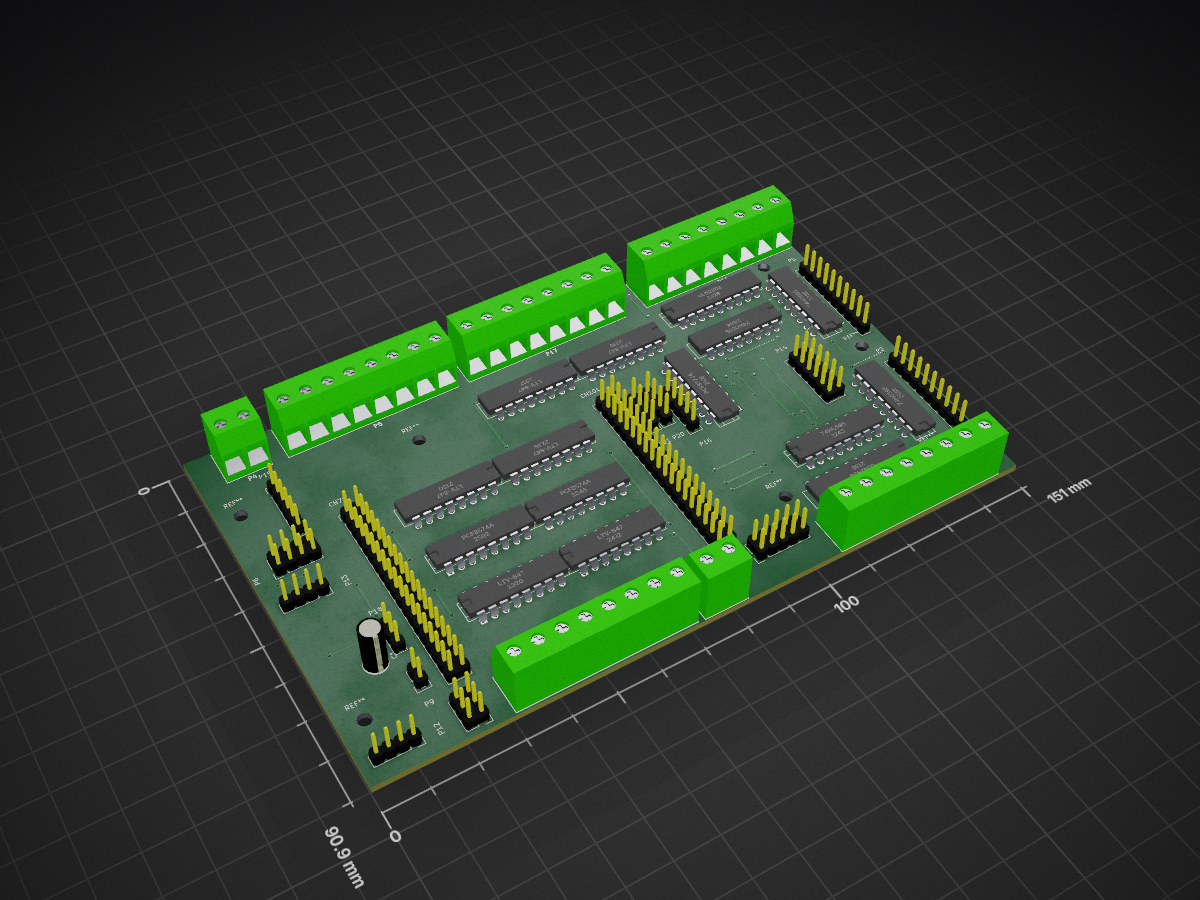
Nucleo shield is an open-source printed circuit board by clementleger, from the clementleger/chc repository on GitHub, published under the GPL-3.0 licence. It is a 2-layer board of 151 × 90.9 mm with 77 parts on 170 nets, routed with 1,244 tracks and 44 vias.
It is built around the PCF8574AP, LTV-847 and 74HC595, with the ULN2803 among its other parts. Its parts include 31 resistors, 23 connectors, 15 ICs and 1 capacitor.


Configurable Home Controller is a home automation software in order to control relays, sensors, etc. It aims at beeing the low level interface between the server and the electric part of the installation. For that, it is connected through ethernet to the home network.
The board has a lot of IO such as:
Sensors:
GPIO:
Screen:
Buses:
Ethernet:
The currently implemented protocol is MySensor and can be used other ethernet or serial.
The software part uses JSON to describe the board.
### Requirements
In order to be able to build the software, you will need gcc4mbed. For that, use the following command:
$ cd sw/gcc4mbed $ ./linux_install
Then follow the instruction.
To build chc, you will need to go into sw/src folder. Then execute make:
$ make
The system will generate binaries for Configured nucleo boards and for
To override the default config, use make CONFIG=config_name


The schematic and board layout was made using Kicad
| Qty | Value | Footprint | References |
|---|---|---|---|
| 30 | R | Resistors_SMD:R_0805_HandSoldering | R1, R2, R3, R17, R18, R19, R20, R25, R26, R27, R28, R34, R35, R36, R37, R38 +14 |
| 6 | LTV-847 | Housings_DIP:DIP-16__300 | U3, U4, U5, U6, U15, U16 |
| 4 | 74HC595 | Housings_DIP:DIP-16__300 | U1, U2, U11, U12 |
| 3 | PCF8574A | Housings_DIP:DIP-16__300 | U7, U8, U14 |
| 2 | ULN2803 | Housings_DIP:DIP-18__300 | U9, U10 |
| 1 | CONN_02X06 | Pin_Headers:Pin_Header_Straight_2x06 | P14 |
| 1 | CONN_1WIRE | Pin_Headers:Pin_Header_Straight_1x03 | P18 |
| 1 | CONN_EXT2 | Pin_Headers:Pin_Header_Straight_2x03 | P15 |
| 1 | CONN_EXTI2C | Pin_Headers:Pin_Header_Straight_1x05 | P16 |
| 1 | CONN_EXT_SPI | Pin_Headers:Pin_Header_Straight_1x06 | P19 |
| 1 | CONN_INH1 | w_conn_screw:mors_8p | P1 |
| 1 | CONN_INH2 | w_conn_screw:mors_8p | P5 |
| 1 | CONN_INH3 | w_conn_screw:mors_8p | P17 |
| 1 | CONN_LCD_SD | Pin_Headers:Pin_Header_Straight_2x05 | P7 |
| 1 | CONN_OUT3 | Pin_Headers:Pin_Header_Straight_1x10 | P2 |
| 1 | CONN_OUT4 | Pin_Headers:Pin_Header_Straight_1x10 | P8 |
| 1 | CONN_OUTH1 | w_conn_screw:mors_8p | P10 |
| 1 | CONN_OUTH2 | w_conn_screw:mors_8p | P11 |
| 1 | CONN_RS485_IN | Pin_Headers:Pin_Header_Straight_1x04 | P13 |
| 1 | CONN_RS485_OUT | Pin_Headers:Pin_Header_Straight_1x04 | P12 |
| 1 | CONN_SCT | Pin_Headers:Pin_Header_Straight_1x02 | P9 |
| 1 | CON_BH | Pin_Headers:Pin_Header_Straight_1x04 | P21 |
| 1 | CON_BME | Pin_Headers:Pin_Header_Straight_1x04 | P20 |
| 1 | CP | Capacitors_ThroughHole:C_Radial_D5_L11_P2 | C1 |
| 1 | ETH_CONN | Pin_Headers:Pin_Header_Straight_2x04 | P6 |
| 1 | Nucleo-F411RE-CN10 | Pin_Headers:Pin_Header_Straight_2x19 | CN101 |
| 1 | Nucleo-F411RE-CN7 | Pin_Headers:Pin_Header_Straight_2x19 | CN71 |
| 1 | POWER_24V_CON | w_conn_screw:mors_2p | P3 |
| 1 | POWER_CON | w_conn_screw:mors_2p | P4 |
| 1 | R_LCD_LED | Resistors_SMD:R_0805_HandSoldering | R33 |
The 70 most common of 77 parts.


jbteja/jbt05-io-extender-74hc595-uln2803-mosfet
IO extender for switching On/Off low current motors and solenoid valves


Bugatsec/OpenDeck-RP2040-v0
OpenDeck-RP2040-v0 is a DIY 9-key macro pad prototype inspired by the Elgato Stream Deck, built around the Seeed XIAO RP2040.


Believotron/Believotronics
Believotronics is a low-cost DIY open source robotics platform you can print and build at work or from home. Our first projects are a MicroscopeBot and a ThroughholeSolderBot.

It measures 151 × 90.9 mm and has 2 copper layers, 1.6 mm thick.
77 parts, built around the PCF8574AP, LTV-847, 74HC595 and ULN2803. The full list of its parts is on this page, with links to each part's symbol and footprint where PCBKit's library has them.
From the clementleger/chc repository on GitHub, at the commit this page was made from: the board is hw/nucleo_shield/nucleo_shield.kicad_pcb. PCBKit opens the board in the browser, with nothing to install.
Its repository publishes it under the GPL-3.0 licence: you may reuse it on that licence's terms (keep the author's notice, and for a copyleft licence share your changes alike).