
2 layers152.4 × 101.6 mm
8088-FE2010A SBC
skiselev/micro_8088
Micro 8088 - IBM XT Compatible Processor Board based on Faraday FE2010 chipset
72 parts412GPL-3.0

 chrisalbertson/NeatoLidarInterfacePCB10
PCB for interfacing a LIDAR from a Neato XV-11 or Botvac vacuum cleaner using STM32F103 (Blue Pill)
NeatoLidarInterface is an open-source printed circuit board by chrisalbertson, from the chrisalbertson/NeatoLidarInterfacePCB repository on GitHub. It is a 2-layer board of 49 × 69 mm with 8 parts on 42 nets, routed with 64 tracks and 0 vias.
It is built around the PN2222A. Its parts include 5 connectors, 1 resistor, 1 IC and 1 transistor. It belongs with the STM32 boards of this library.
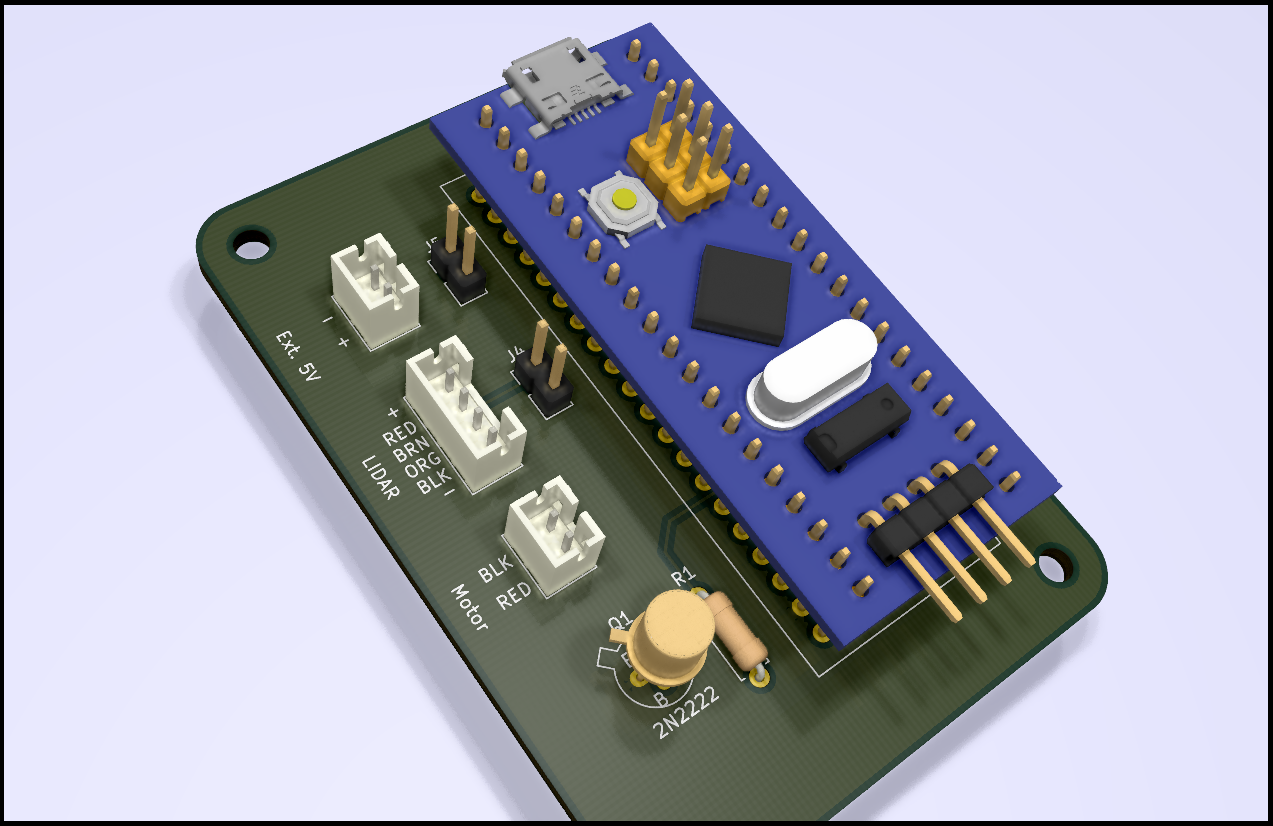
These are KiCAD design files for an interface PCB for the LIDAR units used in Neato XV-11 and Botvac vacuum cleaners. This PCB and it's firmware is very much like the open source product sold by GetSurreal.com This version of their idea uses a less expensive but much more powerfull (STM32 based) plug-in modual and also allows for external power.
This board (with the firmware from my other repository xxx) has the following features:
Instructions for how to jumpper the board are on the back side silk screen. Youhave the otopn to use either type LIDAR and to power the LIDAR either from USB or an external 5V power supply. The external supply would only be required of you are connecting to an unpowered hub. (A 500 mA supply is more than large enough.)
Both work equally well but there are differences.
This unit look the best and is the most compact but it uses a slip ring and mechanical brushes to comutate the data and powert othe spinner scanner. It seems to work but all mechanical brushes will eventualy fail.
The blastic base has a ugly looking shape. But the slip ring has been repalced by a non-contact system. Power is transmitting using a pair of coils that work like a transformer where the secondary is spinning and the data is send up and down the spin axis by a wiresless (and fiberless) optical link. The only down side is that this LIDAR uses about down the amount of current.
The processor used here is much faster and has more FLASH memory than the original version. I plan to use this to enable some more features. Some of them might be:
| Qty | Value | Footprint | References |
|---|---|---|---|
| 2 | Conn_01x02 | Connector_JST:JST_PH_B2B-PH-K_1x02_P2.00mm_Vertical | J1, J3 |
| 2 | Conn_01x02_Male | Connector_PinHeader_2.54mm:PinHeader_1x02_P2.54mm_Vertical | J4, J5 |
| 1 | 1K | Resistor_THT:R_Axial_DIN0207_L6.3mm_D2.5mm_P7.62mm_Horizontal | R1 |
| 1 | Conn_01x04 | Connector_JST:JST_PH_B4B-PH-K_1x04_P2.00mm_Vertical | J2 |
| 1 | PN2222A | Package_TO_SOT_THT:TO-18-3 | Q1 |
| 1 | STM32BluePill | MyFootprints:STM32BluePill | U1 |
skiselev/micro_8088
Micro 8088 - IBM XT Compatible Processor Board based on Faraday FE2010 chipset

Staacks/there.oughta.be
Projects featured on my blog at https://there.oughta.be


plusvic/simplebus2-intercom
General description of the Simplebus2 protocol used by some Comelit's intercoms. Hardware for retransmitting Simplebus2 messages over UART.


It measures 49 × 69 mm and has 2 copper layers, 1.6 mm thick.
8 parts, built around the PN2222A. The full list of its parts is on this page, with links to each part's symbol and footprint where PCBKit's library has them.
From the chrisalbertson/NeatoLidarInterfacePCB repository on GitHub, at the commit this page was made from: the board is NeatoLidarInterface.kicad_pcb. PCBKit opens the board in the browser, with nothing to install.
Its repository states no licence, so its author keeps all rights: ask chrisalbertson before reusing the design.