

2 layers120 × 100 mm
Smart planter unrouted
chainstart/makerai-lab
MakerAI hardware-agent research, whitepaper, lab artifacts, and MVP pipeline
41 parts
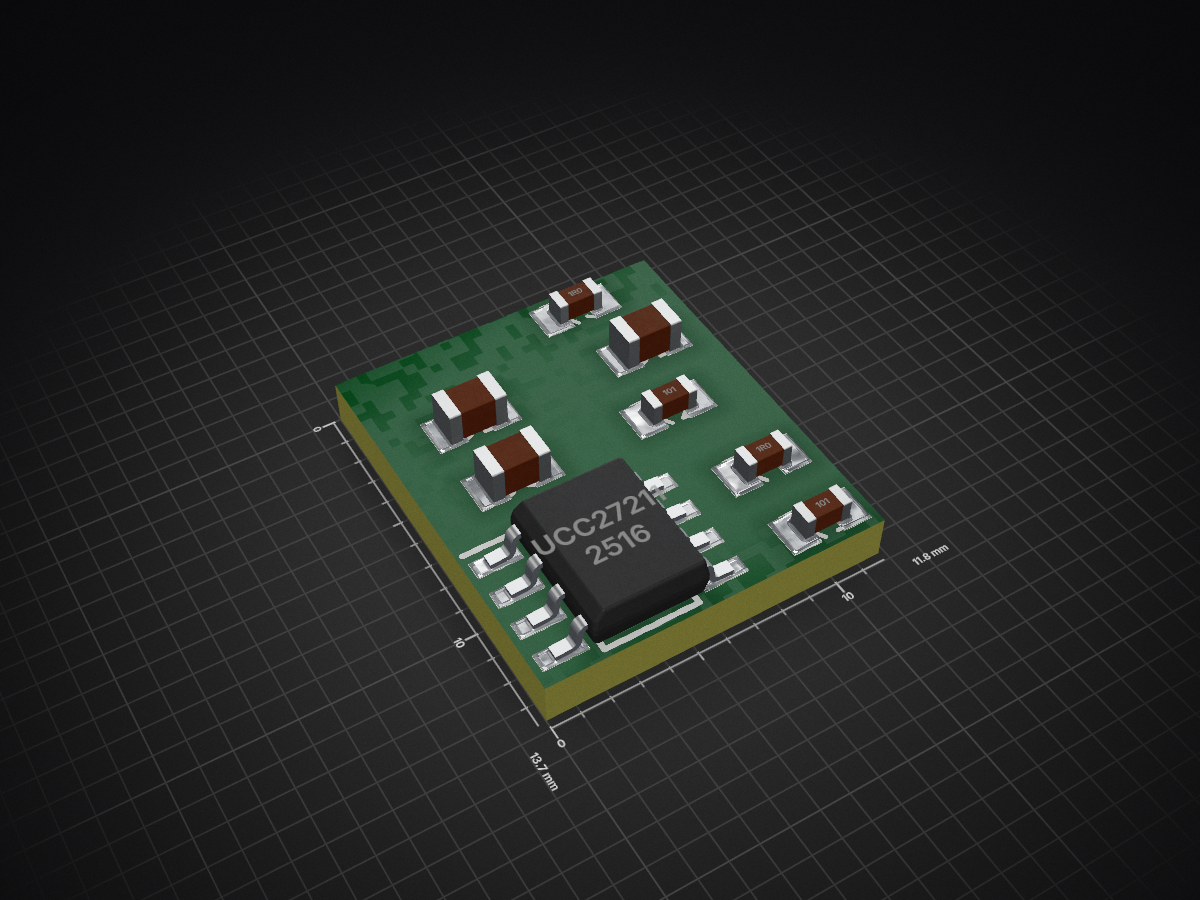
MakerAI hardware-agent research, whitepaper, lab artifacts, and MVP pipeline
P14 is an open-source printed circuit board by chainstart, from the chainstart/makerai-lab repository on GitHub. It is a 2-layer board with 8 parts on 12 nets.
It is built around the UCC27211D. Its parts include 4 resistors, 3 capacitors and 1 IC.
MakerAI is an AI-native hardware runtime and manufacturing platform. The board design path turns reviewed, structured engineering inputs into auditable KiCad schematics and PCBs; it does not treat a rendered image or an autorouter return code as proof that hardware is ready to build.
The sole active EDA implementation is
skills/makerai-board-design. It targets
low-voltage, low-power, low-speed, module-based embedded boards and provides:
The fixed smart-pot MVP and the earlier Hardware-DSL/KiCad script experiment are
archived under legacy/. They are not current design backends.
skills/
  makerai-board-design/       Current schematic, PCB, routing, and review skill.
    assets/                   Schemas, examples, evidence, profiles, and templates.
    references/               Engineering policies and workflow documentation.
    scripts/                  Deterministic generators, checkers, and exporters.
    tests/                    Fast workflow and policy regression tests.

legacy/
  pcb-mvp/                    Archived fixed smart-pot manufacturing MVP.
  kicad-script-demo/          Archived natural-language/Hardware-DSL EDA prototype.
  lab/                        Archived tool evaluations and experiment evidence.
  reports/                    Archived project reports and presentations.
  research/                   Archived market, module, and ecosystem research.

docs/                         White papers, proposals, and design discussions.
reports/                      Reports produced by the current skill route.
Generated skill environments, downloaded tools, and scratch runs live below the
skill as .venv/, .tools/, and .runs/; they are intentionally ignored by
Git. Reproducible inputs, lock files, source code, and policies are versioned.
The current route keeps concerns separate:
design.json owns components, exact pins, nets, footprints, and constraints.design.evidence.json owns primary-source evidence, assumptions, waivers, and
mandatory human-review boundaries.See the skill instructions, architecture, and professional schematic workflow for the authoritative process.
Bootstrap and verify the isolated EDA environment:
SKILL_DIR="$PWD/skills/makerai-board-design"
"$SKILL_DIR/scripts/bootstrap.sh"
"$SKILL_DIR/scripts/doctor.py" --strict
"$SKILL_DIR/.venv/bin/python" -m pytest -q "$SKILL_DIR/tests"
Generate and review the reference ESP32-S3 schematic in a fresh output directory:
SKILL_DIR="$PWD/skills/makerai-board-design"

"$SKILL_DIR/scripts/run_professional_schematic.py" \
  "$SKILL_DIR/assets/examples/esp32-s3-sensor-hub.json" \
  --profile "$SKILL_DIR/assets/schematic-layouts/esp32-s3-sensor-hub-professional-v1.json" \
  --evidence "$SKILL_DIR/assets/examples/esp32-s3-sensor-hub.evidence.json" \
  --template-dir "$SKILL_DIR/assets/schematic-templates/blocks" \
  --source-catalog "$SKILL_DIR/assets/template-sources.lock.json" \
  --output build/esp32-s3-sensor-hub-schematic
The command refuses to overwrite a non-empty output directory. A passing result
is SCHEMATIC_AUTOMATED_REVIEW_PASSED: an engineering-review candidate that
still requires the documented human checks. PCB placement, routing, and release
commands are documented in the skill instructions.
The automated route does not cover mains, high-energy batteries, medical or automotive safety functions, motor power stages, discrete RF, DDR, PCIe, Ethernet PHY layout, isolation barriers, or certification sign-off. Those cases require a qualified engineer and a design-specific review plan.
Never describe an automatically generated design as production-ready. Use these states consistently:
generated: files exist, but required gates have not all passed;review-candidate: automated gates pass and human review remains;release-approved: a named human reviewer completed the release checklist;blocked: at least one required gate failed or the design is outside scope.The archived implementations and their selected outputs remain in
legacy/ so earlier results can be inspected and reproduced.
New features, board families, validation rules, and release decisions must use
the current skill route.
The broader product direction remains documented under docs/, while
historical tool evaluations, reports, and research evidence remain under
legacy/.
The board-design skill source is MIT licensed. Optional upstream tools are kept at process boundaries and retain their own licenses. Review upstream licenses before redistributing tool binaries or copied material.
| Qty | Value | Footprint | References |
|---|---|---|---|
| 2 | 1 | test:R_0805 | R3, R4 |
| 2 | 100 | test:R_0805 | R1, R2 |
| 1 | 100nF | test:C_0805 | C2 |
| 1 | 220nF | test:C_0805 | C3 |
| 1 | 4.7uF | test:C_0805 | C1 |
| 1 | UCC27211 | test:UCC27211 | IC1 |
8 parts, built around the UCC27211D. The full list of its parts is on this page, with links to each part's symbol and footprint where PCBKit's library has them.
From the chainstart/makerai-lab repository on GitHub, at the commit this page was made from: the board is legacy/lab/section6-tool-tests/outputs/PCBSchemaGen-sample-results/p14_results/p14.kicad_pcb. PCBKit opens the board in the browser, with nothing to install.
Its repository states no licence, so its author keeps all rights: ask chainstart before reusing the design.
chainstart/makerai-lab
MakerAI hardware-agent research, whitepaper, lab artifacts, and MVP pipeline

chainstart/makerai-lab
MakerAI hardware-agent research, whitepaper, lab artifacts, and MVP pipeline

chainstart/makerai-lab
MakerAI hardware-agent research, whitepaper, lab artifacts, and MVP pipeline

chainstart/makerai-lab
MakerAI hardware-agent research, whitepaper, lab artifacts, and MVP pipeline

chainstart/makerai-lab
MakerAI hardware-agent research, whitepaper, lab artifacts, and MVP pipeline

chainstart/makerai-lab
MakerAI hardware-agent research, whitepaper, lab artifacts, and MVP pipeline

chainstart/makerai-lab
MakerAI hardware-agent research, whitepaper, lab artifacts, and MVP pipeline

chainstart/makerai-lab
MakerAI hardware-agent research, whitepaper, lab artifacts, and MVP pipeline

chainstart/makerai-lab
MakerAI hardware-agent research, whitepaper, lab artifacts, and MVP pipeline

chainstart/makerai-lab
MakerAI hardware-agent research, whitepaper, lab artifacts, and MVP pipeline

chainstart/makerai-lab
MakerAI hardware-agent research, whitepaper, lab artifacts, and MVP pipeline

chainstart/makerai-lab
MakerAI hardware-agent research, whitepaper, lab artifacts, and MVP pipeline


Deco025/resonare
Resonare: open-source 120 W LCC-S resonant wireless charger, transmitter and receiver boards (KiCad 10, 4-layer)

BenjaminMeyerEE/Digital-Synchronous-Buck-Converter
12 V to 6 V, 10 A synchronous buck converter with closed-loop digital control on an STM32G474RET6. Custom 4-layer board in KiCad.

Blaze-Pascal/EKA-PiF-MCU_PSU
2-phase synchronous digitally controlled buck converter (30V in, up to 10A out). Features a 4-layer custom KiCad PCB optimized for EMI.

IpinZhu/foc-esc
这是一个基于 STM32G473RC 的实验性三相 PMSM/BLDC 电机控制平台。仓库包含驱动板设计,以及使用 Rust 2024 + Embassy 实现的电流控制型磁场定向控制(FOC)固件。


shonzinger-spec/ee-portfolio
Electrical engineering portfolio: simulated and verified EE projects (firmware, SPICE, KiCad, Wokwi) by Shon Zinger
