2 layers91.5 × 100 mm
Lights pcb
QuinnFreedman/modular
A collection of free & open source DIY synthesizer module designs for Eurorack
59 parts116
 cedric-dufour/LIRC-HighPowerSerialTransceiver1
LIRC High-Power Serial Transceiver [CC-BY]
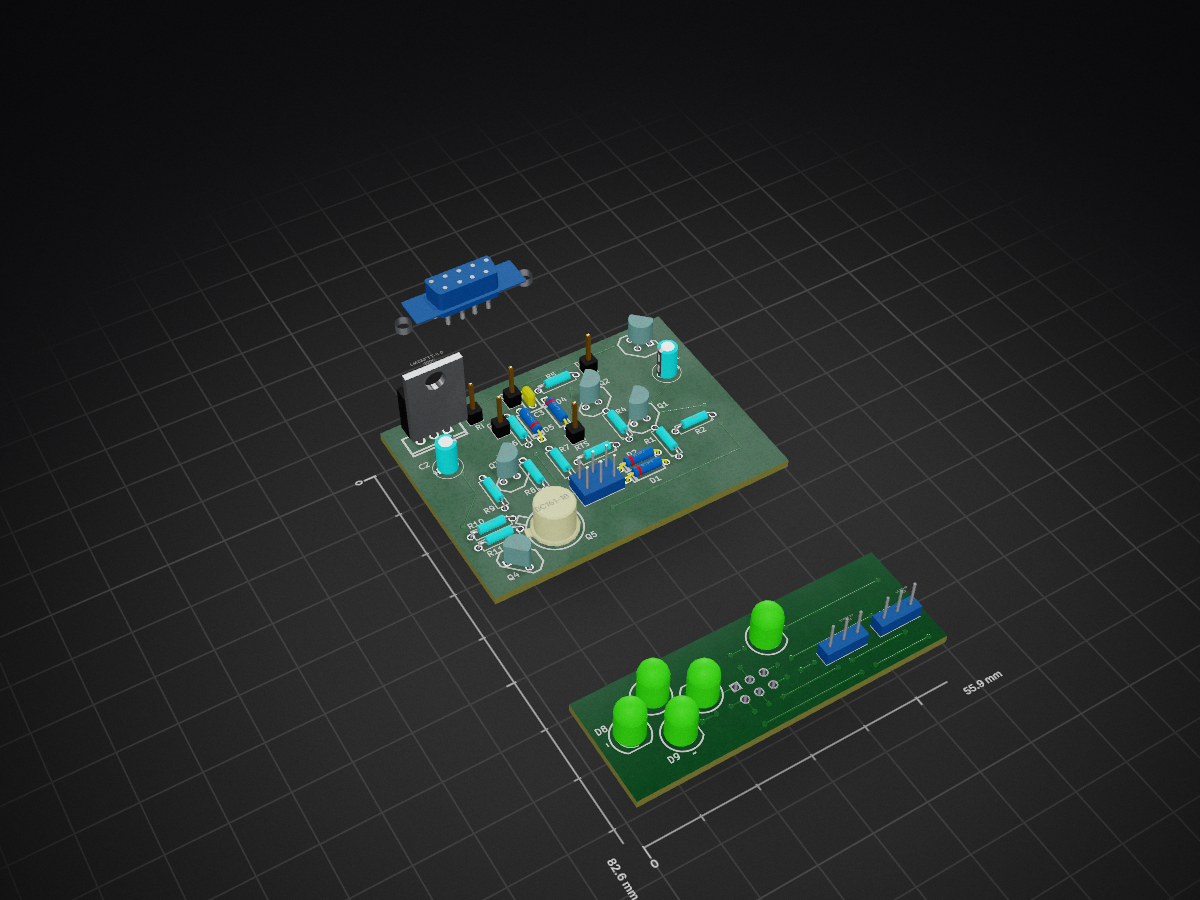
LIRC HighPowerSerialTransceiver is an open-source printed circuit board by cedric-dufour, from the cedric-dufour/LIRC-HighPowerSerialTransceiver repository on GitHub, published under the CC-BY-4.0 licence. It is a 2-layer board of 55.9 × 82.6 mm with 40 parts on 25 nets, routed with 132 tracks and 39 vias.
It is built around the LM2936Z-5.0, LM2937ET-8.0 and TSOP2238, with the TSOP2256 and TSAL6200 among its other parts. Its parts include 11 resistors, 9 diodes, 5 transistors, 4 ICs and 3 capacitors.


This electronics project spawned from my need to blast Philips RC6 infrared codes across my entire living room and remote control my existing Feller Zeptrion [1] (house control) electric installation, with the help of the Linux Infrared Remote Control (LIRC) [2].
Unfortunately, my existing USB dongle would not transmit RC6 codes while my spare serial transmitter would lack the power to blast IR accross the entire room.
I thus designed this High-Power Serial Transceiver with the following key points in mind:
high-power IR transmission, using an external power source such as the RS-232 12-volt "Power-over-System" provided by some card (e.g. Exsys 44092-2 [3]) or using a 9-volt battery
versatile IR reception, compatible with both 36/38kHz and 56kHz remotes
indicator LED to monitor IR reception (and transmission)
do-it-yourself using "off-the-shelf" standard components [4]
starting with the designs proposed by LIRC and its contributors:
http://www.lirc.org/transmitters.html
http://www.lirc.org/receivers.html
and using this opportunity to over-design some of the components, such as to protect the high-power LEDs to be driven out of specifications by the full range of potential RS-232 signals/voltages (using a high-pass input filter and a two-transistors constant current source).
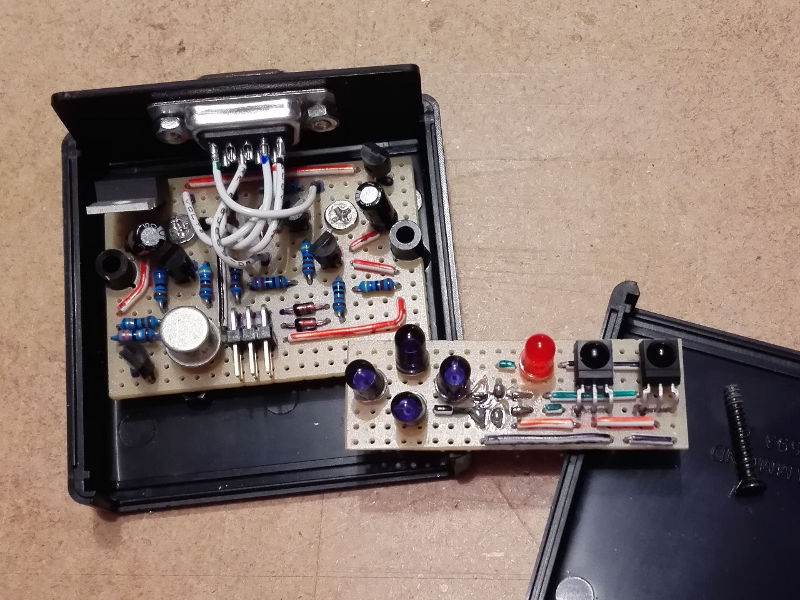
Provided files are:
KiCAD/Eeeschema schematic (and corresponding PDF plot)
KiCAD/PCBnew layout (and corresponding SVG export)
Please bear with me that the provided PCB layout is targeted towards 2.54mm-pad rapid prototype boards rather than actual PCB manufacturing.
Enjoy!
References:
| Qty | Value | Footprint | References |
|---|---|---|---|
| 5 | Val** | PIN_ARRAY_1 | DCD, DTR, GND, RI, RTS |
| 4 | 1N4148 | D3 | D1, D2, D4, D5 |
| 4 | 4.7kΩ | R3 | R2, R4, R5, R8 |
| 3 | 10kΩ | R3 | R1, R6, R7 |
| 3 | ~ | LED-5MM | D7, D8, D9 |
| 2 | 10uF | C1V5 | C1, C2 |
| 2 | 2N3904 | TO92-INVERT | Q2, Q3 |
| 2 | 2N3906 | TO92-INVERT | Q1, Q4 |
| 2 | Val** | pin_array_3x2 | PIN_ARRAY_3X2, PIN_ARRAY_3X2 |
| 1 | 220Ω | R3 | R3 |
| 1 | 3.3Ω | R3 | R11 |
| 1 | 4.7nF | C1 | C3 |
| 1 | 6.8kΩ | R3 | R10 |
| 1 | 680Ω | R3 | R9 |
| 1 | BC161-16 | TO39EBC | Q5 |
| 1 | DB9 | DB9FD | J1 |
| 1 | LD20_RED | LED-5MM | D3 |
| 1 | LM2936Z-5.0 | TO92-INVERT | U1 |
| 1 | LM2937ET-8.0 | TO220_123_VERT | U2 |
| 1 | TSAL6200 | LED-5MM | D6 |
| 1 | TSOP2238 | PIN_ARRAY_3X1 | IC1 |
| 1 | TSOP2256 | PIN_ARRAY_3X1 | IC2 |
QuinnFreedman/modular
A collection of free & open source DIY synthesizer module designs for Eurorack

bikeNomad/micropython-tv-b-gone
A MicroPython version of the classic TV-B-Gone tool with new code database

maehw/DiyIrTower
Do-it-yourself infrared serial communication tower (compatible with LEGO IR serial tower)

ajvizganapathy-pixel/FlipperZero-DIY-STM32WB55-NucleusDark
DIY Flipper Zero clone using STM32WB55CGU6 — KiCad PCB, Momentum firmware, 200+ apps, BadUSB scripts, wiring diagrams


Samuel-Malaj/PicoCalc-Open-Source-Student-Scientific-Calculator
Open source scientific calculator built on Raspberry Pi Pico W — custom PCB, WiFi messaging, IR projector control and games.

dmarcr1997/COR-SAT
COR-SAT turns natural-language mission requests into tested Python mission packages for a Raspberry Pi satellite payload.
It measures 55.9 × 82.6 mm and has 2 copper layers, 1.6 mm thick.
40 parts, built around the LM2936Z-5.0, LM2937ET-8.0, TSOP2238 and TSOP2256. The full list of its parts is on this page, with links to each part's symbol and footprint where PCBKit's library has them.
From the cedric-dufour/LIRC-HighPowerSerialTransceiver repository on GitHub, at the commit this page was made from: the board is LIRC-HighPowerSerialTransceiver.kicad_pcb. PCBKit opens the board in the browser, with nothing to install.
Its repository publishes it under the CC-BY-4.0 licence: you may reuse it on that licence's terms (keep the author's notice, and for a copyleft licence share your changes alike).