Skip to the content
4 layers76 × 88.8 mm4Layers trl board, the printed circuit board in 3D

4Layers trl board

bvernoux/kicad_rf14

KiCad RF Stuff

Size
76 × 88.8 mm
Copper layers
4
Thickness
1.6 mm
Parts
18
Nets
8
Pads
60
Tracks, vias
19, 387
Pours
9
Routed
Yes
KiCad
KiCad 5 (file 20171130)
Created
17 Feb 2020
Updated
17 Aug 2021

Overview

4Layers trl board is an open-source printed circuit board by bvernoux, from the bvernoux/kicad_rf repository on GitHub. It is a 4-layer board of 76 × 88.8 mm with 18 parts on 8 nets, routed with 19 tracks and 387 vias.

Its parts include 12 connectors, 4 resistors and 2 fuses.
README

OSHPark_4Layers_trl-board_v0_1/README.md

OSHPark_4Layers_trl-board_v0_1

OSHPark 4Layers trl-board v0.1

This Board is based on Mario Hellmich's design see https://www.mariohellmich.de/projects/trl-cal/trl-cal.html

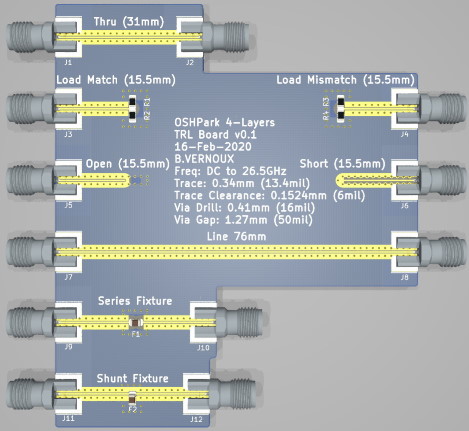
TRL Calibration Board for evaluation of SMA BELFUSE 142-0771-831(Up to 26.5GHz) connectors and for experimentation on series/shunt fixtures.

It contains following features:

  • A thru standard for TRL
  • A 50 Ohms match standard
  • A 25 Ohms mismatch standard for verification
  • An open standard for verification
  • A short standard, used as a reflect standard for TRL
  • A line of 45 mm length (Called also "Line 76mm" to reflect total length), used as a line standard for TRL
  • A series fixture for 0805 components
  • A shunt fixture for 0805 components

The board is designed assuming the following parameters (based on OSH Park 4 Layers 190Tg FR408-HR specifications):
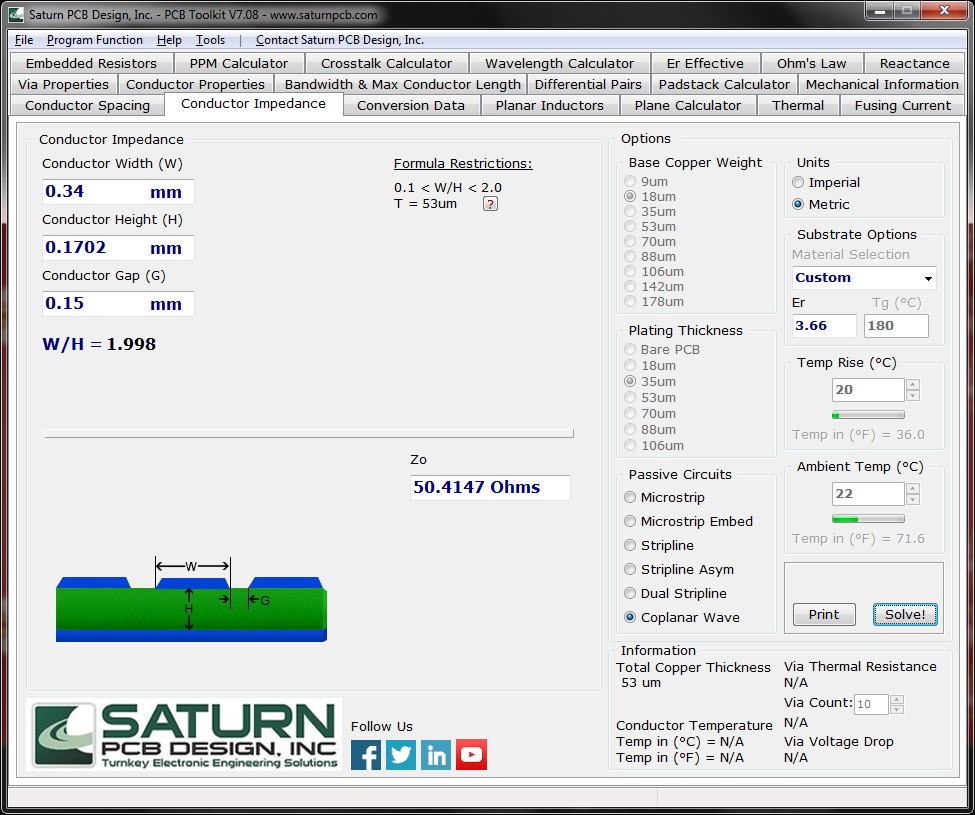
  • Base Material / Board thickness: 1.6 mm (63 mil)
  • Center Conductor Width: 0.34036 mm (13.4 mil)
  • Gap Width: 0.1524 mm (6 mil)
  • Permittivity: 3.66 (3.68 @2GHz)
  • Loss Tangent: 0.0092 @2GHz
  • Copper Weight: 1oz outer (35µm), 1/2oz inner (17.5µm)
  • Trace surface: Cu
  • Impedance: 50 Ohms (+/-2 Ohms)
  • PCB Finish: ENIG (Gold), compliant with IPC-4552

SaturnPCB_PCB_Toolkit_v7_08_CPWG_Z50Ohms_OSHPark_4Layers

For more details on TRL see https://www.mariohellmich.de/projects/trl-cal/trl-cal.html

Parts

18
QtyValueFootprintReferences
12142-0771-831kicad:Southwest_Microwave_1092-02A-5J1, J2, J3, J4, J5, J6, J7, J8, J9, J10, J11, J12
2100kicad:R_0402_1005MetricR1, R2
250kicad:R_0402_1005MetricR3, R4
2Fixture 0402kicad:C_0402_1005MetricF1, F2

More from bvernoux/kicad_rf

2

Similar boards

  • 4 layers18.6 × 34.4 mmNfc sense ntag BME, the printed circuit board in 3D

    Nfc sense ntag BME

    unsurv/NFC_temp

    passive temperature NFC tag

    18 parts49
  • 4 layers42.4 × 40.8 mmView screen, the printed circuit board in 3D

    View screen

    SeedLabs-it/smartknob-hardware

    PCB and CAD files for smartknob devkit

    18 parts47
  • 4 layers97.8 × 22.2 mmGvpsimm, the printed circuit board in 3D

    Gvpsimm

    schlae/gvpsimm

    GVP-Compatible 64-pin 4MB SIMM

    18 parts31CERN-OHL-P-2.0
  • 4 layers100 × 60 mmPicocart64 v1, the printed circuit board in 3D

    Picocart64 v1

    khill25/Dreamdrive

    Open source Retro Rom Carts and ODEs by Dreamcraft Industries

    18 parts26
  • 4 layers76 × 31 mmVm006-mixbus, the printed circuit board in 3D

    Vm006-mixbus

    mirdej/vmix

    Multichannel modular analog PAL video mixer based on the SYNKIE project

    18 parts21
  • 4 layers85 × 56 mmProbe shield, the printed circuit board in 3D

    Probe shield

    probe-rs/hive

    A Raspberry PI shield for testing probe-rs against many chips & probes.

    18 parts15

Questions

How big is the 4Layers trl board PCB?

It measures 76 × 88.8 mm and has 4 copper layers, 1.6 mm thick.

What parts does the 4Layers trl board use?

18 parts. The full list of its parts is on this page, with links to each part's symbol and footprint where PCBKit's library has them.

Where can I download the 4Layers trl board KiCad files?

From the bvernoux/kicad_rf repository on GitHub, at the commit this page was made from: the board is 4Layers_trl-board_v0_3/4Layers_trl-board.kicad_pcb. PCBKit opens the board in the browser, with nothing to install.

Can I use the 4Layers trl board design in my own project?

Its repository states no licence, so its author keeps all rights: ask bvernoux before reusing the design.