2 layers
LED Module CH32V203
buildwithnoknok/module-usb-led-16x
noknok LEDs 16x - USB-controlled 16x RGBW LED module (round board, CH32V203)
97 partsMIT

 buildwithnoknok/module-usb-led
noknok LEDs - USB-controlled 8x WS2812b RGB LED module for the noknok ecosystem
LED Module CH32V203 is an open-source printed circuit board by buildwithnoknok, from the buildwithnoknok/module-usb-led repository on GitHub, published under the MIT licence. It is a 2-layer board of 40 × 40 mm with 51 parts on 44 nets, routed with 448 tracks and 21 vias.
It is built around the CH32V203G6U6, XC6206P332MR and WS2812B, with the ESD9B5.0ST5G among its other parts. Its parts include 18 capacitors, 12 diodes, 9 resistors, 5 connectors and 2 ICs. It belongs with the lEDs and displays boards and the RISC-V boards of this library.


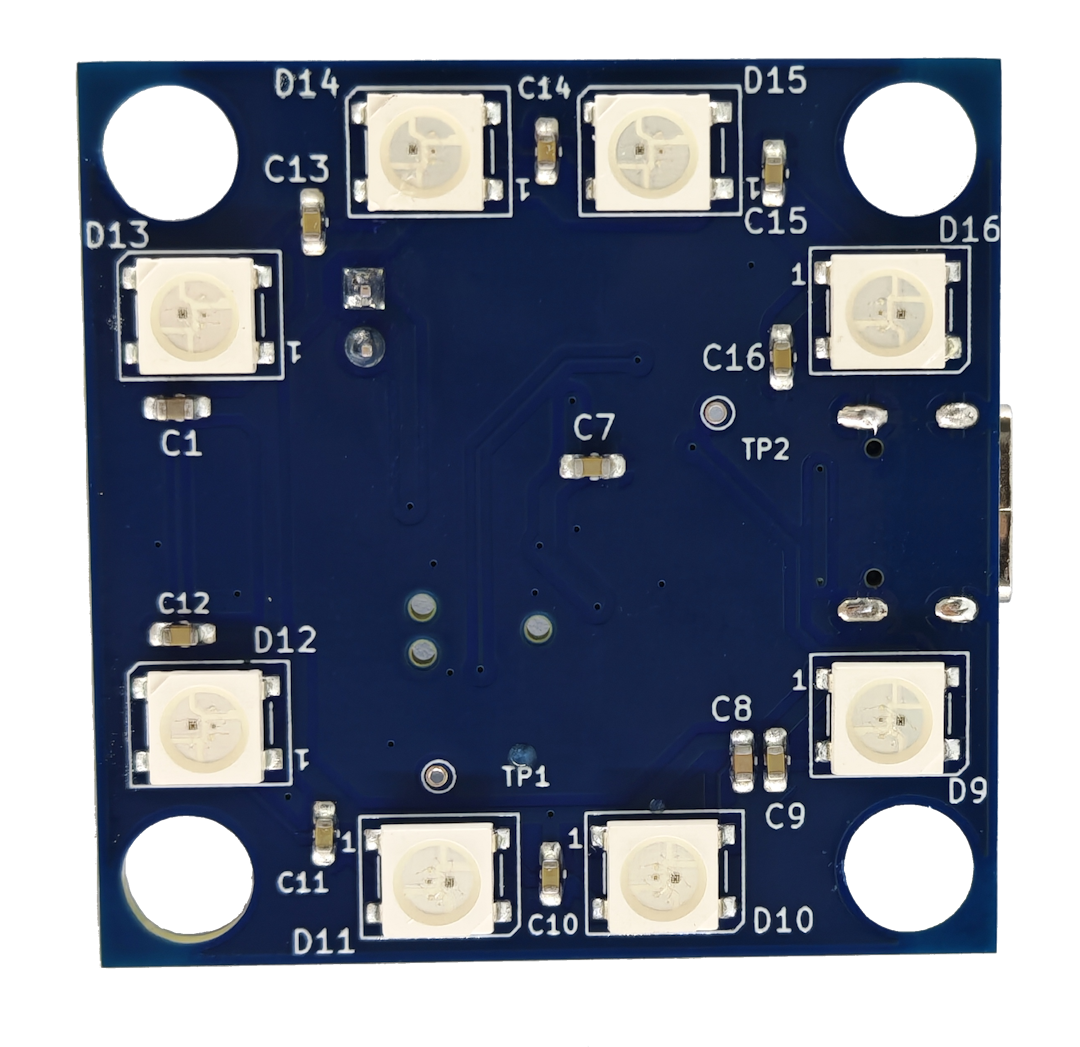
A USB-controlled ring of 8 WS2812b RGB LEDs for the noknok ecosystem. The Raspberry Pi Pico drives it as a USB host; it can also be driven directly from a PC.
The Pico hosts the module over PIO-USB (D+ → GP16, D− → GP17, behind a powered hub
such as the DataHub). The NoknokLEDs driver lives in
brain-Pico/software/noknok_usb.py
and is discovered by the Conductor:
from noknok import Conductor

c = Conductor()
c.enumerate_usb()          # brings up the USB host port, finds all LED modules
# (use c.enumerate_all() for a product that mixes I2C + USB modules)

leds = c.leds[0]                                  # or c.by_uid("<serial>"), or c.role["lamp"]
leds.set_all(255, 0, 0)                           # all red
leds.set_pixel(3, 0, 255, 0)                      # LED 3 green
leds.set_brightness(128)                          # global brightness
leds.set_led(0xFF, 0, 0, 255, brightness=200, duration_ms=1000)  # all blue 1 s, then off
leds.play_preset(leds.PRESET_RAINBOW, speed=40)  # non-blocking animation on the module
leds.play_preset(leds.PRESET_SUNDOWN, speed=30, r=0, g=0, b=255)  # 30 min fade to off, blue
leds.off()
Each module carries a unique serial, so multiple LED modules on one hub are addressed individually. See Ecosystem → enumeration.md (USB Module Discovery & Identity) and roles.md (role assignment — this is an output module, assigned by cue-and-confirm).
PowerShell / Python helpers in tools/ (noknok_leds.ps1, noknok_leds_pc.py)
auto-detect the module and expose the same commands.
/hardware — KiCad files, schematics, 3D models/firmware — source (src/), built binaries (bin/), and the firmware change record (readme.md)/tools — PC control scripts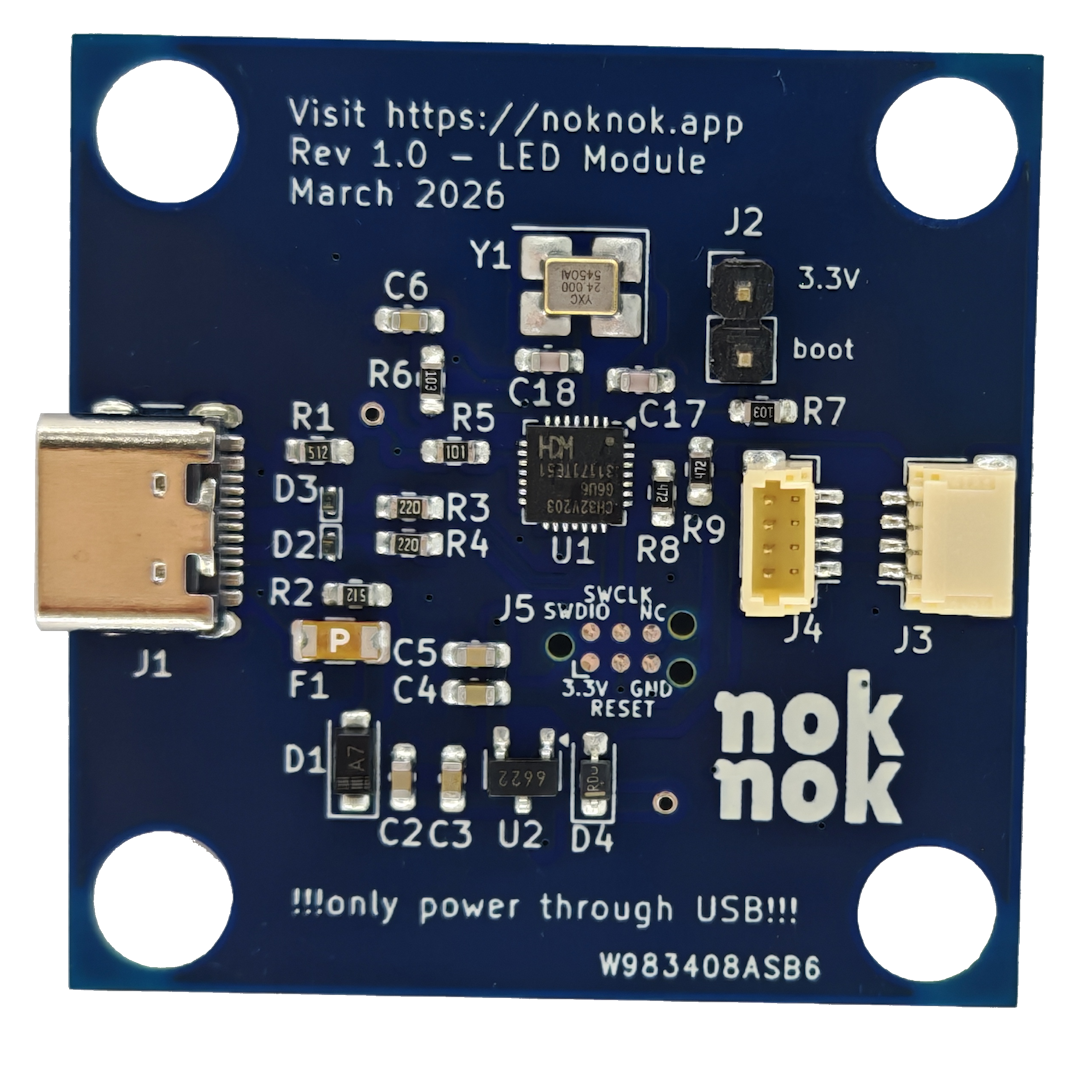
noknok is a registered trademark in Switzerland (Swissreg 1300007033).
Qwiic is a registered trademark of SparkFun Electronics, Inc. STEMMA QT is a trademark of Adafruit Industries, LLC. Both are named here only to state connector compatibility - noknok is not affiliated with, endorsed by, or sponsored by either company.
| Qty | Value | Footprint | References |
|---|---|---|---|
| 9 | 0.1uF | Capacitor_SMD:C_0603_1608Metric_Pad1.08x0.95mm_HandSolder | C6, C9, C10, C11, C12, C13, C14, C15, C16 |
| 8 | WS2812B | LED_SMD:LED_WS2812B_PLCC4_5.0x5.0mm_P3.2mm | D9, D10, D11, D12, D13, D14, D15, D16 |
| 4 | 10uF | Capacitor_SMD:C_0603_1608Metric_Pad1.08x0.95mm_HandSolder | C1, C2, C5, C8 |
| 3 | 1uF | Capacitor_SMD:C_0603_1608Metric_Pad1.08x0.95mm_HandSolder | C3, C4, C7 |
| 2 | 10k | Resistor_SMD:R_0603_1608Metric_Pad0.98x0.95mm_HandSolder | R6, R7 |
| 2 | 18pF | Capacitor_SMD:C_0603_1608Metric_Pad1.08x0.95mm_HandSolder | C17, C18 |
| 2 | 22R | Resistor_SMD:R_0603_1608Metric_Pad0.98x0.95mm_HandSolder | R3, R4 |
| 2 | 4.7k | Resistor_SMD:R_0603_1608Metric_Pad0.98x0.95mm_HandSolder | R8, R9 |
| 2 | 5.1k | Resistor_SMD:R_0603_1608Metric_Pad0.98x0.95mm_HandSolder | R1, R2 |
| 2 | ESD9B5.0ST5G | Diode_SMD:D_SOD-923 | D2, D3 |
| 2 | TestPoint | TestPoint:TestPoint_THTPad_D1.0mm_Drill0.5mm | TP1, TP2 |
| 1 | 100R | Resistor_SMD:R_0603_1608Metric_Pad0.98x0.95mm_HandSolder | R5 |
| 1 | 1N4007 | Diode_SMD:D_SOD-123 | D1 |
| 1 | CH32V203G6U6 | Package_DFN_QFN:WQFN-28-1EP_4x4mm_P0.4mm_EP2.7x2.7mm | U1 |
| 1 | Crystal | Crystal:Crystal_SMD_3225-4Pin_3.2x2.5mm_HandSoldering | Y1 |
| 1 | D_Schottky | Diode_SMD:D_SOD-323_HandSoldering | D4 |
| 1 | Jumper Cap | Connector_PinHeader_2.54mm:PinHeader_1x02_P2.54mm_Vertical | J2 |
| 1 | LOGO | footprints:noknok_KiCad_Logo_10x10mm | G*** |
| 1 | Qwiic / StemmaQT Connector | Chris_Library:JST_SH_SM04B-SRSS-TB_1x04-1MP_P1.00mm_Horizontal_CHRIS | J3 |
| 1 | Qwiic / StemmaQT Connector | Connector_JST:JST_SH_BM04B-SRSS-TB_1x04-1MP_P1.00mm_Vertical | J4 |
| 1 | Resettable Polyfuse | Fuse:Fuse_1206_3216Metric | F1 |
| 1 | TagConnect_TC2030 | Connector:Tag-Connect_TC2030-IDC-NL_2x03_P1.27mm_Vertical | J5 |
| 1 | USB_C_Receptacle_USB2.0_16P | Connector_USB:USB_C_Receptacle_GCT_USB4105-xx-A_16P_TopMnt_Horizontal | J1 |
| 1 | XC6206P332MR | Package_TO_SOT_SMD:SOT-23-3 | U2 |
buildwithnoknok/module-usb-led-16x
noknok LEDs 16x - USB-controlled 16x RGBW LED module (round board, CH32V203)


matthiasnowak/jewelled
This is a panel meant for production of the Earrings, allowing for 2 Earrings per panel.


It measures 40 × 40 mm and has 2 copper layers, 1.6 mm thick.
51 parts, built around the CH32V203G6U6, XC6206P332MR, WS2812B and ESD9B5.0ST5G. The full list of its parts is on this page, with links to each part's symbol and footprint where PCBKit's library has them.
From the buildwithnoknok/module-usb-led repository on GitHub, at the commit this page was made from: the board is hardware/kicad/LED_Module_CH32V203.kicad_pcb and its schematic hardware/kicad/LED_Module_CH32V203.kicad_sch. PCBKit opens the board in the browser, with nothing to install.
Its repository publishes it under the MIT licence: you may reuse it on that licence's terms (keep the author's notice, and for a copyleft licence share your changes alike).