2 layers19.5 × 11.5 mm
Debug pogo adapter
briskspirit/Sisu_SSE-9
Experimental six-layer LTE replacement mainboard for the Nokia 3210, built around RP2354B and Telit LE910C1-WWX.
7 parts19Unlicense

 briskspirit/Sisu_SSE-919
Experimental six-layer LTE replacement mainboard for the Nokia 3210, built around RP2354B and Telit LE910C1-WWX.
Sisu SSE-9 is an open-source printed circuit board by briskspirit, from the briskspirit/Sisu_SSE-9 repository on GitHub, published under the Unlicense licence. It is a 6-layer board of 43.9 × 118.2 mm with 296 parts on 330 nets, routed with 2,393 tracks and 1,076 vias.
It is built around the BGSA14GN10E6327XTSA1, NAU88C22YG and USBLC6-2SC6, with the BQ25171QWDRCRQ1, LE910C1-WWXD and LTC2959IDDB#TRMPBF among its other parts. Its parts include 100 capacitors, 81 resistors, 16 switches, 14 diodes and 8 ICs. It belongs with the computers and single-board computers boards and the RP2350 boards of this library.


Sisu SSE-9 is an experimental six-layer replacement mainboard for the Nokia 3210 mechanical platform. It keeps the original enclosure, keypad, display, audio contacts, battery contacts, and bottom connector while replacing the electronics with an RP2354B application controller and a Telit LE910C1-WWX LTE module.
Rev B2 has been fabricated and hand assembled. The board is suitable for development and bring-up, but it is not a drop-in production design.
[!WARNING] Rev B2 has known hardware faults and required post-assembly rework. Read ERRATA.md before ordering, assembling, or powering a board.
| Front | Back |
|---|---|
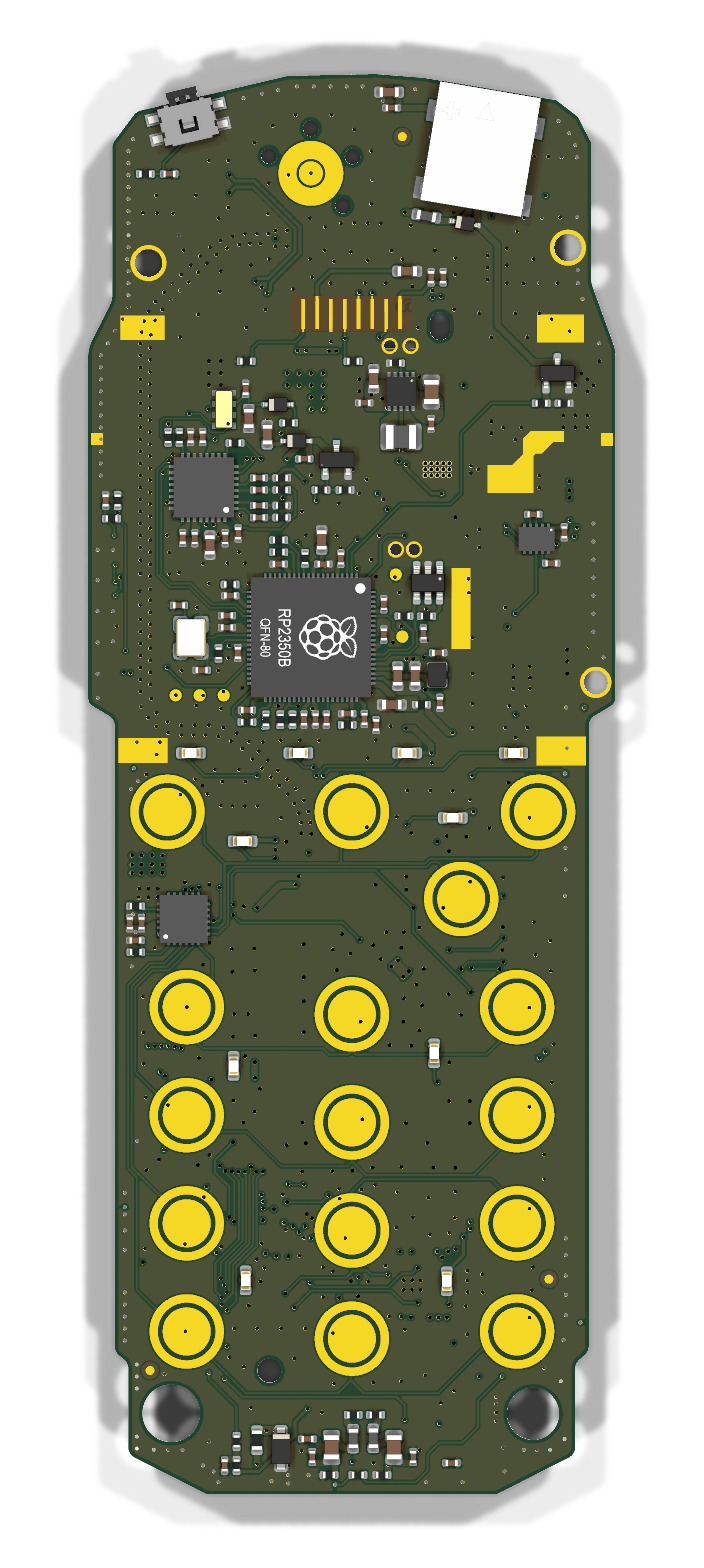 | 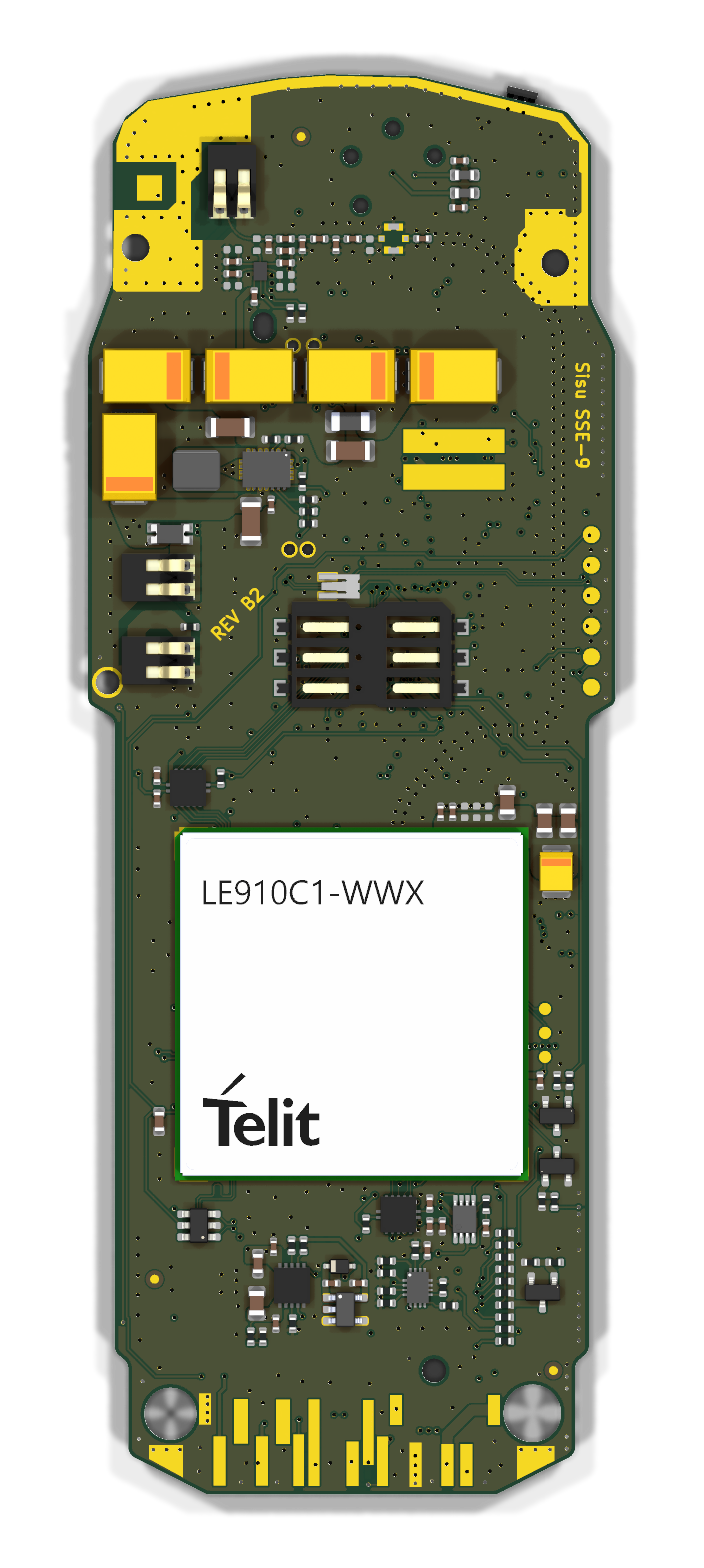 |
subassemblies/debug_pogo_adapterSisu_SSE-9.kicad_pro: main KiCad projectSisu_SSE-9.kicad_pcb: Rev B2 mainboard layout*.kicad_sch: root and hierarchical schematicslib_10/: project-local symbols, footprints, and 3D modelsSisu_SSE-9_bom_filled.xlsx: grouped BOM with sourcing and review notesOrdering/: historical manufacturing archives for fabricated revisionssubassemblies/debug_pogo_adapter/: pogo-to-JST service adapterERRATA.md: known Rev B2 faults, rework, and validation limitsThe current files are saved with KiCad 10.0.5. Clone the repository and open
Sisu_SSE-9.kicad_pro from KiCad's project manager. The symbol and footprint
tables use project-relative paths, so no shared user library is required.
git clone https://github.com/briskspirit/Sisu_SSE-9.git
cd Sisu_SSE-9
Older KiCad releases cannot read this project's file format reliably.
Sisu_SSE-9.csv, Sisu_SSE-9_bom_filled.csv, and
Sisu_SSE-9_bom_filled.xlsx are generated from the current post-assembly Rev
B2 source. The filled workbook retains supplier-review notes, but stock status
is only a historical snapshot and must be checked again before ordering.
RF tuning positions intentionally have no final MPN. Their values are provisional and depend on the antenna, enclosure, assembly, and calibration. Mechanical contact footprints such as the display zebra, speaker, motor, and spring contacts remain visible in the engineering BOM but are excluded from placement output.
The ZIP files under Ordering/ are immutable records of data sent for previous
fabrication runs. They are useful for comparison, not as the preferred source
for another order. The root KiCad files include post-assembly corrections that
are newer than the Rev B2 archive.
Before fabrication:
Firmware is developed in the sibling Sisu_DCP-3 project and will be linked
here when its public repository is available.
Issue reports, measurements, footprint corrections, and tested design changes are welcome. Please identify the board revision, modem variant, battery chemistry, and the exact test conditions. Hardware changes should include ERC and DRC results plus a review of generated fabrication data.
Original project material is released under the Unlicense. Third-party material remains the property of its respective owners; see THIRD_PARTY_NOTICES.md.
Nokia is a trademark of Nokia Corporation. This is an independent hobby project and is not affiliated with or endorsed by Nokia, HMD Global, Telit, Raspberry Pi, or any component manufacturer.
| Qty | Value | Footprint | References |
|---|---|---|---|
| 40 | 100nF | Capacitor_SMD:C_0402_1005Metric | C2, C3, C10, C12, C14, C15, C16, C19, C23, C25, C27, C30, C32, C33, C34, C100 +24 |
| 21 | 100k | Resistor_SMD:R_0402_1005Metric | R1, R2, R3, R14, R15, R18, R28, R38, R39, R40, R42, R43, R46, R47, R49, R52 +5 |
| 16 | SW_Push | 3210:SW_Dome_Nokia_3210 | SW2, SW3, SW4, SW5, SW6, SW7, SW8, SW9, SW10, SW11, SW12, SW13, SW14, SW15, SW16, SW17 |
| 12 | 10k | Resistor_SMD:R_0402_1005Metric | R27, R29, R32, R36, R37, R51, R56, R57, R59, R60, R77, TH1 |
| 12 | 27 | Resistor_SMD:R_0402_1005Metric | R7, R10, R19, R20, R21, R22, R23, R24, R26, R31, R34, R35 |
| 10 | 1uF | Capacitor_SMD:C_0402_1005Metric | C5, C17, C18, C20, C22, C24, C31, C49, C94, C98 |
| 10 | 330 | Resistor_SMD:R_0402_1005Metric | R58, R61, R63, R67, R69, R72, R75, R76, R78, R81 |
| 10 | LED_Small | LED_SMD:LED_0603_1608Metric | D4, D5, D6, D7, D8, D9, D10, D11, D12, D13 |
| 9 | 33pF | Capacitor_SMD:C_0402_1005Metric | C37, C39, C42, C58, C61, C62, C63, C65, C66 |
| 8 | 1k | Resistor_SMD:R_0402_1005Metric | R5, R13, R25, R30, R48, R53, R55, R66 |
| 6 | Fiducial_0.75mm_Mask1.5mm | Fiducial:Fiducial_0.75mm_Mask1.5mm | FID1, FID2, FID3, FID4, FID5, FID6 |
| 5 | 22uF 6.3V | Capacitor_SMD:C_0603_1608Metric | C1, C7, C11, C29, C96 |
| 5 | 4.7uF | Capacitor_SMD:C_0603_1608Metric | C28, C44, C45, C47, C89 |
| 5 | 470uF 10V | 3210:CP_EIA-7343-43_AVX-E_Reflow | C68, C69, C70, C71, C74 |
| 5 | AO3400A | Package_TO_SOT_SMD:SOT-23 | Q1, Q2, Q3, Q4, Q5 |
| 5 | BLM18 | Inductor_SMD:L_0603_1608Metric | FB1, FB2, FB3, FB4, FB5 |
| 5 | DNP | Capacitor_SMD:C_0402_1005Metric | ZP4, ZP5, ZP10, ZP11, ZP12 |
| 4 | 10nF | Capacitor_SMD:C_0402_1005Metric | C52, C54, C57, C81 |
| 4 | 2.2k | Resistor_SMD:R_0402_1005Metric | R11, R12, R16, R17 |
| 4 | PTH_GND_Hole_0.95mm | 3210:PTH_GND_Hole_0.95mm | H3, H4, H5, H6 |
| 3 | 15pF | Capacitor_SMD:C_0402_1005Metric | C36, C43, C83 |
| 3 | 22uF 10V | Capacitor_SMD:C_1206_3216Metric | C72, C73, C76 |
| 3 | 47uF | Capacitor_SMD:C_0805_2012Metric | C79, C85, C86 |
| 2 | 0 | Capacitor_SMD:C_0402_1005Metric | ZS3, ZS4 |
| 2 | 1.10k 1% | Resistor_SMD:R_0402_1005Metric | R71, R73 |
| 2 | 1N5819WS | Diode_SMD:D_SOD-323 | D1, D3 |
| 2 | 3.3k | Resistor_SMD:R_0402_1005Metric | R8, R9 |
| 2 | 4.7uF | Capacitor_SMD:C_0402_1005Metric | C26, C55 |
| 2 | 47uF 6.3V | Capacitor_SMD:C_0805_2012Metric | C59, C60 |
| 2 | BAS170WS-G3-18 | Diode_SMD:D_SOD-323 | D2, D15 |
| 2 | PTH_GND_Hole_2.30mm | 3210:PTH_GND_Hole_2.30mm | H1, H2 |
| 2 | USBLC6-2SC6 | Package_TO_SOT_SMD:SOT-23-6 | U6, U14 |
| 1 | 0467001.NR | Fuse:Fuse_0603_1608Metric | F1 |
| 1 | 1.0pF | Capacitor_SMD:C_0402_1005Metric | ZP1 |
| 1 | 1.33M | Resistor_SMD:R_0402_1005Metric | R79 |
| 1 | 1.33M 1% | Resistor_SMD:R_0402_1005Metric | R44 |
| 1 | 1.4pF | Capacitor_SMD:C_0402_1005Metric | ZP7 |
| 1 | 1.5uH | Inductor_SMD:L_Wuerth_MAPI-4030 | L3 |
| 1 | 100uF 10V | Capacitor_Tantalum_SMD:CP_EIA-3528-21_Kemet-B | C87 |
| 1 | 10nH | Capacitor_SMD:C_0402_1005Metric | ZP9 |
| 1 | 12MHz | Crystal:Crystal_SMD_3225-4Pin_3.2x2.5mm | Y1 |
| 1 | 14pF | Capacitor_SMD:C_0402_1005Metric | ZS2 |
| 1 | 15nH | Capacitor_SMD:C_0402_1005Metric | ZP6 |
| 1 | 18k 1% | Resistor_SMD:R_0402_1005Metric | R68 |
| 1 | 1nF | Capacitor_SMD:C_0402_1005Metric | C64 |
| 1 | 1uF 25V | Capacitor_SMD:C_0805_2012Metric | C99 |
| 1 | 2.2uH | Inductor_SMD:L_1008_2520Metric | L1 |
| 1 | 2.4nH | Capacitor_SMD:C_0402_1005Metric | ZS1 |
| 1 | 200k 1% | Resistor_SMD:R_0402_1005Metric | R45 |
| 1 | 2040852-1 | 3210:TE_2040852-1 | J4 |
| 1 | 22uF | Capacitor_SMD:C_0603_1608Metric | C13 |
| 1 | 22uF 10V | Capacitor_SMD:C_0805_2012Metric | C9 |
| 1 | 24k 1% | Resistor_SMD:R_0402_1005Metric | R70 |
| 1 | 27nH | Capacitor_SMD:C_0402_1005Metric | ZP3 |
| 1 | 3.0pF | Capacitor_SMD:C_0402_1005Metric | ZP2 |
| 1 | 3.3uH | Inductor_SMD:L_Changjiang_FTC201610S | L2 |
| 1 | 36.5k 1% | Resistor_SMD:R_0402_1005Metric | R4 |
| 1 | 36k 1% | Resistor_SMD:R_0402_1005Metric | R64 |
| 1 | 4.7uF 16V | Capacitor_SMD:C_0603_1608Metric | C4 |
| 1 | 470k | Resistor_SMD:R_0402_1005Metric | R33 |
| 1 | 470nF | Capacitor_SMD:C_0402_1005Metric | C21 |
| 1 | 6.8nH | Capacitor_SMD:C_0402_1005Metric | ZP8 |
| 1 | 8.2pF | Capacitor_SMD:C_0402_1005Metric | C84 |
| 1 | 82k 1% | Resistor_SMD:R_0402_1005Metric | R74 |
| 1 | 82pF | Capacitor_SMD:C_0402_1005Metric | C82 |
| 1 | ANT_CONN | 3210:XB-BC-12-2P170-08 | J1 |
| 1 | BGSA14GN10E6327XTSA1 | 3210:BGSA14GN10E6327XTSA1 | IC1 |
| 1 | BLM31 | 3210:BLM31SN500SN1L | FB6 |
| 1 | BOOTSEL | TestPoint:TestPoint_Pad_D1.0mm | TP2 |
| 1 | BQ25171QWDRCRQ1 | 3210:VSON10_BQ25171_3X3_TEX | U15 |
| 1 | CMT-1085-85-SMT-TR | 3210:MagneticBuzzer_CUI_CMT-1085-85-SMT-TR | U1 |
| 1 | DNP | Resistor_SMD:R_0402_1005Metric | R41 |
| 1 | GND | TestPoint:TestPoint_Pad_D1.0mm | TP1 |
| 1 | GND | 3210:XB-BC-12-2P170-08 | J7 |
| 1 | LE910C1-WWX | 3210:Telit_LE910C1-WWX_LGA-181_29.4x29.4mm | U11 |
| 1 | LTC2959IDDB#TRMPBF | 3210:LTC2959IDDB_TRMPBF | U5 |
| 1 | MHF4L | 3210:I-PEX_MHF4L_20579-001E | J2 |
| 1 | Motor_DC | 3210:3210_vibra_motor | M1 |
| 1 | NAU88C22YG | Package_DFN_QFN:QFN-32-1EP_5x5mm_P0.5mm_EP3.1x3.1mm | U4 |
| 1 | PTH_GND_Hole_2.00mm | 3210:PTH_GND_Hole_2.00mm | H7 |
The 271 most common of 296 parts.
briskspirit/Sisu_SSE-9
Experimental six-layer LTE replacement mainboard for the Nokia 3210, built around RP2354B and Telit LE910C1-WWX.


niektb/sluisbrinkie-eurorack-published
Published Modules of the Sluisbrinkie project

tombueng/hilprobe
HILprobe: multi-function UUT probe for hardware-in-the-loop testing - RS-485, CAN FD, logic analyzer, 4-ch scope, two programmable UUT supplies. KiCad 10, 6 layers, RP2350B + ESP32-S3.

theBrutzler/ESP32_GBC_RETROFIT
A retrofit board with an esp32 for a gameboy color case


It measures 43.9 × 118.2 mm and has 6 copper layers, 1.02 mm thick.
296 parts, built around the BGSA14GN10E6327XTSA1, NAU88C22YG, USBLC6-2SC6 and BQ25171QWDRCRQ1. The full list of its parts is on this page, with links to each part's symbol and footprint where PCBKit's library has them.
From the briskspirit/Sisu_SSE-9 repository on GitHub, at the commit this page was made from: the board is Sisu_SSE-9.kicad_pcb and its schematic 4g_lte.kicad_sch. PCBKit opens the board in the browser, with nothing to install.
Its repository publishes it under the Unlicense licence: you may reuse it on that licence's terms (keep the author's notice, and for a copyleft licence share your changes alike).