
4 layers98 × 75 mm
PiFinder4
brickbots/PiFinder
A plate solving telescope finder based around a Raspberry PI and RPI HQ Camera
157 parts257GPL-3.0

 brickbots/PiFinder257
A plate solving telescope finder based around a Raspberry PI and RPI HQ Camera
PiFinder smt is an open-source printed circuit board by brickbots, from the brickbots/PiFinder repository on GitHub, published under the GPL-3.0 licence. It is a 2-layer board of 93.8 × 64.2 mm with 54 parts on 55 nets, routed with 391 tracks and 229 vias.
It is built around the BNO055. Its parts include 17 diodes, 6 resistors, 4 capacitors, 3 connectors and 1 transistor.
A plate solving telescope finder based around a Raspberry PI, imx296 camera, and custom UI 'hat'
For an overview of what the PiFinder™ is and how it came to be visit the official project website at PiFinder.io
The PiFinder™ uses the Cedar Detect and Cedar Solve libraries by smroid. Cedar Solve is licensed under Apache-2.0.
Cedar Detect is published under the Functional Source License (FSL-1.1-MIT),
which permits broad non-commercial use but excludes commercial uses that compete
with Cedar Detect. Because the PiFinder™ is also offered commercially, it bundles
and distributes the Cedar Detect binaries under a separate license granted
expressly by the copyright holder — not under the public FSL terms. The prebuilt
binaries live in bin/; see bin/README.md for the
full licensing details and a copy of the Cedar Detect license. Note this is
distinct from the PiFinder project's own GPL-3.0 LICENSE.
Thank you to smroid for all your support of the PiFinder project!
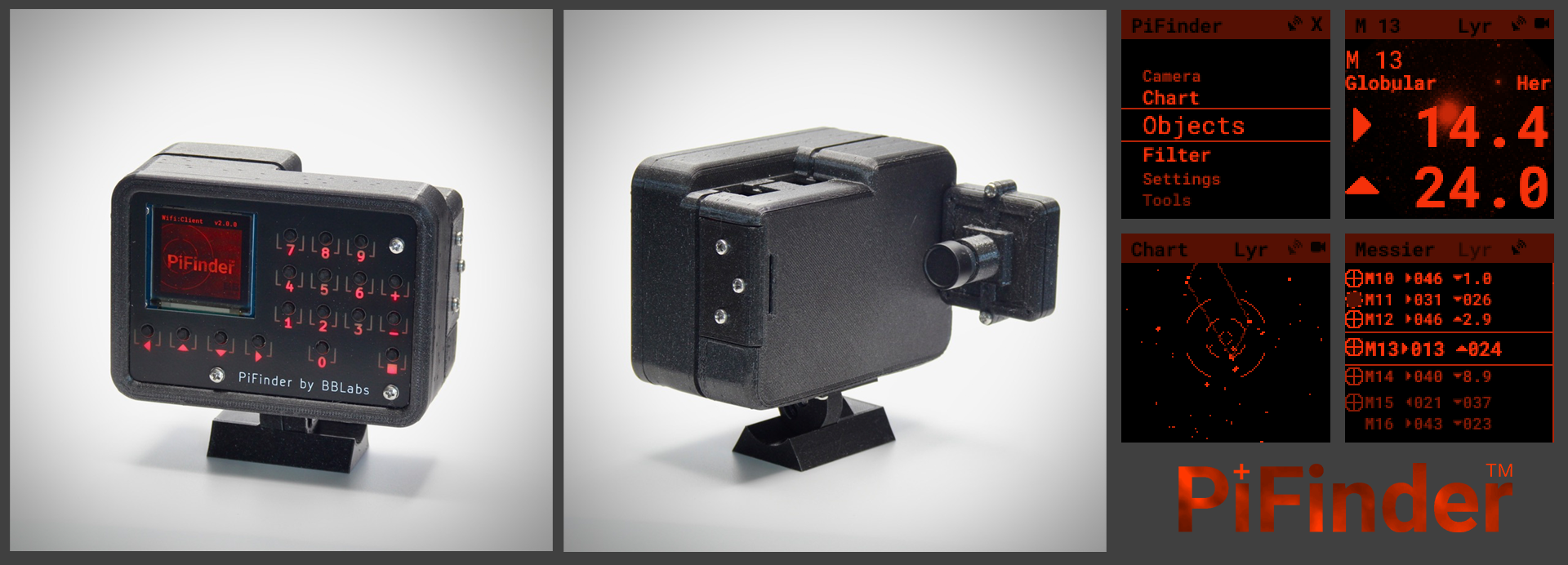 The PiFinder™ is my attempt to improve my time at my telescope. I don't get nearly enough of it and I want to enjoy it as much as possible. So after years of observing with paper charts and, later, a Nexus DSC here is what I felt I was missing:
My hope is that other people will find this combination of functionality useful, will build their own PiFinder™ and help the whole project improve by making suggestions and potentially contributing to the software. It's a pretty easy build with off the shelf parts and beginner friendly soldering.
The PiFinder™ is fully open-source hardware and software. You can order PCB's and 3d print the case with the files in this repo and order all the parts from the parts List.
If you would like pre-assembled units, kits or other items to jump start your PiFinder™ journey, visit PiFinder.io to see what's available and place an order.
If you are using a PiFinder, I recommend you watch releases in this repo. Click the 'Watch' button up at the top right of the page, choose 'Custom' and then 'Releases' to make sure you don't miss any new features!
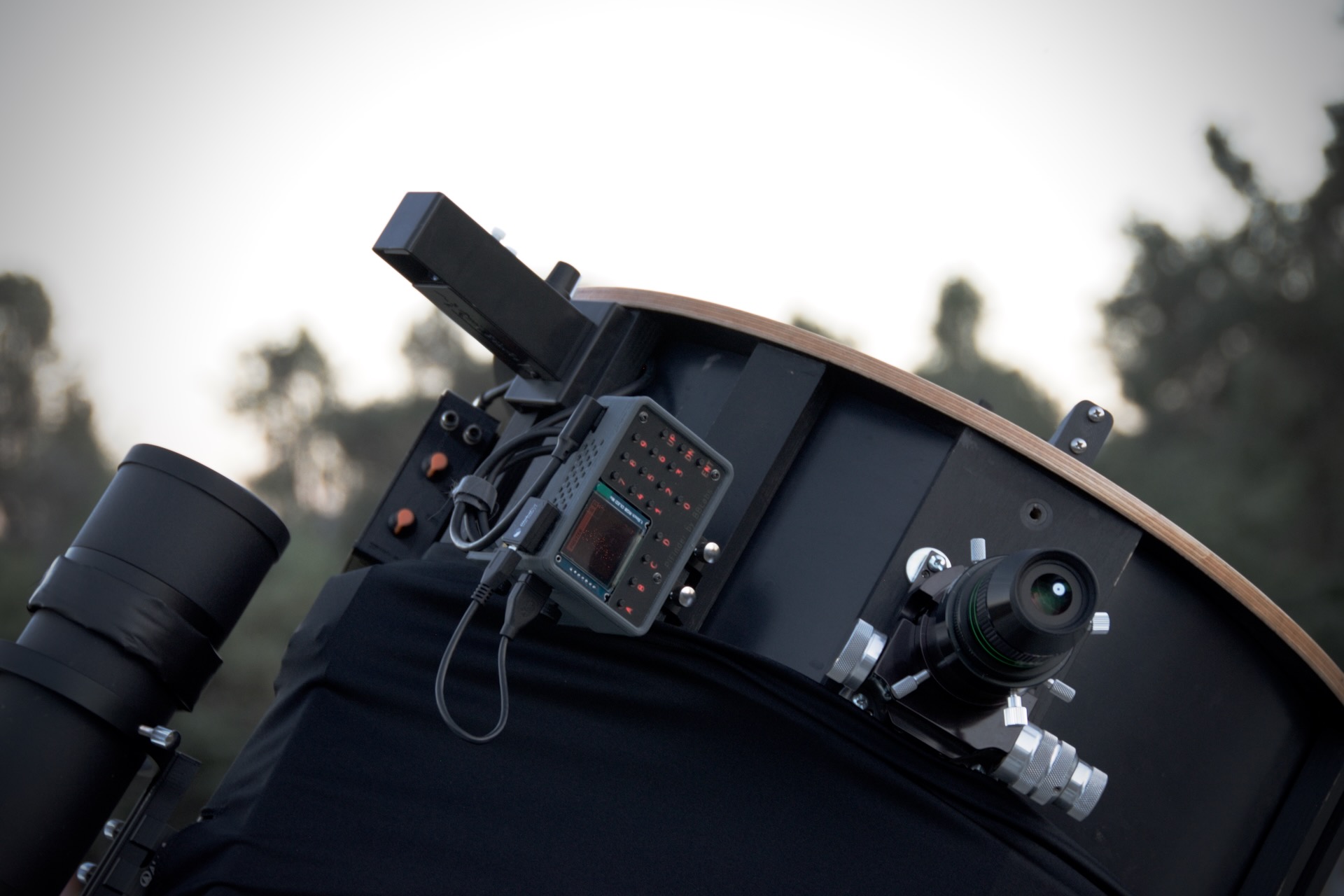
If you'd like to learn more about how it works, and potentially build your own, everything you need should be here. I recommend starting with the User Manual and then checking out the build process using the links below.
Join the PiFinder™ Discord server for support with your build, usage questions, and suggestions for improvement.
| Qty | Value | Footprint | References |
|---|---|---|---|
| 17 | LED | LED_SMD:LED_1206_3216Metric | D1, D2, D3, D4, D5, D6, D7, D8, D10, D11, D12, D13, D14, D15, D16, D17 +1 |
| 17 | SW_Push_Dual | RSU:SW_Push_6x6mm_SMT_withhole_tight | SW_A1, SW_B1, SW_C1, SW_D1, SW_DN1, SW_GO1, SW0, SW1, SW2, SW3, SW4, SW5, SW6, SW7, SW8, SW9 +1 |
| 4 | 10k | Resistor_SMD:R_0805_2012Metric | R3, R4, R5, R6 |
| 3 | Hole_Pad | Horizon:Mount_M2.5 | H1, H3, H4 |
| 2 | 22pF | Capacitor_SMD:C_0805_2012Metric | C3, C4 |
| 1 | 100nF | Capacitor_SMD:C_0805_2012Metric | C2 |
| 1 | 1uF | Capacitor_SMD:C_0805_2012Metric | C1 |
| 1 | 22 | Resistor_SMD:R_0805_2012Metric | R1 |
| 1 | 330 | Resistor_SMD:R_0805_2012Metric | R2 |
| 1 | BNO055 | Package_LGA:LGA-28_5.2x3.8mm_P0.5mm | IMU1 |
| 1 | Crystal | Crystal:Crystal_SMD_3215-2Pin_3.2x1.5mm | Y1 |
| 1 | GPS Module | RSU:GT-U7_GPS_smt | J4 |
| 1 | LOGO | RSU_Graphics:bblabs_logo_sml | G*** |
| 1 | Q_NPN_EBC | RSU:PF_SOT-23-NPN | Q1 |
| 1 | Raspberry_Pi_2_3 | PiHat:Pin_Header_Straight_2x20 | J1 |
| 1 | display | RSU:Waveshare1.5inOled_flushmount | J2 |


01binary/str1ker
A human-scale mech integrated with Robot Operating System


Aharoni-Lab/Miniscope-LFOV
Large field-of-view miniature microscope for rats and larger animals.

bodri/kapukiTRX-hw-trx
DIY RC transmitter/receiver system based on SX1280 chipset for RC planes
It measures 93.8 × 64.2 mm and has 2 copper layers, 1.6 mm thick.
54 parts, built around the BNO055. The full list of its parts is on this page, with links to each part's symbol and footprint where PCBKit's library has them.
From the brickbots/PiFinder repository on GitHub, at the commit this page was made from: the board is kicad/PiFinder_v3/PiFinder_smt.kicad_pcb and its schematic kicad/PiFinder_rev4/BQ25895_Power.kicad_sch. PCBKit opens the board in the browser, with nothing to install.
Its repository publishes it under the GPL-3.0 licence: you may reuse it on that licence's terms (keep the author's notice, and for a copyleft licence share your changes alike).
